HM Royal Marines Shocked The Internet With A Thunderous Live Prodigy Medley That Nobody Saw Coming
When the bands of HM Royal Marines revealed they would perform a live medley of songs by The Prodigy, most people assumed it had to be some kind of surreal internet joke. The image of one of Britain’s most disciplined military ensembles stepping into the chaotic electronic world of tracks like “Breathe,” “Omen,” and “The Day Is My Enemy” sounded almost impossible to picture. Yet what could have easily turned into a novelty performance instead became one of the most unexpectedly thrilling musical crossovers in recent memory. Performed during the prestigious Mountbatten Festival of Music at London’s Royal Albert Hall, the medley stunned audiences with its sheer intensity, precision, and creativity, quickly spreading online and leaving longtime Prodigy fans completely speechless.
The Mountbatten Festival of Music has always carried an atmosphere of tradition and ceremony. Held annually at the Royal Albert Hall, the event typically showcases the extraordinary discipline and musical excellence of the Royal Marines through military marches, orchestral arrangements, and grand ceremonial performances. Nobody attending expected one of the evening’s defining moments to involve the aggressive pulse of rave-inspired electronic music that once blasted through illegal warehouse parties in the 1990s. Yet that clash between military precision and anarchic electronic energy is exactly what made the performance feel so unforgettable from the very first notes.
As the stage lights shifted and the percussion section prepared themselves, confusion quickly spread through the audience. There was a visible sense of disbelief inside the hall as the opening rhythms began resembling something far darker and more aggressive than the audience expected from a military orchestra. Then suddenly the iconic sounds of The Prodigy exploded through the venue, transformed through brass arrangements, pounding live percussion, and enormous orchestral textures. Instead of softening the music for a formal setting, the Royal Marines leaned fully into the aggression and adrenaline that made The Prodigy legendary in the first place.
One of the most remarkable aspects of the performance was how naturally the orchestra adapted electronic music into a live military arrangement without losing any intensity. Songs like “Breathe” and “Omen” rely heavily on distorted synths, electronic loops, and raw programmed energy, yet the Royal Marines somehow recreated that same overwhelming force entirely through live instrumentation. Massive brass sections replaced synthesizers while military drums delivered pounding rhythms powerful enough to shake the hall. Rather than feeling gimmicky, the arrangement sounded strangely cinematic and enormous, almost as if the songs had always been waiting for this kind of orchestral transformation.
Much of the credit for the medley’s success belongs to Band Corporal Aaron Pitman, who arranged the performance. Instead of simply translating the songs note for note, the arrangement expanded them into something grander and more theatrical while preserving the aggressive heartbeat of the originals. The transitions between tracks felt seamless, allowing the medley to build momentum continuously rather than feeling like disconnected snippets stitched together. Fans online repeatedly praised how intelligently the music had been adapted, noting that the arrangements amplified the drama and power already hidden inside The Prodigy’s songs.
Inside the Royal Albert Hall itself, the audience reaction became increasingly intense as the performance unfolded. Many spectators initially appeared unsure whether to laugh, cheer, or simply stare in disbelief. Yet within minutes, that uncertainty transformed into genuine excitement. Heads began nodding to the rhythm while visible smiles spread throughout the crowd. Even people unfamiliar with The Prodigy seemed overwhelmed by the sheer force of the arrangement. The collision of strict military discipline and rave-inspired chaos somehow created an atmosphere that felt both elegant and wildly rebellious at the same time.
For longtime Prodigy fans watching online later, the emotional reaction became even stronger. The band has always represented rebellion, outsider culture, and raw anti-establishment energy, making the idea of their music being performed by the Royal Marines feel almost surreal on paper. Yet many fans described the performance as unexpectedly moving because it demonstrated how powerful and timeless the music truly was. One viral comment perfectly captured the strange emotional weight of the moment: “Crazy to think The Prodigy used to break into warehouses to play illegal gigs, and now their music is being performed by the military.”
The medley also highlighted something often overlooked about The Prodigy’s songwriting itself. Beneath the aggressive electronics and chaotic energy, many of their songs contain surprisingly strong melodic and rhythmic foundations. Stripped away from synthesizers and rebuilt through orchestral instrumentation, tracks like “Voodoo People” and “The Day Is My Enemy” revealed themselves as compositions capable of surviving entirely different musical environments without losing impact. That realization became one of the most fascinating aspects of the performance because it elevated the music beyond nostalgia and proved its genuine compositional strength.
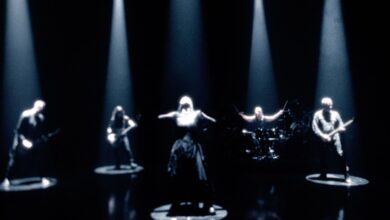
Visually, the performance looked spectacular as well. The Royal Marines appeared beneath dramatic blue lighting and laser effects that transformed the Royal Albert Hall into something closer to an industrial electronic concert than a formal military showcase. Rows of disciplined percussionists hammered out rhythms with mechanical precision while brass players delivered towering melodies with astonishing power. The contrast between immaculate military uniforms and the chaotic intensity of The Prodigy’s music created imagery so bizarre and compelling that clips from the performance spread rapidly across social media platforms almost immediately afterward.
Online reactions exploded once the footage began circulating beyond the original audience. The video accumulated hundreds of thousands of views across YouTube, Facebook, and music websites, attracting comments from stunned viewers who admitted they clicked expecting comedy but instead found themselves completely mesmerized. Many viewers confessed they replayed the performance multiple times simply because they could not believe how well the music translated into this entirely unexpected format. Others described it as one of the rare crossover performances that actually improved appreciation for both sides involved.
Part of the medley’s appeal also came from its complete sincerity. The Royal Marines never approached the music with irony or parody. There were no comedic gimmicks or exaggerated attempts to mock rave culture. Instead, the performance treated The Prodigy’s music with complete seriousness and respect, allowing the compositions themselves to shine through orchestral power and military precision. That sincerity became essential because it transformed what could have been internet novelty content into something genuinely artistically impressive.
The performance arrived during a period when musical genre boundaries were already becoming increasingly blurred across modern culture. Audiences had grown more open to unexpected collaborations between classical music, electronic music, metal, hip-hop, and orchestral performance. Yet even within that climate, the sight of the Royal Marines delivering a thunderous Prodigy medley still felt uniquely shocking. It was exactly the kind of crossover nobody would logically predict, which made its success even more satisfying once audiences realized how brilliantly it actually worked.
For older fans especially, the performance carried an additional emotional layer because The Prodigy represented such a defining force throughout the 1990s and early 2000s. Their music was loud, confrontational, dangerous, and rebellious in ways that terrified parts of mainstream society at the time. Seeing those same songs later embraced inside one of Britain’s most prestigious ceremonial music festivals created a strange sense of cultural full-circle evolution. Music once viewed as chaotic underground noise had somehow become worthy of orchestral tribute inside the Royal Albert Hall itself.
The medley also served as a reminder of just how versatile military musicians truly are. Outside ceremonial events and official appearances, many audiences underestimate the technical and creative abilities required to perform at such an elite level. The Royal Marines demonstrated astonishing adaptability throughout the performance, seamlessly blending military precision with electronic aggression in ways few orchestras could realistically achieve. The result felt less like musicians simply covering famous songs and more like elite performers completely reinventing them.
As more viewers discovered the video online, the reaction continued growing far beyond Britain. International audiences shared clips across rock, electronic, and orchestral music communities, many expressing disbelief that the performance was real at all. For some, it became an introduction to the musical capabilities of the Royal Marines. For others, it renewed appreciation for The Prodigy’s influence on modern music culture. Either way, the performance succeeded in bridging completely different worlds through pure musical force and creativity.
What ultimately made the medley so unforgettable was its refusal to play things safely. Instead of delivering a softened orchestral interpretation designed to comfortably fit a traditional military setting, the Royal Marines embraced the danger, aggression, and adrenaline that define The Prodigy’s identity. They transformed rave anthems into something cinematic, thunderous, and strangely emotional while still preserving the rebellious spirit hidden inside the original tracks.
And somehow, against all expectations, it worked perfectly.