Dhani Harrison Joins Tom Petty for an Emotional “Handle With Care” Tribute
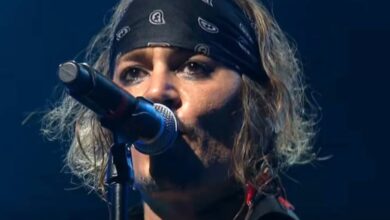
Ever wondered why a familiar face can make a concert feel suddenly more personal? Watch Dhani Harrison beside Tom Petty at Concert for George, and the answer begins to emerge. Under the warm red stage lights, George Harrison’s son has an unmistakable resemblance to his father. Yet the lasting appeal of this performance lies in what the musicians do together: they give a much-loved song the warmth of a gathering among friends, with one deeply important person present through his music.
Concert for George took place at London’s Royal Albert Hall on November 29, 2002, the first anniversary of George’s death. Olivia Harrison and Eric Clapton organized the tribute, bringing together musicians from different chapters of his life. The occasion carried an obvious sadness, but its program also made room for affection, humor, and celebration. Hearing these songs performed by people who knew their creator gave the evening a closeness that a more conventional tribute might have struggled to achieve.
The performance featured here is “Handle With Care,” officially credited in the concert’s track listing to Tom Petty and the Heartbreakers with Jeff Lynne and Dhani Harrison. That detail gives the scene its particular significance. Petty and Lynne had made music with George in the Traveling Wilburys, so the song connected this memorial to an actual shared history. Dhani’s presence brought a family connection into that circle, making the meeting of guitars and voices especially poignant.
“Handle With Care” began as a recording intended for the other side of a George Harrison single. The Traveling Wilburys’ official history describes how Harrison, Petty, Lynne, Bob Dylan, and Roy Orbison came together in 1988 and enjoyed the result enough to turn the collaboration into a group. That origin helps explain the song’s enduring charm. Its appeal comes from distinctive musicians finding a common language, with melody and companionship doing more of the work than any grand declaration.
At the Royal Albert Hall, that spirit found a fitting setting. Petty and Lynne were returning to a song they had helped create, while Dhani stood beside them with an acoustic guitar. The official concert video captures the warmth of that combination: familiar voices, a steady pulse, and a younger musician participating in his father’s musical world. Watch the performance below with that history in mind, and the photograph’s emotional pull becomes easier to understand.
Petty’s presence gives the performance an immediate sense of ease. His voice has a recognizable grain, and his guitar playing sits comfortably within the arrangement. He approaches the song as music he knows from the inside. For a viewer, that familiarity matters: the tribute feels carried by someone with a real connection to its subject. The performance does not need an elaborate explanation onstage for that connection to register.
Lynne is equally central to the scene. His vocal contributions help recreate the interplay that gives the Wilburys recording its character, while the surrounding musicians keep the arrangement moving. It is useful to listen beyond the most familiar face in the frame. The song’s effect depends on the exchange between voices, the support of the band, and the space each part leaves for the others. Its emotional force grows out of that shared effort.
Dhani’s role also deserves to be understood on its own terms. In this performance, he contributes as an acoustic guitarist within an ensemble. His place in the group lets the song breathe and helps connect its rhythm to the musicians around him. Calling every moving moment a demonstration of inherited genius can miss what is actually valuable here. There is musical care in joining a band, listening closely, and serving the arrangement on an evening of such personal significance.
The resemblance to George is impossible to overlook in the image. Dhani’s dark hair and features can bring to mind photographs of his father as a younger man, and that visual connection gives the performance an added emotional layer. But the camera also records Dhani as himself: a son taking part in a tribute, holding his own instrument, and sharing the stage with his father’s friends. That combination of familiarity and individuality is more affecting than resemblance alone.
“Handle With Care” is particularly suited to this setting because it allows different personalities to occupy the same song. The music moves between individual voices and a shared chorus, creating a feeling of company without making every singer sound alike. Heard as part of a memorial, that structure takes on another meaning. One can hear it as a small musical community holding together, preserving something that remains important to everyone involved.
The Heartbreakers’ contribution gives that community a firm musical foundation. Rather than treating the song as a fragile museum piece, the band keeps it alive through timing, momentum, and the familiar physical presence of musicians playing together. The guitars have room to overlap, and the performance maintains a forward movement. That balance is part of its charm: the occasion is emotional, while the music still has the energy and sociability of a band onstage.
Petty’s portion of the concert also included “Taxman” and “I Need You,” according to George Harrison’s official film listing. Placing “Handle With Care” alongside those selections widened the picture of George’s songwriting life. The program could move from Beatles material to a later collaboration without losing its focus. For listeners discovering the event through one short video, that surrounding context reveals why the tribute feels larger than any single photograph or song.
The wider concert embraced more than the familiar rock catalog. Its official program included Indian music, performances involving Anoushka Shankar, and a Monty Python interlude, alongside appearances by Paul McCartney, Ringo Starr, Billy Preston, and many others. Those choices suggest a portrait of a person with friendships and interests that reached beyond one band. Within that broad celebration, the Petty, Lynne, and Dhani performance forms a particularly intimate chapter.
The footage also shows why a concert film can carry a memory further than a still image. A photograph gives us the resemblance and the setting; the moving performance lets us follow the musicians’ interaction and hear how their contributions fit. Concert for George was originally released as a film in 2003, and the official video makes this part of the evening available on its own. Even separated from the full program, the song retains its human scale.
What remains after the final chord is a sense of continuity. George’s music passes between friends who helped shape it and a son who carries his own relationship with it. Dhani’s resemblance may be the first thing a viewer notices, but the performance offers a richer reason to keep watching. Petty, Lynne, the Heartbreakers, and Dhani make a song feel shared again, allowing a tribute born from loss to leave behind warmth, gratitude, and a living connection.