Travis Barker Had Phil Collins’ Most Famous Drum Entrance to Play
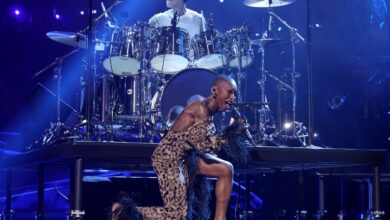
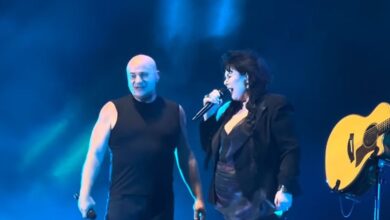
One viewer who saw the Rock Hall footage of “In the Air Tonight” made a point of mentioning the person at the back of the stage. “Can’t leave out one of the best drummers honoring one of the greatest drummers,” they wrote about Travis Barker playing Phil Collins’ drum part while Cynthia Erivo sang.
Barker had already come onstage at the Peacock Theater in Los Angeles that night to introduce Collins for his solo induction. The ceremony took place on November 14, 2026. When he returned behind the drums, he went from talking about Collins’ work to playing a passage that people can recognize before the song gives them a chance to hear it.
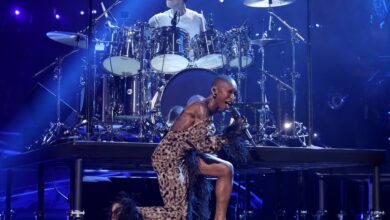
The kit is visible behind Erivo well before she reaches the fill. In the early part of the performance, the space belongs largely to the vocal. She has time to hold a phrase and let it settle, while Barker’s position onstage gives the audience a very clear idea of where the next change is going to come from.
The entrance is sometimes treated as if it were a little solo that can be lifted out of the recording. In the theater, it had to arrive at the right point in a performance that was already underway. There is a pulse before the fill and another vocal line coming afterward. The drummer has to carry the song across that change.
Watch what happens to the space around Erivo once the drums come in. The opening gives her voice room to hang in the air. After Barker’s entrance there is suddenly a full kit underneath it. The vocal that follows tells you as much about the size of the change as the fill itself does.
The first audience recording gives the tribute enough time to unfold. Start with the voice and see how long you find yourself thinking about the drums before Barker gives the crowd the sound it was waiting for.
The drums from another seat
The alternate recording puts the listener in another part of the Peacock Theater. The difference between the two cameras is helpful. One gives you a clearer impression of the room and the other lets you follow the kit more closely. In both, the fill comes out of a stretch in which the voice has been doing most of the work.
The original recording is also a useful reference. Collins was both the drummer and the singer on the record. At Rock Hall those roles were split between two people, which made the exchange between the voice and kit easy to see as well as hear.
The two parts come together in Collins’ original
What Barker brought to the evening was a way of performing a familiar part in front of the person who made it famous. The expectation in the room gave the waiting as much weight as the arrival.
The viewer’s comment makes room for that part of the tribute. Erivo had to build the performance up to the entrance, and Barker had to take it across the threshold. The two jobs meet in the seconds after the fill.