Miley Cyrus Brings Her Rock Voice to Led Zeppelin’s ‘Black Dog’ at iHeartRadio
Miley Cyrus put Led Zeppelin’s “Black Dog” at the centre of her rock instincts when she performed it at the iHeartRadio Music Festival in Las Vegas. The appearance at T-Mobile Arena on September 21, 2019, brought one of Zeppelin’s most recognisable songs into a set built for an audience with tastes stretching well beyond classic rock. Its unaccompanied vocal calls gave Cyrus an immediate opportunity to make her own voice the main event.
According to the festival organiser’s account, Cyrus opened the second night and reached “Black Dog” after “Nothing Breaks Like a Heart” and “Mother’s Daughter.” That placement mattered: the Zeppelin song arrived within her own repertoire, rather than as a separate tribute segment. It showed how a familiar rock standard could belong inside the same live identity as her contemporary material.
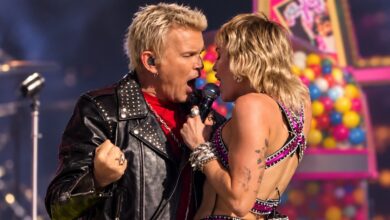
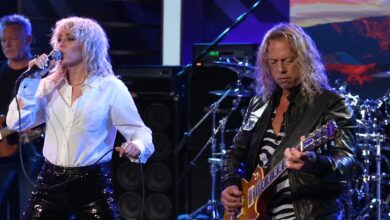
The visual presentation reinforced the choice. Leather gloves, a leather outfit and substantial gold jewellery gave the performance a harder edge, with Cyrus leaning into the microphone against the dark stage setting. Those details framed the song, but “Black Dog” puts a particular demand on the singer that styling cannot answer: its opening exchanges leave the voice exposed before the instruments return.
First released as the opening track on Led Zeppelin’s fourth album in 1971, “Black Dog” is built around those exchanges. Robert Plant’s vocal phrases and the returning instrumental figure take turns commanding attention. Covering it means working with the pauses as well as the force, preserving the anticipation that makes each re-entry count.
Cyrus’s rough-edged vocal character gives that framework a different personality. The appeal is not that she disappears into Plant’s identity; it is that a voice associated with another generation can occupy the same exposed spaces and remain recognisably her own. The song offers a useful test of presence because a singer has to hold attention before the riff supplies its momentum.
The band has an equally important job. Guitar, bass and drums need to make the returning figure decisive while keeping its unusual rhythmic shape intact. That shared timing is central to the music’s impact: a vocal phrase creates expectation, and the instrumental answer releases it. The iHeartRadio performance below captures Cyrus taking on that arrangement in an arena setting.
There is a reason the riff asks for such coordination. In a lesson first published in Guitar World in 1996, John Paul Jones described writing a phrase with an extra beat before Plant’s next entrance. He also explained the bridge’s shifting accents, which initially made it difficult for the group to keep track of the beat together.
Jones’s explanation places the challenge in the composition itself. The band adjusted the accents to make the downbeats clearer, finding a way to retain the riff’s character without losing its underlying pulse. For musicians returning to the song, that history is a reminder that the apparent simplicity of a powerful rock figure can conceal careful collective work.
The recording’s origins also put the Las Vegas interpretation in perspective. Jimmy Page’s official discography dates the fourth album’s sessions from December 1970 to February 1971, using Headley Grange and Island Studios with engineer Andy Johns. “Black Dog” emerged as the album’s first statement, establishing the weight and vocal exposure that later performers would revisit.
At iHeartRadio, Cyrus connected that older vocabulary to the freedom she described onstage. The organiser’s report recorded her reflecting on the artists who had influenced her and on the festival giving her room to sing their music. Heard in that context, choosing Zeppelin was part of a personal live repertoire, rather than a claim to replace the band’s original singer.
The suggestion that she belongs to an earlier rock era is a listener’s way of describing that fit. What the performance actually places in front of the audience is more concrete: a contemporary singer, a demanding song and a band negotiating its stops and returns. Those elements give the cover its appeal and keep the attention on the exchange between singer and band.
For another setting, Cyrus’s Glastonbury rendition of “Black Dog” offers a useful companion. It comes from a separate festival appearance, on the Pyramid Stage at Worthy Farm, rather than from the Las Vegas concert. Comparing the two lets listeners follow how the same singer carries the song between different live environments.
The second related recording returns to Led Zeppelin themselves. Their official “Black Dog” film from Madison Square Garden in 1973 places Plant, Page, Jones and John Bonham inside the arrangement that made the song famous. It provides a direct historical counterpart to Cyrus’s interpretation and a reminder of the band interplay at the heart of the composition.