Miley Cyrus Gives Led Zeppelin’s ‘Black Dog’ a Fierce New Voice at Glastonbury
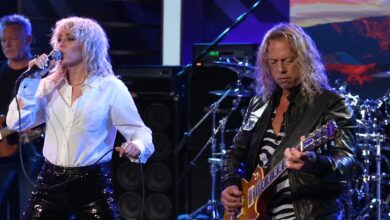
When Miley Cyrus brought Led Zeppelin’s “Black Dog” to Glastonbury’s Pyramid Stage on June 30, 2019, the song offered an immediate test of her rock instincts. Its exposed vocal calls and sharply returning riff leave little room for a singer to hide. Cyrus met that challenge with a grainy, forceful delivery, making the familiar exchanges between voice and band the centre of the performance.
The appearance came during her Sunday evening slot at Worthy Farm in Somerset. Glastonbury’s official programme placed Cyrus on the Pyramid Stage from 5:45 to 6:45 p.m., between Kylie Minogue and Vampire Weekend. Within that prominent festival setting, a song first released nearly five decades earlier became part of a contemporary pop star’s live vocabulary. The choice brought Led Zeppelin’s music into a setting where listeners could arrive with very different expectations.
“Black Dog” opened Led Zeppelin’s untitled fourth album in 1971. Its identity depends on more than a memorable guitar sound: the spaces around Robert Plant’s vocal phrases are part of the composition’s machinery. A singer steps into the gap, the instruments answer, and the tension builds through those repeated handovers. Performing it convincingly means understanding how the whole group shapes that exchange.
Cyrus’s vocal texture gives those openings a different colour. She leans into the roughness of her tone, keeping the delivery direct while the band supplies the heavy replies. The result draws attention to her phrasing as much as her volume. A commanding entrance matters, but so does knowing when to release a line and let the riff take over.
The musicians behind her are therefore essential to the performance’s impact. Guitar, bass and drums have to make the returning figure feel decisive without flattening its rhythmic character. The recording makes that relationship easy to follow: the vocal creates anticipation, and the band answers it. The force comes from their coordination, with each return making the familiar pattern feel alive.
That balance helps explain the appeal of the Glastonbury cover. Cyrus brings a recognisable voice to material associated with another singer, while retaining the exchanges that make the song distinctive. It gives longtime Zeppelin listeners a familiar structure to follow and offers other viewers a route into the original recording. The performance below captures that meeting between a modern festival audience and a cornerstone of heavy rock.
The history of the riff makes the backing band’s role particularly relevant. In a lesson originally written for Guitar World, John Paul Jones described the rhythmic difficulties involved in getting “Black Dog” to work. He explained that his early idea had proved hard for the group to follow without losing the beat. The finished song’s apparent swagger grew from musicians solving that problem together.
Jones’s contribution is an important part of a track often remembered through Plant’s voice and Jimmy Page’s guitar. The songwriting credits name Jones, Page and Plant, and the central figure gives the composition its unmistakable shape. That makes “Black Dog” a useful reminder of how a rock standard can emerge from the interaction of a band, even when the frontman becomes its most visible representative.
The original recording was made during the sessions for the fourth Led Zeppelin album, which Page’s official discography dates from December 1970 to February 1971. Those sessions used Headley Grange in Hampshire and Island Studios in London, with Andy Johns engineering. The album’s opening track placed rhythmic weight and vocal exposure together from the outset, establishing a sound that later singers and musicians would repeatedly revisit.
For Cyrus, Glastonbury made that inheritance part of a visible rock direction. Contemporary coverage in Kerrang! and NME highlighted the heavier side of her set, with “Black Dog” among the choices that caught reviewers’ attention. Those reports provide evidence that the performance registered beyond her existing pop audience. They also place it in its proper moment: a 2019 festival appearance, before the release of her rock-oriented album Plastic Hearts the following year.
The possibility of introducing younger listeners to Zeppelin is one of the cover’s most interesting consequences. That is an opportunity rather than a measurable conclusion about everyone in the crowd. A listener might recognise Cyrus first, then follow the song back to Led Zeppelin IV. Another might arrive knowing every turn of the riff and stay to hear how a different voice handles it. A successful cover can accommodate both journeys.
What makes this particular choice effective is that the song gives Cyrus and her musicians something substantial to negotiate. “Black Dog” asks for timing, space and a shared sense of when to strike. On the Pyramid Stage, those demands give the performance its focus. The appeal lasts beyond the initial surprise of a pop star choosing Zeppelin because the music itself supplies the drama.
For a direct comparison, Led Zeppelin’s official “Black Dog” film from Madison Square Garden in July 1973 returns to Plant, Page, Jones and John Bonham performing the song themselves. Released as part of The Song Remains the Same, the footage offers another view of the exchanges between the singer and the instrumental figure. It is a separate performance from another era, giving the Glastonbury cover a useful historical companion.
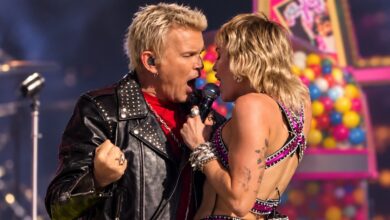
A second companion comes from Cyrus’s own work with Billy Idol at the 2021 Super Bowl TikTok Tailgate. Their official live video pairs “Night Crawling” with Idol’s “White Wedding,” bringing her rock interests into a collaboration with another established performer. It shows a different setting for the same broad appeal: Cyrus placing her distinctive voice inside a live band arrangement rooted in rock.