Freddie Mercury Takes On the Cameras During Queen’s ‘Hammer to Fall’ at Live Aid
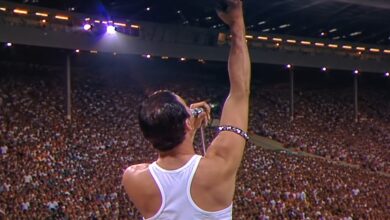
A television camera was supposed to record Freddie Mercury at Live Aid. During Queen’s “Hammer to Fall,” it briefly became part of his performance. As Brian May drove the song forward, Mercury moved around the stage with an entertainer’s eye for anything that could become a moment. His playful encounter with a cameraman remains a revealing detail in footage often remembered for the scale of the occasion.
Queen performed at Wembley Stadium on July 13, 1985, before an audience of around 72,000. Within their compact Live Aid set, “Hammer to Fall” brought the band’s hard-rock attack into sharp focus. May’s guitar riff supplies an immediate sense of momentum, while Roger Taylor and John Deacon keep the performance moving beneath Mercury’s vocal.
The song had appeared on The Works the previous year, with May credited as its writer. On this stage, its recurring guitar figure becomes a physical cue as much as a musical one. Mercury can move away from the centre, turn towards May or redirect his attention to a camera, and the riff continues to hold everything together.
The camera encounter works because Mercury recognises the opportunity immediately. An object from the machinery of a television broadcast becomes something he can play to. The moment feels loose and mischievous, yet it never stops the song. His attention shifts between the people at Wembley and the lens carrying the performance beyond the stadium.
That ability gives the footage an intimacy its enormous setting might otherwise resist. A stadium audience sees a figure commanding a wide stage; a television viewer can catch a grin, a glance or a sudden change of direction. Mercury seems alert to both perspectives. His smallest gestures can travel through the broadcast with the same confidence as his largest movements.
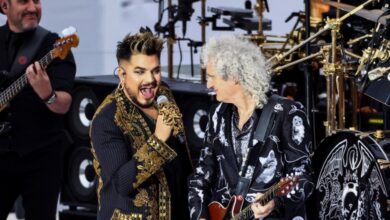
May provides a different kind of presence beside him. His concentration on the guitar anchors the sequence, offering a steady visual and musical counterweight to Mercury’s restlessness. Their close interaction on stage captures that relationship particularly well: a frontman animated by the moment beside the musician sustaining its central riff.
There is a darker foundation beneath the excitement. May later explained on his own website that “Hammer to Fall” concerns life, death and the awareness that mortality belongs to everyday existence. He also connected part of its imagery to growing up with the threat of nuclear war. Those themes give the song more gravity than its exuberant delivery might initially suggest.
At Live Aid, the tension between that subject and the performance’s vitality is especially striking. Mercury sings into a forceful arrangement while behaving as though the stage offers endless possibilities. The song’s underlying unease remains, but the immediate experience is one of people making music with urgency. Its impact comes from holding those feelings together.
The surviving performance also shows how much drama a small interaction can create. The cameraman episode needs no explanation to register: Mercury notices someone, engages with them and brings the audience along. The guitar, rhythm section and vocal carry on around it. Decades later, it remains a vivid example of his instinct for turning the practical business of a concert into entertainment.
Queen’s “Somebody to Love” from the 1981 Montreal concert film offers another view of Mercury’s command of a stage. Its gospel-influenced phrasing and dramatic vocal build provide a contrast to the riff-driven momentum of “Hammer to Fall,” while retaining the directness of the band’s live interplay.
For another glimpse of Mercury’s playful stagecraft, Queen’s “Tutti Frutti” at Wembley in 1986 moves into a different rock ’n’ roll tradition. The performance captures the same appetite for movement and spontaneous-looking gestures, this time within a Little Richard classic.