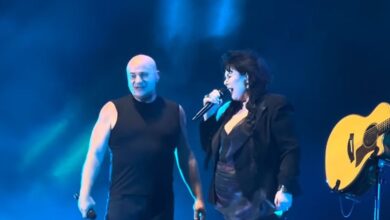
One Rock Hall Viewer Was in the Room When Cynthia Erivo Sang ‘In the Air Tonight’
“I was in the room,” a viewer wrote under a Facebook clip of Cynthia Erivo and Travis Barker performing “In the Air Tonight.” The viewer said the audience was stunned by the performance and felt the video did it no justice. That is one person’s account of the night. The longer footage gives you a way to hear what they might have been responding to.
Erivo and Barker performed Phil Collins’ song at the Rock & Roll Hall of Fame induction ceremony on November 14, 2026, at the Peacock Theater in Los Angeles. Collins was being inducted as a solo performer. Barker introduced him and later played the drum part on the tribute, with Erivo singing out in front of the kit.
With this song, a short clip has to pick a moment. A few seconds of Erivo’s voice catch the sound of a particular phrase. A few seconds of drums catch a fill people have been imitating for decades. The performance in the theater gave the audience something the clip can easily skip, the time between those points.
Listen to how much space there is around Erivo in the early part of the recording. She has room to stretch a word and let the rest of the line settle. The buildup works because the band allows that space to last. Barker’s kit is visible behind her, so the spectacle of the stage gives you a hint about what is coming before you hear it.
For people who know the Collins recording, the wait is part of listening. There is a point where you can almost count the fill in before anyone has played it. In a theater, that expectation is shared with people around you. The full audience recording brings a little of the room into the sound, including the space that the vocal and drums have to fill.
The useful place to start is the beginning of the song. Let Erivo finish the early lines and give Barker’s entrance time to arrive. The change in scale is much clearer when you hear what happens on both sides of the fill.
What changes from a different seat
A second audience recording lets you listen from somewhere else in the theater. The balance shifts with the camera’s position. One angle can make the vocal feel nearer. Another can make the kit or the room easier to hear. Listening across the two is a better way to understand what a viewer meant by being there than trying to take a single microphone’s point of view as the whole performance.
The part after the fill matters for the same reason. The song has been preparing you for the drum entrance, and then Erivo still has to sing through the sound it opens up. If you stop at the hit, you miss what happens when she can sing against the full sound of the drums.
Where Phil Collins put the space
Collins’ original recording has the same patience. The first section leaves room for the vocal, and the fill changes the scale of everything you hear around that voice. Putting on the original after the tribute makes it easier to hear which part of the drama belongs to the song and which part comes from the performers and the room.
That is where the comment from the theater earns another look. The viewer remembered a performance in which the sound had somewhere to go, from one person singing into a microphone to a stage full of drums and a room full of people hearing the change at once.