Dave Grohl Helped Aerosmith Turn Two Opening Songs Into a Hollywood Bowl Comeback
Aerosmith used the first two songs of their own Hollywood Bowl set to make the pace of the night clear. “Toys in the Attic” came first. “Back in the Saddle” followed, with Steven Tyler out front and Dave Grohl at the drum kit. The pair makes a good introduction to what happened that night. The first tune carries its speed close to the surface, while the second builds expectation around the vocal and the weight of the full band.
The show took place on October 29, 2026, the first of two California, Dream On: Aerosmith & Friends dates in Los Angeles. The wider program gave guests space to play songs associated with Aerosmith before the group took over its own set. Tyler was 78, and Joe Perry, Brad Whitford and Tom Hamilton were part of that opening with Grohl, who joined them on drums. The performance let an audience that had spent the evening hearing the catalogue in other hands hear what the band made of it together.
“Toys in the Attic” is a particularly direct way to move into a set. The guitar gets to the listener quickly and keeps a lot of information in motion. A drummer on the song needs to preserve that sense of forward movement while giving the riffs a dependable place to land. Grohl can make a hit look large from the crowd’s perspective, while the sound still needs to travel at the pace the guitars have set.
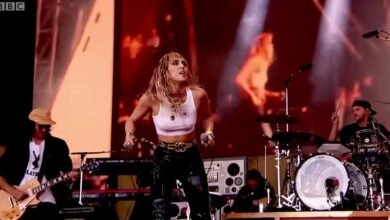
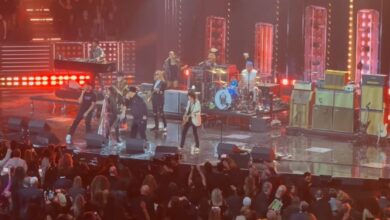
You can see why the shot of the drum kit works next to the shots of Tyler and Perry. The front of the stage supplies much of the visible identity of Aerosmith, especially when Tyler leans into a familiar line and Perry’s guitar is right beside him. Grohl’s spot behind them explains part of the force coming from that direction. A raised stick can signal the weight that is about to arrive without requiring a change of focus away from the singer for very long.
“Back in the Saddle” gives the players a different sort of opening. There is a sense of waiting for a figure to take shape before the vocal can seize the room. Grohl can work with that space instead of having to push every bar as quickly as the first song goes by. The band still sounds recognizably like the group that just came onstage. It is able to use the same force for a slower buildup.
Those two beginnings are worth hearing consecutively. They show what a guest drummer can contribute while the band holds on to the character of its songs. Grohl helps the first one reach the crowd at speed, then gives the next one space for a voice and a riff to establish their own size. Tyler has a different place to begin in each song, and the band makes both of those entrances feel intentional.
Watch the performance
The distinction between songs is particularly audible when you follow the bass under the guitars. Hamilton’s part makes it possible to feel the movement even when the camera is fixed on Tyler. The sound has a center while the singer uses the space around a phrase. That is one of the benefits of watching the two numbers as an opening sequence. You can hear the players establish their relationship before the performance settles into a longer set.
Longtime listeners can bring a substantial memory of the original recordings to these songs. That does not mean a show can depend on reproducing the details of those versions. The Bowl performance has an audience ready to react, and the musicians have to get a large place moving at one pace. Grohl’s touch comes through as part of that work. The group can lean hard into the songs without leaving them somewhere the audience cannot follow.
Tyler also has a way of making the change visible. The first part of the set gives him a reason to move with the guitars and draw the eye forward. The next song makes a different kind of room for his voice. Watching that change lets an audience remember the parts of Aerosmith that belong to the players around him. In the best stretches, one gesture near the microphone and one from the drum kit feel like parts of the same phrase.
Calling the night a comeback says something about the moment that brought the people to the Bowl. The first two songs say more about how the band wanted to meet them. They are quick to establish a rhythm, happy to let the guitar announce what is coming and able to use a voice against a band with a great deal of energy to give. They leave the audience with a clear sense of the concert it has just entered.
A useful part of the opening is that the quick song gives the crowd permission to move immediately. There is very little settling in to do once the guitars go past the first figure. Then the change in weight at the start of the next piece has something to work against. Grohl can keep the band sounding large while letting the new tempo and the space around Tyler’s entrance register. The pair gives a better account of how the whole band sounds than either opener could supply on its own.
Two more versions
A separate crowd recording of “Back in the Saddle” gives the second song a fresh vantage point. Its opening has time to emerge from the wider sound, and the change that arrives with Tyler is especially easy to pick out. Played after the two-song clip, it lets you revisit how the players ask the audience to wait through the first few bars before everything comes together.
“Dream On” from the same opening night reveals another side of the band’s pace. Tyler has a longer path to the famous high section, with room for the arrangement to gather behind him. The first two songs get the crowd moving immediately. This recording shows how the same band can keep that attention when a song requires a more patient start.