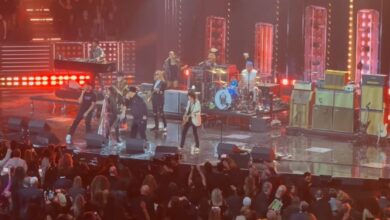
Brian May’s Guitar Carries the Conversation After Andrea Bocelli Takes the Lead
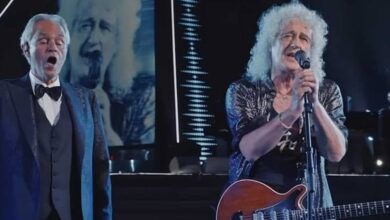
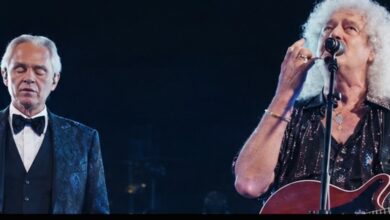
Brian May begins “Who Wants to Live Forever” in Tuscany with a singer’s sense of scale. He could have opened this Queen ballad with the sound that makes him recognizable from a single electric guitar note. Instead, he gets close to the microphone and sings the first lines plainly, leaving room at the ends of the phrases. Andrea Bocelli stands beside him, and the song has somewhere to go before either man reaches for its full weight.
The guitar becomes especially interesting once Bocelli takes the melody. His tenor can stretch a phrase out and make even a familiar line seem to travel farther. May listens to that stretch and makes his electric guitar part of the same conversation. The identity of the performer you hear changing the shape of the music stays the same. The thing he uses to do it has changed.
There is a reason the handover feels so natural. May wrote the song for the 1986 film Highlander, and Queen’s studio recording on A Kind of Magic already makes room for two fundamentally different voices. May has the opening and Mercury takes a prominent lead as the arrangement opens out. A second voice, with a sharply different color from the first, belongs to the piece’s original design.
In the Teatro del Silenzio performance, Bocelli takes that opening in another direction. The gradual widening of his sound fits a song that asks an enormous question in an unusually personal way. His vowels can carry the length of a line, while May gives its details shape on guitar. Even with a large accompaniment around them, you can still follow the little differences in how they begin and release each sound.
That last detail is worth hearing with headphones. After taking in the main vocal, let your ear move back toward May. A guitarist’s response can begin after a singer seems to have finished a thought, or sustain underneath the next one. The song gains a sense of continuity from those decisions. Its big moments are still there. The smaller connections explain why the big moments feel earned.
The duet was recorded in 2024 at the Teatro del Silenzio in Lajatico, Tuscany, and released as part of Andrea Bocelli 30: The Celebration. The concert statement is all the more memorable for the way May and Bocelli build it. The part where the arrangement lets you hear two artists listening to each other is right there in the transition from May’s voice to Bocelli’s.
Watch the performance
Where the guitar fits
Electric guitar in an orchestral ballad can easily become another layer of sustained sound. May’s tone makes his playing easier to recognize. A note has a distinct beginning and a rounded tail, and a bend can give even a short figure a feeling of destination. In a piece so concerned with time, that little effort to get from one pitch to another has an expressive purpose of its own.
Bocelli’s sound moves differently. A good part of its power comes from carrying the vowel through the line and keeping it present until the phrase has somewhere to land. The space May leaves around the tenor gives you a chance to hear that control. When the guitar comes forward, its own sustained sound keeps something of the same feeling going. The two musicians sustain a note in different ways, and the ear keeps finding the connection.
The arrangement also gives the audience a choice about what to follow. On a first hearing, Bocelli’s entrance commands attention. On a second, the instrument on May’s shoulder and the sound behind the singers can become the main story. That kind of replay value comes from decisions that are small enough to be missed and deliberate enough to change the shape of an entire passage.
Think about how carefully May controls scale at both ends of the song. The opening asks him to leave some of his sound in reserve, so the next singer can arrive with a sense of expansion. The electric guitar allows him to return to the foreground by degrees. Both roles depend on knowing exactly how long a musical gesture needs to last.
What the Queen recording gives the duet
The studio recording unfolds on a scale that comes partly from its orchestral colors. The shape of the opening vocal is already audible before that fuller sound takes over. Pay attention to the point where the emotional center begins to move. Both the phrasing and the changing accompaniment prepare the arrival of the larger voice. The effect depends on the first voice having a clearly defined character of its own.
For the Tuscany performance, Bocelli’s entrance leaves you free to remember the studio version and hear what his training brings to the song. May’s guitar is a common thread in that experience. It connects the composer’s vocal at the beginning with the moment the duet becomes a larger piece of music. By the end, you have heard May use two different ways of carrying a melody through the same arrangement.
The choice to hold back is part of the payoff. When a musician with the tone and catalog of Brian May lets a quiet part of the song stay quiet, there is something for the guitar to reveal later. It is a pleasure to watch a songwriter revisit a piece that has taken on a life of its own and find a fresh place for himself inside it.
Two more versions
Queen’s official music video gives you the original handover at its most familiar. Follow the path from May’s restrained first phrases to the larger vocal and orchestral sound later in the recording. The sense that the song can grow around a second voice is the same structural idea the Tuscany duet uses with Bocelli.
Queen and Adam Lambert’s live recording from the 2016 Isle of Wight Festival lets you hear the arrangement from the audience side of a rock show. Follow the shift from the sustained opening to the fuller stage sound. In that setting, the drama between the voice and the accompaniment comes forward in a different balance from the Tuscany duet.