The Small Choices That Make Brian May’s Voice Stand Out Beside Andrea Bocelli
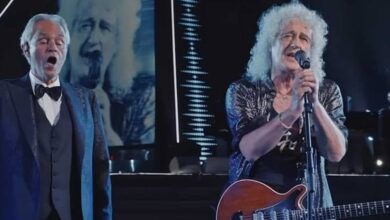
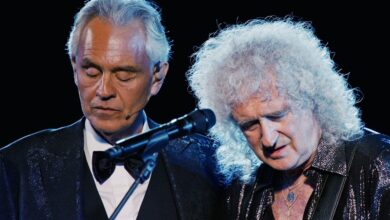
At the beginning of “Who Wants to Live Forever” in Tuscany, Brian May sings like someone trying to get a sentence across to one person. He stays close to the microphone and gives the words a shape that feels familiar from ordinary speech. It is an unexpectedly intimate start for a performance filmed at the Teatro del Silenzio, with Andrea Bocelli waiting beside him and a song that can fill much bigger spaces.
The detail to notice is how May finishes a phrase. He lets the sound settle and leaves a little time for the words to register. A singer with a more sustained approach might draw the ear toward the end of the note. May puts plenty of character in the middle of the line and gives the release its own purpose. The slight pause feels like part of the lyric.
Then Bocelli takes up the melody. Listen to the width of the vowels and the way he keeps a tone going even as its intensity changes. The movement sounds different almost immediately, and the entrance makes May’s earlier choices easier to hear. Two singers can agree on where a tune should go and still have different ideas about how much time a listener needs to get there.
For some Queen listeners, hearing this song also means hearing a memory of Freddie Mercury. May had already given its opening his own character on the band’s recording, which makes the Tuscany performance a chance to hear a familiar quality at close range. This is his composition, and there is an ease in how he fits each phrase to the shape of the words.
May’s guitar sound has an obvious identity, down to the way he bends a note and gives it a tail that seems to keep singing. Something similar happens when he is simply standing at a microphone. It is a matter of emphasis and timing. The note he elects to leave a little early can be the one that makes you lean in hardest for the next line.
Bocelli and May gave this performance in Lajatico in 2024, and it appears in Andrea Bocelli 30: The Celebration. For a closer look at what May contributes as a vocalist, start with the first exchange. It is easy to remember the sweep of the later passages and forget how deliberately the opening has prepared you for them.
Watch the performance
Give the end of each line a second listen
May’s delivery has a conversational quality even when the tune calls for a fairly sustained sound. That quality comes through in the separation between words. Some of them arrive with a firm edge, while others ease into the harmony. The words that carry the main thought have a little extra presence. The effect can sound effortless until you try singing the same passage with all the accents in the same place.
Listen to the small spaces between thoughts, too. In a song about the size and uncertainty of a life, a pause keeps the sense of the question open. The accompaniment gives you the harmony, and the voice gives you a moment to sit inside it. By the time the phrase turns over, the next words can feel like a response to something the first singer has left hanging. On a repeat play, the change from the last soft syllable to the next inhale is especially easy to catch.
Bocelli can put that same question across through a longer musical arc. Even when a line is made up of several separate words, you can hear one breath carry it through. May and Bocelli give their audience two different places to put its attention. May brings it toward an individual word. Bocelli brings it toward the direction of the phrase as a whole.
The meeting makes for a particularly clear recording of a skill that can be hard to point out in a group as famous for its harmonies as Queen. In the opening, May has the space to let the identity of his voice register. When the arrangement broadens, your ear already knows what he sounds like. You can pick out his contribution even with a much fuller texture around him.
The guitar player’s sense of breath
On a guitar, May can sing through a phrase by delaying a bend or letting one note ring against the harmony. His voice has its own limits and colors, and its timing can carry a similar sense of intention. It is worth paying attention to the places where the vowels give way to the consonants. The release of a word can bring a phrase to rest as decisively as any resolving note.
The Highlander connection helps explain the strength of the material, too. May wrote the song for a film about immortality and the pain of outliving people you love. The words have a weight of their own. A plainspoken vocal can bring the human scale of that idea within reach before the arrangement opens up and asks the bigger question.
The Tuscany performance is a good place to hear how useful a personal sound can be when the other singer has one of the world’s most recognizable tenors. May does a lot with where he breathes, which words he leans on and how he lets a phrase end. Those are things he can decide afresh every time he sings the song. They are also the reasons a few measures of this performance can stay with you.
Two more versions
Queen’s “’39,” written and sung by May on the original studio recording, gives his phrasing an acoustic setting. The light rhythm under the verse leaves you free to hear how his stresses fall on the words that move the story along. Those natural stresses are also a big part of what he brings to the much slower ballad in Tuscany.
In Queen’s original video for “Who Wants to Live Forever,” listen to the scale of the sound around May’s opening lines. His voice stays close and clearly placed as the arrangement gathers weight. Hearing those phrases in the studio first makes it easier to catch what he does with their ends and pauses in the live version with Bocelli.