How Brian May and Andrea Bocelli Bring Freddie Mercury to Mind in Tuscany
When Brian May and Andrea Bocelli sang “Who Wants to Live Forever” at the Teatro del Silenzio, a question hung over the piece long before the two voices came together. The song is closely bound to Freddie Mercury in the minds of Queen listeners. How do you give an audience that knows his delivery by heart a new reason to hear the song all the way through?
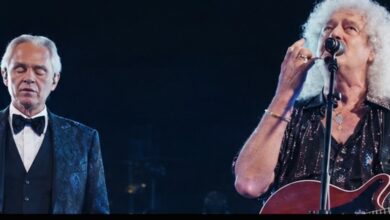
May answers first by singing the opening in his own voice. The camera can move close enough to make the beginning feel private, even as the performance takes place in the open air at Lajatico. You can see the two musicians sharing the stage and hear the modest scale of the vocal. It is an unusually still way to start a piece that has been heard in some enormous spaces.
Bocelli gives the melody a different sense of distance when he enters. The tenor line opens up and holds its shape, and the arrangement seems to grow around it. Hearing him take that space can bring Mercury’s phrasing to mind precisely because a listener has something so distinct to put beside it. The memory and the present performance can be heard at the same time.
A glimpse of Mercury on the stage screen makes that relationship visible. There is a face on the screen that belongs to the song’s history and there are two musicians living through the song in real time. May has a place on both sides of that picture. He wrote the song for Highlander in 1986, recorded it with Queen and now has a hand in how a new voice takes it forward.
The occasion was the 2024 concert in Tuscany later featured in Andrea Bocelli 30: The Celebration. A performance for that setting could underline every moment that seems to call for a grand effect. A strength of this version is how long it gives its opening to the words and how plainly it lets the change of singers happen. The audience can feel the distance the music travels.
The tune comes with a question about living forever, and a listener can hear a particular poignancy in the idea of the work outlasting one of the people who made it. May and Bocelli leave enough of the original shape of the song for that feeling to arrive on its own. The visual reminder of Mercury has greater force once the live voices already have you listening.
Watch the performance
The songwriter’s place in the tribute
Queen’s studio recording has long given people a way to hear two voices within the same dramatic world. May opens it and Mercury takes a lead as the song develops. May’s place in the Tuscany version is easy to understand in that light. His singing has a history with the song already, so the performance can begin in a place an old listener knows before bringing in a different second voice.
The scale of the song also leaves room for different kinds of weight. May can carry a line with its timing and emphasis. Bocelli can carry it with a broad musical breath and an exceptionally clear sustained tone. After the handover, it becomes possible to hear the same tune as an intimate question and as a sound large enough to push against the boundaries of the stage.
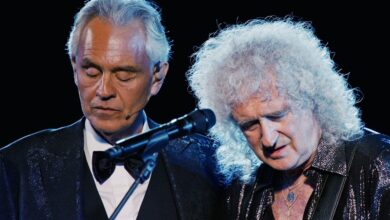
The shared performance leaves room for particular gestures to register. May looks down or toward the microphone, Bocelli has stretches where his face is still, and the camera has time to follow both. These little visual details help explain how the piece can slow an audience down. Both performers have the patience to let a vocal line end before asking the next moment to begin.
The venue suits that patience. Outside, the sound can feel as if it is moving away from the performers into the space around them. The close microphones in the film give a viewer another scale entirely. You can keep your eyes on the faces and hear the beginnings of the individual phrases. Those two perspectives give the performance its feeling of being intimate and public at once.
A Queen song with room for another singer
Long before they reached Tuscany, the surviving members of Queen had already heard a guest give this song a new public life. At the Freddie Mercury Tribute Concert at Wembley Stadium in April 1992, Seal sang it with the band. The occasion had a different purpose and atmosphere, with musicians coming together to celebrate Mercury and raise awareness about AIDS. The song fit that setting as naturally as it had fit a film about the limits of human life.
It is worth comparing your reaction to the first vocal line in each of those settings. The Queen recording carries its period and its voices in the texture of the music. At Wembley there is an audience hearing the song together in the year after Mercury’s death. In Tuscany a different audience hears the composer begin it beside a tenor from another tradition. The melody is familiar in each case, and its surroundings change the feeling of the question.
That may be the most lasting detail of the Bocelli performance. A song can become one of the ways an audience remembers a person, and it can keep room for an arrangement that sounds fully alive in the present. May’s opening lets you hear how close he still is to the song. When Bocelli takes it up, his tone makes it something they are making together in that moment.
Two more versions
Seal sang “Who Wants to Live Forever” with Queen at Wembley in 1992. His voice gives the song a much different kind of weight in a stadium. Listen for how his attack brings individual words forward as the accompaniment grows. It is another example of a guest singer bringing a recognizable sound of his own to an occasion shaped by Mercury’s memory.
Queen’s original “Who Wants to Live Forever” video lets you go straight back to the voices behind that memory. Listen to May at the beginning and the way Mercury broadens the sound when the performance gathers force. After hearing the two live interpretations, the switch in the original recording is a good place to return to the character of the song itself.