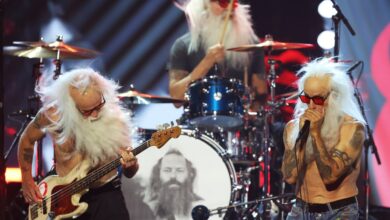
Forty-Five Years After Phil Collins, Cynthia Erivo Sang “In the Air Tonight” Barefoot
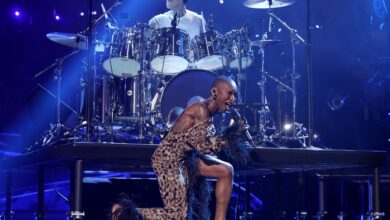
There’s a photograph from the Rock & Roll Hall of Fame that tells you where to look in Cynthia Erivo’s “In the Air Tonight.” Erivo is barefoot, down on one knee with the microphone at her mouth. Travis Barker is directly behind her on a raised platform, surrounded by a drum kit that takes up much of the frame.
The song had been out for forty-five years when they performed it. Phil Collins released it in 1981 and was inducted as a solo artist on November 14, 2026, at the Peacock Theater in Los Angeles. Barker introduced Collins at the ceremony and later took the drum part in the tribute.
The camera gives you two different places to focus. Barker barely needs to take up any space in the opening minutes, even though the kit is up on a riser and visible from across the room. Erivo has the floor in front of it. She can close the space between herself and the audience by stepping forward or by dropping nearer to the floor.
That low position changes what the loud part of the song looks like. An extended note might look bigger if the singer raised an arm or stood tall. In the photograph, it’s the voice and the scale of the kit that suggest volume. The singer’s posture pulls your attention to the effort in that one moment.
There is a useful difference between the frame and the footage. The frame captures two performers in a single arrangement. The footage lets you follow which of them has your attention as the song moves from a quiet entrance toward the passage everyone expects.
In the first recording, watch the space in front of the drum riser as much as you watch the kit. It makes the staging easier to see over the course of the song.
The second camera shows the same tribute from a different position. It helps explain why the photograph with Erivo close to the floor and Barker above her captures so much of the arrangement in a single frame.
The official music video below goes back to Collins’s own version. Its close focus on the singer makes a useful contrast with what two performers had to do to make the song read across a theater.