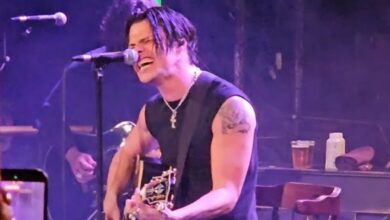
Love Bites Turns The Colosseum Into A Singalong Cathedral In Def Leppard’s Las Vegas Finale On February 28, 2026
Def Leppard’s “Love Bites” has always worked like a slow-motion thunderclap: it creeps in gentle, then lands with a chorus that feels impossibly big for a song built on heartbreak and restraint. On February 28, 2026, at The Colosseum at Caesars Palace in Las Vegas, that dynamic hit even harder because the room is engineered for clarity. This isn’t a stadium where the wind steals syllables and the chorus becomes a blur of noise. This is a theatre where every harmony can cut through, where the quiet parts don’t get swallowed, and where a power ballad can feel as physical as a riff monster. It was also the final night of a run that turned a strip landmark into a rock residency destination again, so “Love Bites” didn’t arrive as “the ballad slot.” It arrived as an emotional payoff.
There’s a specific kind of tension right before that opening line, the hush that spreads when people realize the next song isn’t about jumping or fist-pumping, it’s about remembering. In Vegas, the crowd energy tends to be flashy and loud, but the moment “Love Bites” is recognized, it flips into something more intimate. You can sense the collective decision to sing, not just listen. That matters with this song, because the chorus doesn’t work as a flex; it works as a confession that thousands can share without looking at each other. “Love bites, love bleeds” is simple on paper, yet it becomes a personal slogan in a live room. In this 2026 performance, that line doesn’t sound like a nostalgic catchphrase—it sounds like a lived-in truth that fans have carried through decades.
What makes “Love Bites” special in the Def Leppard catalog is how it balances polish with bruises. The band’s signature is layered perfection—stacked vocals, guitar tones that shimmer, a rhythm section that hits with almost mechanical steadiness. But “Love Bites” is the point where that sheen turns into a spotlight on vulnerability instead of a shield. The Las Vegas residency setting amplifies that contrast. When the verse is delivered cleanly, it feels conversational; when the chorus opens up, it feels like the ceiling lifts. That shift is the entire reason this song became a defining power ballad, and it’s also why it ages so well live: it doesn’t require the singer to outrun time, it requires him to sell the feeling.
Joe Elliott’s approach to this song has always been less about big vocal acrobatics and more about phrasing—how he leans into a line, how he holds a word just long enough to let the crowd attach their own story to it. In a residency environment, that phrasing can become even more deliberate, because the band is playing the same room repeatedly and learning exactly what the space gives back. You can hear the confidence that comes from that familiarity: the pauses are cleaner, the entrances feel intentional, and the band leaves enough air for the audience to become the second lead vocalist. The Colosseum isn’t a place you overpower; it’s a place you aim. “Love Bites” is all about aim, and that’s why this version lands with a sharper emotional edge than many open-air recordings.
Another reason the 2026 Vegas version feels different is the context of the set around it. This residency leaned into both hits and selections that signaled a band still curious about its own history and presentation, with a production designed to feel larger than the theatre footprint. Reports and coverage around the run emphasized a refreshed stage show and a setlist that still keeps the classics as pillars while changing the framing around them. In that kind of pacing, “Love Bites” becomes a strategic reset button: it lowers the temperature without killing momentum, and then it rebuilds the emotional intensity so the final stretch of the show hits like a victory lap rather than a checklist.
It’s easy to forget how bold “Love Bites” was in the original Hysteria era. Def Leppard were masters of high-gloss rock, but this track proved they could do tenderness without losing power, and that they could top the charts with something that didn’t rely on speed or aggression. The song became their only number-one single on the US Billboard Hot 100, which is still one of those facts that surprises people who assume “Pour Some Sugar On Me” must have owned that spot. That historical weight changes the way “Love Bites” plays in a modern set: it’s not simply a fan favorite; it’s a career landmark. When it appears late in a residency finale, it feels like the band tipping its hat to the moment the world fully agreed they were unstoppable.
The Colosseum itself plays a role in how the song breathes. With a capacity around the low 4,000s for this run, it sits in that rare sweet spot where a major band can still create a “we’re all in this together” feeling without losing the roar of a big crowd. You can hear individual voices during the quiet parts, and you can hear the mass of voices snap into unison on the chorus. That scale is perfect for “Love Bites,” because the verses need intimacy and the chorus needs a wave. In a stadium, the wave is automatic but intimacy is hard. In a club, intimacy is easy but the wave can feel small. In this room, the song gets both.
By the time the chorus cycles through, the performance becomes less about the band executing a classic and more about the audience proving why the classic survived. Fans don’t just sing along; they sing like they’re protecting the song from fading, like they’re preserving the exact emotional memory they first attached to it. It’s not a random nostalgia hit, either. The reviews and reactions tied to the finale night talk about the band sounding “spot on,” the venue having no bad seats, and the show feeling like one of the best people have seen from them—responses that fit perfectly with why “Love Bites” still matters. When a ballad earns that kind of live respect, it stops being “the slow song” and becomes the beating heart of the night.
After a fan-shot capture of the night locks in the atmosphere, it’s impossible not to appreciate how different “Love Bites” feels compared to the studio blueprint. The original recording is famously sculpted—massive background vocals, carefully layered guitars, and a sense of drama that’s built as much in the mix as in the writing. That precision is part of the song’s identity, but it also sets a high bar for live versions. In 2026, what stands out is not an attempt to replicate every studio trick, but the way the band translates the emotion into a room where the audience can provide the “extra layers” with their voices. The chorus becomes the choir, the theatre becomes the reverb, and the song turns from a studio monument into a living thing that can bend slightly night to night.
One of the best ways to understand what makes the 2026 rendition hit is to revisit an older performance era when the song was still relatively young and the band was living inside the Hysteria universe full-time. In late-’80s television performances, “Love Bites” often carries a brighter urgency—less reflective, more immediate—like the wound is still fresh. The tempo feels a touch more impatient, and the delivery leans into the dramatic tension of a band proving it can dominate both rock credibility and pop scale. Watching those versions after the Vegas finale underscores the song’s evolution: the notes are the same, but the meaning deepens. The 2026 version doesn’t feel like a young band showing range; it feels like a veteran band honoring a scar they never had to hide.
The Hysteria tour-era footage is also a reminder of how important the second guitar voice is to the emotional impact of “Love Bites.” The song is built on melody and harmony more than riffing, and that means the guitars have to speak like singers—sustaining, answering, and swelling at exactly the right moments. Older live clips highlight that interplay in a rawer way, where you can almost see the band “steering” the dynamics rather than relying on studio layering. When you compare that to the residency setting, you hear a different kind of control: less scrappy, more cinematic, shaped for a theatre that rewards detail. The connective tissue between eras is the same—Def Leppard treating a power ballad like a headline event, not a breather.
Bringing the comparison closer to the residency itself, another fan-shot from the same Vegas run helps show why the February 28 performance feels like a culmination rather than just another date on the calendar. The band’s comfort in the room grows as the residency progresses, and that comfort translates into pacing—where the pauses land, how the crowd responds, how the chorus lift feels less like a cue and more like a spontaneous surge. Even if the arrangement stays consistent, the emotional temperature changes when the crowd knows it’s a final night. “Love Bites” thrives on that kind of heightened awareness because it’s a song about the moment you realize something is slipping away. In a finale setting, that theme quietly mirrors the end of the run itself.
By the end of the song in Vegas, the biggest difference isn’t a flashy variation or a surprising new vocal run. It’s the sense of communion. The audience doesn’t treat the chorus as a hook; they treat it as a shared statement. That’s what “Love Bites” has become over time—less a track you remember and more a track you revisit, because it still fits new chapters of life. A residency finale magnifies that feeling: everyone in the room chose this night, this place, this band, and this song. And for a few minutes, under theatre lights in the middle of the Strip, a power ballad from the Hysteria era stops being history and becomes the present tense again.