Paul McCartney Ignites Columbus with a Timeless Got Back Tour Performance at 83
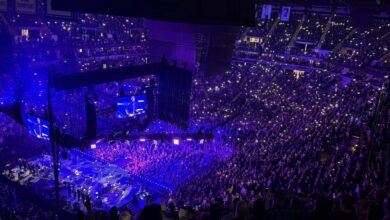
On a chilly Saturday night in downtown Columbus, the glow of Nationwide Arena’s marquee felt less like a concert listing and more like a declaration: Paul McCartney was back. Hours before showtime on November 8, 2025, the streets around the arena were already buzzing with a mix of Beatles shirts, Wings tour tees, and brand-new Got Back merch. Inside, fans found their seats under the high rafters of the NHL-sized venue, a building more used to slap shots than singalongs, now transformed into a shrine for one of the most important songwriters in history. From the upper bowl to the floor, people checked the clock, snapped photos of the stage, and traded predictions about the setlist. The shared sentiment in the air was simple and slightly unbelievable: at 83 years old, Paul McCartney was about to play for them, in their city, for the first time in years.
The Got Back 2025 tour had already built serious mythology by the time it rolled into Columbus. Billed as McCartney’s first major North American run in three years, the trek stretched from late September in Palm Desert to late November in Chicago, with Columbus sitting neatly in the final leg, the 14th show of the North American stretch. Fans arriving that night knew they weren’t just catching another legacy act circling the arena circuit; they were witnessing a tour that effectively stitched together the entire post-pandemic McCartney live era, picking up where earlier Got Back outings in 2022–2024 had left off. That sense of continuity—of a story still being written rather than politely wrapped up—already made the Columbus date feel more like a new chapter than a nostalgia stop.
When the house lights finally dimmed, it wasn’t with the sudden blackout of a modern pop spectacle but with a gentle fade that felt almost old-school. A collage of Beatles, Wings, and solo-era images washed over the screens, underscored by instrumental snippets that teased melodies everyone in the building knew by heart. Then, almost casually, there he was: Paul McCartney, walking onstage with that familiar half-stride, half-bounce, waving like he’d just bumped into old friends at the supermarket. The roar that followed didn’t sound like polite respect for a legend; it sounded like pure, youthful hysteria. For a few seconds, age evaporated—his and theirs. It was just Paul and a roomful of people who had grown up, grown older, and somehow still felt sixteen when they heard “Yeah, yeah, yeah.”
McCartney has always been a master of pacing, and the Columbus show wasted no time proving it. Rather than easing in gently, he kicked off with uptempo crowd-grabbers—Beatles era, of course—forcing everyone out of their seats almost immediately. The sound in the arena was crisp and surprisingly intimate for such a large space, with his voice sitting clearly in the mix: weathered in places, yes, but still unmistakably his. There was grit on some high notes and a little extra warmth in the lower register, but the phrasing, timing, and musical instincts remained razor sharp. You could feel people around the arena nudging each other in disbelief: he really does still sound like Paul.
As the show moved through its opening stretch, the genius of the setlist design became obvious. Instead of stacking Beatles songs in one block and relegating Wings and solo material to the margins, McCartney wove them together like one long, coherent story. A burst of early-Beatles rock ’n’ roll would roll into a Wings anthem, which in turn might be followed by a reflective solo ballad from the last decade. It was as if he were gently insisting that all these eras belonged on equal footing, that “Band on the Run” and “Maybe I’m Amazed” had every right to stand shoulder to shoulder with “Let It Be” and “Hey Jude.” The crowd didn’t argue for a second; they sang every era with identical enthusiasm.
One thing that stood out all night was just how much McCartney still seems to enjoy the mechanics of being in a band. This wasn’t a “living statue” situation where the star is politely carried by a group of anonymous pros. His longtime touring band—Rusty Anderson and Brian Ray on guitars, Paul “Wix” Wickens on keys, Abe Laboriel Jr. on drums, plus the Hot City Horns—felt like an extension of his musical personality. They locked into harmonies with the kind of telepathy that only forms over decades on the road. At several points, especially during rocker sections, McCartney would turn toward his bandmates, grin, and lean into the groove like a kid jamming in a garage, not an 83-year-old knight of the realm helming a multimillion-dollar tour.
@realryanmcc Paul McCartney performing “ Blackbird ” Live at Nationwide Arena Columbus #paulmccartney @Paul McCartney ♬ original sound – Ryan McCormick
@alltheworldsa_stage @Paul McCartney singing Blackbird was pure perfection. #paulmcartney #paulmcartneygotbacktour #columbusohio #beatles #blackbird ♬ original sound – Alltheworldsastage
In between songs, the show became part rock concert, part storytelling evening. Columbus got the full McCartney patter: the well-worn but still charming anecdotes about John Lennon rolling his eyes at early lyrics, the memory of George Harrison teaching him ukulele parts, little flashes of Liverpool humor that landed just as well in Ohio as they do in the U.K. At one point, he joked that whenever they play an older Beatles tune, the arena lights up with phones and cameras, but when they play something new, “it looks like a black hole out there.” The crowd laughed, then dutifully cheered loudly for the newer material—an unspoken pact between icon and audience that they were there for the whole story, not just the early chapters.
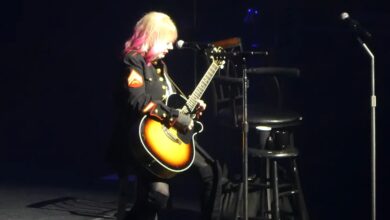
The emotional core of the night arrived during the tributes. McCartney has, for years now, used his set to speak directly to the friends who can no longer share the stage with him, and Columbus felt those moments intensely. When he sat at the acoustic guitar to perform “Here Today,” his song-letter to John Lennon, the arena quieted into a reverent hush. You could see couples link hands, older fans wipe their eyes, younger fans absorb the weight of history in real time. Later, when he picked up a ukulele—famously one of George Harrison’s favorite instruments—for “Something,” the arrangement slowly bloomed from a delicate solo into a full-band swell, the song rising like a gentle prayer. Those segments reminded everyone that this wasn’t just entertainment; it was living history being sung to them by the man who lived it.
Of course, any McCartney show also has to deliver pure, unfiltered fun, and Columbus got more than its share. “Live and Let Die” turned Nationwide Arena into a temporary movie set, with blasts of lights, strobes, and pyrotechnic flashes that had people physically jumping at each explosion. The orchestral lines, handled by keys and horns, soared over Abe Laboriel Jr.’s thunderous drum hits while McCartney attacked the piano with a gusto that ignored his birth certificate completely. You could feel the vibrations in your chest as much as hear the song. When the final explosion hit and the stage dropped back into near darkness, there was a collective exhale, followed by a roar that sounded half delighted, half disbelieving.
@ronvallephoto Paul McCartney columbus 11/10/25 #paulmccartney ♬ original sound – ronvallephoto
If “Live and Let Die” was the cinematic high point, “Let It Be” was the spiritual one. The staging was simple—McCartney at the piano, soft lighting, subtle visuals—but the effect was enormous. People who had been dancing moments earlier now stood still, many with phones forgotten at their sides. The song’s familiarity didn’t dull its impact; if anything, singing it with thousands of other voices made it feel newly personal. Some fans sang in full voice, others mouthed the words quietly, and a few simply listened, eyes closed, as if in a private moment of reflection. It was the kind of communal experience concerts promise and rarely deliver so completely.
Then came the inevitable, irresistible rise of “Hey Jude,” the song that can turn almost any crowd on Earth into an impromptu choir. By the time the “na-na-na” coda rolled around, McCartney had the entire arena waving, splitting the audience into sections for call-and-response, and teasing them when one side wasn’t quite loud enough. Kids stood on seats next to grandparents, all chanting the same nonsense syllables that somehow feel like the most meaningful words in the world when you sing them together. From the floor, the sight of all those arms moving in unison felt like watching a living sea. From the upper levels, it must have looked like the arena itself was breathing.
The encore section sealed the night’s legacy. Returning to the stage to deafening applause, McCartney launched into an Abbey Road-era sprint that culminated with “The End,” complete with trading guitar solos and that famous final line. As those last words—“And in the end, the love you take is equal to the love you make”—echoed across the walls of Nationwide Arena, red, white, and blue confetti rained down over the floor. The effect was both celebratory and strangely intimate, like being inside a snow globe built from six decades of popular music. He gave a final wave, added a playful “See you next year,” and slipped offstage, leaving the crowd half-laughing, half-hoping he actually meant it.
What made the Columbus show particularly special was how it collapsed time. Fans who discovered the Beatles on vinyl in the 1960s stood shoulder to shoulder with listeners who first heard “Blackbird” on streaming playlists. College students wore shirts from tours that happened before they were born; parents pointed to the stage and whispered to their kids that this man’s music had been the soundtrack to their entire lives. Yet the performance never felt like a museum piece or a farewell lap. The band played with the energy of a current, working group, and McCartney’s between-song banter kept things loose and alive. It was less “remember when?” and more “look where we still are.”
There is always a temptation, with artists of McCartney’s stature, to treat each tour as potentially the last. But the Got Back tour carries a slightly different feeling: not denial about age or reality, but a stubborn refusal to let that awareness shrink the experience. In Columbus, he didn’t avoid the subject of being 83—if anything, he leaned into it, quietly letting the length of the show, the difficulty of the material, and the sheer joy radiating from the stage do the talking for him. Rather than trying to erase the years, he seemed to wear them as proof: proof that music really can sustain a life, and a life can, in turn, sustain music.
By the time the house lights came up and fans shuffled out into the cool Ohio night, there was a sense that they’d shared something bigger than just a Saturday concert. People hummed choruses in the hallways, compared favorite moments in the merch lines, and took one last selfie with the arena glowing behind them. Some talked about seeing him decades earlier; others said this might be their only chance, and that it had been more than worth the wait. For at least a few hours, everyday worries—jobs, bills, the news cycle—had been replaced by a simpler reality: a songwriter named Paul came to town and reminded everyone what a song can do.
In the end, what set this show apart wasn’t just the catalogue or the production or the novelty of seeing an 83-year-old Beatle still commanding an arena. It was the way all those elements fused into a single, sustained feeling: gratitude. Gratitude from the crowd that he was still out there doing it, and gratitude radiating from the stage that people still cared enough to show up and sing along. As fans drifted back into Columbus, that feeling lingered. The Got Back tour would move on to its next stop, but for one night in November, Nationwide Arena became something rare—a place where history, emotion, and pure rock-and-roll joy met in the same room and refused to let go.