Def Leppard Turn The Colosseum Into A Choir With “Hysteria” In Las Vegas 2026
On February 28, 2026, Def Leppard walked onto the Colosseum stage at Caesars Palace with the kind of polished confidence that only comes from decades of arena nights, and “Hysteria” instantly felt like the emotional center of the room. This song has always been less about brute force and more about atmosphere, that glossy, late-night pulse where every chord seems to shimmer. In a Vegas residency setting, it lands even harder because the crowd isn’t scattered across a football stadium; it’s close enough to feel every sing-back, every little pause, every moment Joe Elliott holds a phrase just a beat longer to let the audience catch it. “Hysteria” thrives on that intimacy, and the February 28 performance turns the venue into one big, steady exhale.
Part of what makes this night special is how the residency format changes the stakes. A one-off tour stop can be thrilling, but a residency invites a different kind of craft: the band can fine-tune transitions, tighten cues, and build a show where the emotional peaks are placed with intention. “Hysteria” is one of those peaks, not because it’s the loudest moment, but because it’s the one that pulls everyone together. You can feel the room shift when the opening progression appears; people stop moving just to move and start singing like they’re remembering where they were the first time this track found them. Vegas amplifies that feeling, because it’s already a city built on big memories and bigger lights.
The song itself is built like a slow ignition. It doesn’t rush, it doesn’t swing for shock value, it just keeps tightening the grip until the chorus arrives and the whole place is humming. In 2026, that structure feels even smarter. Modern rock crowds are used to instant payoffs, but “Hysteria” still wins by being patient. The performance on February 28 leans into that patience, letting the chord changes breathe so the audience can lean forward emotionally, not just physically. You get that rare sensation where thousands of people are loud, yet the vibe is soft around the edges, like a shared secret being shouted without losing its tenderness.
Joe Elliott’s delivery is key to why “Hysteria” keeps working year after year. He doesn’t need to oversell it; the melody does the heavy lifting, and his job is to guide the room through it like a storyteller. In Vegas, that guiding role becomes more obvious. He phrases lines in a way that invites the crowd to fill the gaps, and when the chorus hits, it’s not just fans singing along, it’s the crowd taking ownership of the moment. “Hysteria” can easily turn into background nostalgia if it’s treated like a checkbox hit, but on February 28 it feels like the band is protecting the song’s mood, making sure it stays romantic, dramatic, and just a little dangerous.
The Colosseum helps, too. There’s a theatrical quality to the space that fits Def Leppard’s whole identity: big hooks, big visuals, and music that’s engineered to feel larger than life. But “Hysteria” is interesting because it’s “larger than life” in a different way. It’s not fireworks; it’s neon. It doesn’t punch; it glows. In a room designed for spectacle, that glow stands out because it’s a different kind of power. You can almost sense the audience’s collective decision to slow down, to savor it, to sing it with the kind of volume that isn’t aggressive, just devoted.
Another reason this version feels different is the era Def Leppard are in as performers. In the late 1980s, “Hysteria” was a statement of ambition, a slick, high-wire pop-rock masterpiece that still had hard-rock muscle underneath. In 2026, it’s a statement of endurance. The band doesn’t play it like they’re chasing perfection; they play it like they know exactly where perfection used to live and how to honor it without freezing it in amber. The result is a performance that feels warm and lived-in, where the tiny rough edges—crowd noise, room acoustics, a vocal inflection—make the song feel human rather than museum-clean.
And then there’s the audience factor that only Vegas seems to create: a mix of diehards who planned their trip around a setlist and casual fans who walked in expecting hits and walked out feeling like they witnessed something personal. “Hysteria” is the bridge between those two groups. Diehards know every harmony and every guitar lick, while casual fans recognize the chorus the second it arrives. On February 28, you can feel both crowds meeting in the same place emotionally, because the song’s mood is universal. It’s dramatic without being cheesy, tender without being weak, and huge without being hollow.
By the time the performance reaches its final stretch, the thing that stands out most is how the song becomes a crowd instrument. Not just people singing, but people singing in a way that changes the sound of the room, like a choir with a rock band wrapped around it. That’s the magic trick of “Hysteria” live: it doesn’t need to be the most explosive track in the set to become the night’s emotional photograph. On February 28, 2026, the Colosseum doesn’t feel like a venue for a few minutes. It feels like a shared memory forming in real time, bright, glossy, and impossible to shake.
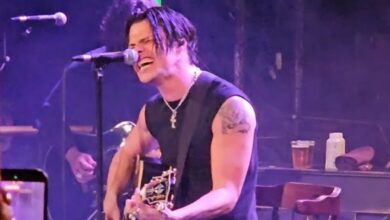
What’s so striking about the February 28 fan-shot capture is how clearly it shows the song’s “pull.” Even through a phone mic, you can hear that the crowd isn’t merely reacting; they’re committing. The chorus has that soft-focus grandeur, and the audience responds like they’ve been waiting all day to sing it with strangers who somehow feel like friends. The residency context also makes the performance feel deliberate, like the band knows exactly how to pace the emotional waves of the night. This isn’t a rushed version tossed in to satisfy radio history; it’s given space, and that space lets the chorus bloom. The way the room swells on the hook is the whole story: “Hysteria” isn’t just being played to the crowd, it’s being built with them.
Returning to the official studio version after hearing the 2026 Vegas performance is like stepping into the blueprint of an era. The production is famously meticulous, the guitars are layered like glass, and the rhythm section sits with that perfectly controlled push that defined late-80s pop-metal at its most ambitious. Listening now, you can hear why “Hysteria” became a kind of emotional anchor for so many fans: it’s romantic without being fragile, powerful without being heavy-handed, and it carries a sense of nighttime motion that never really ages. The Vegas version adds years of lived experience and crowd energy, but the studio cut reminds you the song was always engineered to feel massive in headphones and magical in a room full of voices.
A great way to understand why the 2026 Vegas performance works is to look back at “Hysteria” in the 1988 tour era, when the song was still new enough to feel like a current obsession rather than a classic. In the late-80s live setting, the track carries a different kind of tension: the band is proving their new, polished sound can survive a loud arena without losing its shine. You can hear the crowd discovering that the chorus isn’t just pretty, it’s commanding. Compared with Vegas 2026, the contrast is fascinating. The earlier performance has youthful urgency and a sense of “watch us pull this off,” while Vegas has the calm confidence of a band that already knows it’s going to land. Both versions show the same truth: “Hysteria” was born to be sung back.
The early-90s live era adds another layer, because by then “Hysteria” had already proven it could outlast trends. A 1993 performance reveals how the band learned to make the song feel bigger without forcing it, using pacing and dynamics rather than sheer volume. That’s exactly the skill you hear in Vegas 2026. The song isn’t about sprinting; it’s about control. Seeing it performed in the 90s highlights how Def Leppard kept the track from turning into a postcard by treating it like part of the show’s emotional architecture. It becomes a moment where the band can let the room sing, not as a gimmick, but as a feature. Vegas on February 28 feels like the modern extension of that same lesson, just with a crowd that’s fully trained to join in.
Fast-forward to the festival years and you see “Hysteria” operate under a different pressure: winning over a massive crowd that might not be there specifically for a slow-burn, romantic anthem. Live in 2015, the song proves it doesn’t need perfect conditions. The hook is simply too strong, the melody too familiar, the atmosphere too inviting. This comparison is useful for the Vegas 2026 performance because it underlines what Def Leppard do so well: they can make “Hysteria” feel intimate even when it’s played in open air to thousands. In the Colosseum, that intimacy gets supercharged because the room is built for detail and the audience is close enough to turn the chorus into something that feels personal. The festival version shows its durability; the Vegas version shows its emotional precision.
By 2019, when Def Leppard performed “Hysteria” in a high-profile, career-celebration context, the song carried the weight of legacy without losing its sweetness. That’s an important bridge to the 2026 residency, because a Vegas run is also a kind of celebration—just one that happens night after night, with fans traveling in, making plans, treating it like an event. The 2019 performance showcases how “Hysteria” becomes a signature statement: not just a hit, but a mood the band can summon on command. Vegas on February 28 feels like that signature refined for a room where spectacle is normal, and the only way to stand out is to create a moment that feels honest. “Hysteria” does exactly that, because the chorus isn’t merely famous; it’s communal.
Hearing “Hysteria” from earlier in the same 2026 Vegas residency is the closest possible comparison for what makes February 28 feel distinct. The song’s structure and emotional impact remain consistent, but subtle differences—how the crowd reacts, how the band paces the build, how confidently the room sings the chorus—can make one night feel like it has extra spark. This is where the residency format becomes fascinating: you’re watching a band repeat a classic without it becoming routine, because the audience keeps changing and the vibe shifts slightly each night. The February 28 performance benefits from that end-of-run energy, the feeling that everyone knows they’re catching something near the finish line, when the band is locked in and the crowd is ready to give everything back. It’s the same song, but the room writes a slightly different story.
What all these comparisons underline is the quiet genius of “Hysteria” as a live song: it scales. It can work in 1988 with a band proving itself, in 1993 with a band settling into its command, in 2015 in a festival field, and in 2019 under the bright lights of a legacy moment. In 2026, at the Colosseum, it does something even rarer: it feels luxurious. Not in a shallow way, but in the sense that the audience gets to live inside the song for a few minutes, surrounded by voices and that shimmering chord progression. That’s the residency effect at its best. Instead of the song passing by as one chapter in a long touring night, it becomes the centerpiece of the memory people take home.
And that’s why February 28, 2026 stands out in the Def Leppard live timeline. It’s not only that the band sounded strong; it’s that the environment was perfect for what “Hysteria” actually is. The track is a neon-lit slow-motion anthem, and Vegas is a neon-lit slow-motion city. When those two things meet, the song doesn’t just remind people of the past. It feels present, like it was written for this exact moment: the lights, the room, the chorus rising, strangers singing in unison, and a band that still knows how to turn nostalgia into something that feels alive.