Megadeth Unleashed Pure Paranoia with a Ferocious “Sweating Bullets” in Winnipeg 2026
Winnipeg didn’t get a polite “tour stop” on February 25, 2026 — it got a full-on heavy-metal takeover. Inside Canada Life Centre, the air felt charged long before Megadeth ever hit the stage, because this bill was built for people who like their riffs sharp and their drums unforgiving. With Anthrax and Exodus also on the lineup, the night had that rare festival-energy vibe where every band is a headliner to someone, and nobody is there to half-pay attention. By the time Megadeth’s gear was ready, the room already sounded like it had been yelling for an hour straight — the kind of crowd that doesn’t wait to be invited.
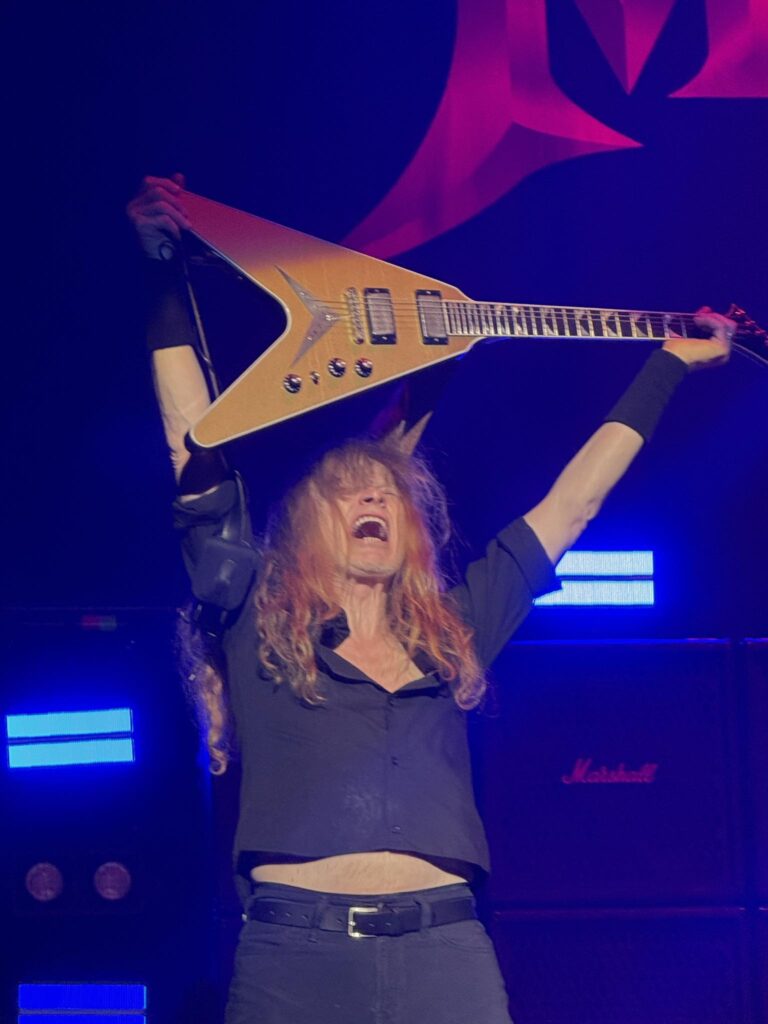
Megadeth’s set in Winnipeg played like a statement, not a routine. The pacing was ruthless: little wasted time, no dead air, just one song snapping into the next with the confidence of a band that knows exactly how to control a big arena. It’s easy to forget how physically “tight” this kind of music has to be until you’re watching it happen at full volume — guitar parts locking to drum accents, quick changes landing clean, and the whole thing still feeling dangerous rather than rehearsed. That balance — precision with teeth — is where Megadeth live has always lived, and Winnipeg got it in high definition.
The show opened with “Tipping Point,” and it set the tone immediately: modern edge, sharp dynamics, and that sense that the band is in attack mode from the first second. From there, the setlist leaned hard into fan-favorite momentum — “Angry Again,” “Hangar 18,” and “She-Wolf” arriving early enough to make it feel like the concert was sprinting. Even if you knew the songs were coming, the way they were deployed mattered: Winnipeg wasn’t being warmed up; it was being thrown into the deep end, and the crowd responded like it had been waiting years for exactly that kind of opening stretch.
What made this night stand out was how the setlist told a story across eras without feeling like a museum tour. “Wake Up Dead” and “In My Darkest Hour” brought that darker, heavier emotional weight — the songs that don’t just thrash, but brood, punish, and then explode. You could feel the temperature shift in the room when those riffs hit: less party, more intensity, as if the arena collectively leaned forward. It’s one thing to hear those titles on a playlist; it’s another to hear them in an arena where thousands of people know exactly where the tension breaks and scream at the same moment.
Then, right in the middle of that intensity, the night pivoted toward the song that feels like Megadeth’s most theatrical piece of paranoia: “Sweating Bullets.” Winnipeg’s placement for it was perfect — not too early, not too late, right where the set was already rolling and the crowd was fully “in.” That matters because “Sweating Bullets” isn’t just fast; it’s character-driven. It lives on voice changes, timing, and a kind of manic storytelling that can either land huge or feel like a novelty if it’s not delivered with conviction. In Winnipeg, it landed huge — a performance built for fan cameras, because you could hear the arena reacting to every turn of the song’s personality.
The magic of “Sweating Bullets” live is that it’s half thrash song, half psychological short film. It demands a frontman who can sell the “conversation” inside the lyrics without turning it into comedy, and it demands a band that can keep the groove heavy while the vocal performance shifts mood. Winnipeg got that full push-and-pull: the tight chug underneath, the sudden accents, the sense that the whole band is playing the soundtrack to a mind spiraling in real time. And because the crowd knows the song’s twists so well, the room becomes part of the performance — people reacting not only to riffs, but to the moments they recognize as the song’s signature “tells.”
What also elevated the Winnipeg version was the context around it. This wasn’t “Sweating Bullets” as an isolated hit; it was “Sweating Bullets” inside a set that had already thrown punches with “Hangar 18” and dragged the arena through the darkness of “In My Darkest Hour.” So when that nervous, twitchy groove arrived, it didn’t feel like a tonal detour. It felt like the next chapter — the point where the intensity turns inward. In a room full of metal fans, that’s a powerful trick: turning a massive arena show into something that feels weirdly intimate, like everyone is locked into the same story at the same time.
After that, the set kept escalating. “I Don’t Care” and “Tornado of Souls” hit with the kind of late-set adrenaline that makes an arena feel smaller than it is, and “Trust” brought that huge, singable release that only works when a crowd is fully committed. Even the sequencing of “Skin o’ My Teeth” and “Let There Be Shred” helped the show breathe in the right places — a reminder that a great metal set isn’t just “the fastest songs,” but the right emotional climbs and drops. Winnipeg got a set that moved like a machine but felt like a fight.
Fan-shot videos matter for nights like Winnipeg because they capture the thing that polished footage rarely does: the arena’s atmosphere as an instrument. You hear the room roar into riffs, the way cheers swell at specific transitions, the way the sound bounces when the whole crowd reacts at once. That’s especially true for “Sweating Bullets,” where the personality of the performance is half the point. The Winnipeg show’s reputation spread the way great metal moments always do now — through clips, comments, and people replaying the same sections because the energy is unmistakable even through a phone mic.
What’s wild about comparing a 2026 arena performance to the official version is how the song’s “crazed” feel changes with scale. On record, “Sweating Bullets” is claustrophobic — a voice inside your head, the rhythm like a pulse you can’t calm down. Live in an arena, it becomes communal: thousands of people collectively leaning into the madness and shouting along to lines that were originally written like private panic. The Winnipeg performance benefited from that contrast. Instead of losing the song’s tension, the bigger room amplified it, because the crowd didn’t treat it like a novelty. They treated it like a classic — a piece of Megadeth identity.
The old-school live versions show why this song has survived for decades: it’s built to be acted as much as it’s played. Early-era performances have that rawness — less “arena production,” more grit — where the manic timing feels like it could slip off the rails at any moment. That’s the DNA Winnipeg was tapping into, even with modern tightness. The best modern performances don’t sterilize the song; they keep the edges alive, letting it feel slightly unhinged while the band stays locked. That combination is exactly why “Sweating Bullets” still pops in a set full of technically heavier songs.
The 2010-era footage highlights another part of the song’s appeal: it’s a crowd-connector in a way that doesn’t depend on being the fastest track of the night. People don’t love it just for riffs; they love it because it gives them moments — those switch-ups, the recognizable vocal cadences, the lines that cue an instant audience response. Winnipeg had that same “moment” quality. You could feel the room light up when the song hit its familiar turns, like the crowd wasn’t just watching, but participating in the storytelling. That’s the kind of live chemistry that turns a solid performance into the clip everybody passes around.
By the time you get to full-show festival-era footage, you see how “Sweating Bullets” fits into the larger Megadeth live identity: it breaks up pure speed with theatrical menace, and it gives the set a dramatic center of gravity. Winnipeg used it the same way. Surrounded by songs like “Mechanix,” “Peace Sells,” and “Holy Wars… The Punishment Due,” it acted as a psychological pressure point — the moment the aggression becomes internal and weird. And when the set eventually hit those closing classics, it felt earned, like the crowd had been dragged through every shade of Megadeth: speed, darkness, paranoia, swagger, and that final victorious surge.
A key detail that made Winnipeg feel special was how complete the night’s arc was. This wasn’t just “play the hits and go.” The set moved from sharp new material into a run of legacy tracks that covered multiple eras, then stacked its finale with songs that feel like metal monuments. “Symphony of Destruction” doesn’t need an introduction anywhere on earth — it’s an arena ritual — and “Peace Sells” has that sneer that still cuts even when you’ve heard it a thousand times. Ending with “Holy Wars… The Punishment Due” is the kind of closer that leaves a crowd feeling like it survived something, not just attended it.
And that’s ultimately why “Sweating Bullets” in Winnipeg mattered inside this particular show: it wasn’t a random mid-set throwback. It was the song that gave the night personality. Plenty of bands can play fast and loud; fewer can turn an arena into a theater of paranoia without losing heaviness. Winnipeg got a version that felt alive — not just accurate — and that’s the difference fans remember. You leave humming riffs, sure, but you also leave remembering the vibe of a moment: the room reacting, the band driving it, and a classic song suddenly feeling present tense again.
Even weeks later, that kind of performance tends to grow in people’s minds, because it represents what live metal is supposed to be in 2026: not nostalgia, but continuity. Old songs don’t survive because they’re old; they survive because they still do something to people. In Winnipeg, “Sweating Bullets” didn’t feel like a relic from 1992 — it felt like a living piece of the band’s identity, delivered in an arena that was ready to shout every twist of it back at them. That’s how you know a performance hit: it stops being “a track in the set” and becomes one of the night’s defining scenes.