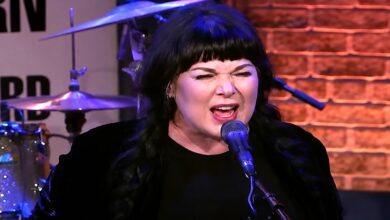
Rush Returned in Los Angeles as Anika Nilles Delivered a Defining First Full Show Behind the Kit
On June 7, 2026, Rush returned to the stage at The Kia Forum in Los Angeles for the opening night of their Fifty Something Tour, and the night immediately became one of the most closely watched rock events of the year. For longtime fans, this was not simply another tour opener. It was the band’s first full concert run in more than a decade, the beginning of a new chapter, and the first complete show with Anika Nilles behind the drum kit.
The fan-filmed full-show footage, captured with complete audio and a constant focus on Nilles, quickly became essential viewing for Rush fans around the world. Instead of short clips or scattered highlights, the video gave viewers a full look at how she handled an entire evening of some of rock’s most technically demanding material. Every fill, transition, accent, and groove was placed under the microscope, and that made the performance even more impressive.
Stepping into a role once defined by Neil Peart is one of the most difficult assignments any drummer could face. Peart was not just Rush’s drummer; he was a core part of the band’s identity, a lyricist, an architect of sound, and one of the most respected musicians in rock history. That history made Nilles’ first full show with Rush feel like a moment loaded with pressure before she even played a note.
Yet from the opening stretch of the concert, Nilles approached the material with calm control and clear respect. She did not perform as though she were trying to erase Peart’s presence or imitate him without feeling. Instead, she honored the structure of the songs while allowing her own personality to move through the performance. That balance became one of the strongest parts of the night.
The show opened with the kind of confidence Rush needed for such a symbolic return. As Geddy Lee and Alex Lifeson settled back into the sound of the band’s catalog, Nilles provided the foundation underneath them with precision and strength. Her playing gave the songs forward motion without making the performance feel rushed or nervous, which was crucial during a night filled with expectation.
A song like “Xanadu” demanded atmosphere, patience, and dynamic control, and Nilles handled that challenge with discipline. Rush’s music often shifts between delicacy and force within seconds, and the full-show footage showed how carefully she followed those movements. She understood when to push, when to leave space, and when to let the song breathe.
“Limelight” gave the audience one of the night’s early emotional peaks. The song has always carried a strange mix of brightness and distance, and in this new setting it felt even more reflective. Nilles supported the groove with clarity, giving Lee and Lifeson room to bring the familiar melody back to life while still keeping the performance grounded.
The pressure intensified with songs like “Subdivisions” and “Freewill,” where Rush’s arrangements leave little room for hesitation. These are not songs that can be carried by simple nostalgia. They require timing, control, and a deep understanding of the band’s musical language. Nilles moved through them with focus, showing that she was not merely surviving the material but actively shaping it.
Throughout the first set, the Kia Forum crowd responded with growing confidence. At first, many fans were likely watching closely, wondering how the new lineup would feel after so many years away from the road. But as the show progressed, applause for Nilles became louder and more spontaneous, especially after the more demanding drum passages.
The emotional weight of Neil Peart’s absence was impossible to ignore. Video tributes throughout the night reminded the audience that this was not a simple reunion built on nostalgia alone. It was also a remembrance, a public act of gratitude, and a careful attempt to move forward without pretending the past could be replaced.
That is why the fan-shot Anika cam became so powerful. It allowed viewers to see the concentration on her face, the discipline in her hands, and the way she carried the music with visible respect. Instead of turning the night into a debate about replacement, the footage showed a musician doing the hardest possible job with seriousness and heart.
The second set raised the stakes even higher. When Rush moved into the “2112” material, the show entered sacred territory for many fans. Those songs are deeply connected to the band’s mythology, and their return on opening night gave the concert a grand, almost ceremonial quality. Nilles played with the kind of precision needed to keep the drama intact.
“YYZ” was another major test. As one of Rush’s most famous instrumentals, it places every musician under direct pressure, but the drums are especially exposed. Nilles attacked the piece with sharp timing and controlled force, giving the audience one of the clearest examples of her technical command. It was one of the moments that seemed to silence lingering doubts in real time.
Then came “Tom Sawyer,” the song that many fans were waiting for. Its drum parts are legendary, and every Rush listener knows the key fills by heart. When Nilles delivered those moments with power and accuracy, the crowd reaction was immediate. The cheers were not polite or cautious; they were loud, relieved, and genuinely excited.
That reaction became one of the defining images of opening night. Thousands of fans inside The Kia Forum were not just applauding a drummer for getting through a difficult song. They were recognizing that Rush’s music still had life onstage, and that Nilles had found a way to honor Peart’s legacy without being crushed by it.
By the time the encore arrived, the night had become more than a comeback show. “By-Tor & The Snow Dog” and “Working Man” brought the performance back toward the band’s earliest roots, reminding fans how far Rush had traveled across five decades. The choice felt meaningful, almost like the band was closing the night by reconnecting the beginning with the present.
The complete Anika-focused footage matters because it documents a turning point. It shows a legendary band trying to move forward with care, a new drummer accepting an enormous responsibility, and an audience slowly shifting from uncertainty to acceptance. That arc is what gave the performance its emotional force.
Rush’s first full show with Anika Nilles in Los Angeles will likely be remembered as one of the most important nights of the Fifty Something Tour. It was not perfect because it needed to be flawless; it was powerful because it was human. The music carried history, grief, pressure, and renewal all at once, and Nilles met the moment with skill, respect, and unmistakable strength.