What the Glastonbury Drum Camera Reveals in Miley Cyrus’s ‘Black Dog’
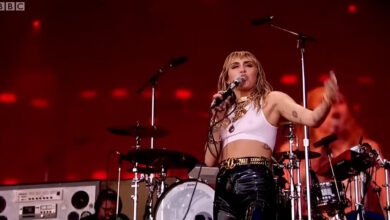
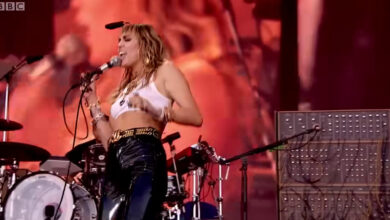
A camera behind the drum kit puts a different person in the foreground of Miley Cyrus’s “Black Dog.” You can still hear Cyrus, but the visual puts hands, drums and the open festival field where the singer would usually be. It is an especially good angle for a Zeppelin cover because the kit has to make a great deal of rhythmic sense while the other players are coming and going.
One viewer imagined what it would feel like for a drummer to play this number to a big outdoor audience. It makes sense in the clip. There are few places for the band to lose its position when the music stops and the words arrive. The distinctive riff sounds immediate when it comes back because the drums give it exactly the place it expects to land.
The camera is also a quick way to understand what the other players are waiting for. When Cyrus has an empty bit of space to sing in, the band hasn’t stopped making decisions. It still needs shared time to pick up around her. You can look at the stick or the cymbal just as the sound gets wider and have a physical clue to how that happens.
A drummer has a lot of ways to make that return feel bigger. Sometimes it is a hard sound on the beat. Sometimes it is the ease of coming back with no extra fuss at all. The Glastonbury arrangement makes the difference audible by giving the vocal gap enough room. You hear the next instrumental run as a clear answer instead of constant noise behind a singer.
From closer to the front you get the focus of the vocal. From behind the kit you get more of the work that helps it move. Those two views give the same part of the song different subjects. The recording is still Cyrus’s cover, and it is easier to hear how capable her stage band is when the camera lets one of its members hold the foreground.
“Black Dog” still sounds good if you put the phone down, of course. The reason to look at this particular part of the Glastonbury film is to get a feel for the scale of the job. The band is making one precise stop and restart after another while there is an entire field in front of them. The view over the cymbals lets you see the size of that space without losing your place in the rhythm.
Watch the performance
Two more versions
The Vegas iHeartRadio cut also gives the drum camera time, this time with an audience gathered in an arena. Follow the next riff from that view and notice how the surrounding room changes the impression of the same kind of stop and restart.
Led Zeppelin live gives you the source of that coordination, with Bonham and the guitar leaving Plant enough space to be heard on his own. After watching the Glastonbury drummer mark those returns, the way the original band shares time becomes even easier to pick out.