The Rough Edge That Made Miley Cyrus’s ‘Black Dog’ Sound at Home at Glastonbury
“Yeah this is her genre. Her pop music is good, but man. She is electrifying when she sings rock.” That was the reaction from one viewer under Miley Cyrus’s Glastonbury “Black Dog.” The clip gives you a practical way to hear what they meant. Start with the moments when the guitar stops and her voice briefly has the song to itself.
Miley puts some friction into the start of a word and leaves enough room for the end of it to carry. It is tempting to hear that as nothing but a louder sound. The guitar makes it possible to notice the finer change. The band waits for its answer and the last syllable is audible in the space before it returns.
Songs built around continuous guitar can let a singer disappear into a sound that is already filling all the gaps. “Black Dog” keeps asking the voice to be there by itself. Some of Cyrus’s most effective work at Glastonbury comes in those few exposed moments. A quick shift in pitch or a little grit can make a short phrase feel unusually direct.
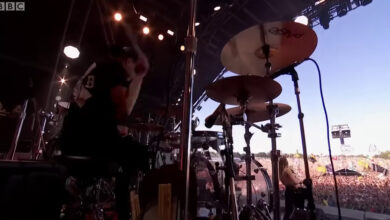
There is still a band to reckon with on the other side of the gap. Cyrus has to reenter without dragging the next answer behind her. She uses the physical reach of the line and then gives the guitarist a clean handoff. The exchange gives the recording much of its energy even before the camera cuts to an open view of the stage.
The original song has enough personality that a singer can arrive with her own sound and the room still knows what she’s playing. The sense of alternating pressure remains. A new voice makes it easier to hear the choice that Plant’s original delivery sometimes makes sound inevitable, especially where the instruments are quiet enough for the vowel to do nearly all the work.
You can hear the consistency of Cyrus’s voice by going back to one early passage after hearing the louder parts. Its roughness was already there when she needed less volume. The energy in the later passages comes partly from hearing more of a sound she had let you get to know. In that way the festival cover offers a reason to keep hearing the verses after the moment that gets shared is over.
Watch the performance
Two more versions
The iHeartRadio version lets the camera move in closer when Cyrus puts force into a phrase. The different venue changes the scale of the band around her, which makes it a good reference for deciding how much of the vocal shape belongs to the song and how much belongs to the singer.
Led Zeppelin’s live “Black Dog” is worth hearing for how little warning Plant needs to get a line in before the riff answers. The pattern is recognizable at Glastonbury, while the grain of Cyrus’s voice makes each of those pauses land differently.