Miley Cyrus’s Lowest Notes Set the Mood for ‘Nothing Else Matters’ With Metallica
Miley Cyrus is close to the microphone when she starts “Nothing Else Matters” with Metallica. She’s working in the lower part of her voice, with enough texture that you can hear individual notes settle before she moves on. The guitars leave enough space for that detail to matter. Even before the band reaches the louder passage most people recognize, the first lines tell you where this version is going.
One of the comments below the Stern performance singled out her lower register. That observation gets to a precise part of the recording. A lot of covers are remembered for a belt, a solo or a change in tempo. Here, the first thing worth returning to is the amount of presence Cyrus gets from notes that she sings close in. Quiet delivery on a low note exposes small movements in a voice that would disappear if the instruments were already at full volume.
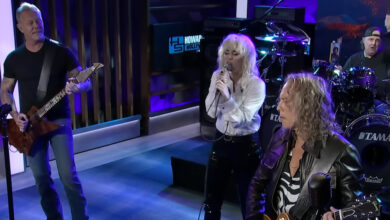
Metallica played the song with her in September 2021 at the SiriusXM studios in Los Angeles. The performance marked thirty years of The Black Album, where the ballad sits among some of the band’s most familiar electric guitar sounds. The opening figure of “Nothing Else Matters” has a recognizably open quality of its own. For a guest singer, it supplies a clear musical frame and leaves most of the blank space above it available.
Listen to the beginning of a line and then its last syllable. Cyrus places some openings gently and lets a little friction into the sound as she holds a vowel. On the release, the vocal can thin again. Those shifts are part of what people identify as rasp, but they also have a practical use. They give you a way to follow a sustained phrase even when no one is adding notes to it.
The band makes that kind of singing possible by letting the opening breathe. The recognizable guitar keeps you oriented in the song while her timing can feel personal. If one word is given a little more room, you still know where the next chord is going to land. Cyrus can spend part of the first verse tracing the melody closely, then hear exactly where the instruments are ready to open up around her.
When Hetfield joins the vocal, his pitch and tone give the ear a second place to settle. The part has additional weight by then, and the guitars have more presence than they did at the opening. The important thing is that the performance already has a character of its own. The lead vocal doesn’t have to reintroduce herself when the original singer comes in. The quiet material at the beginning has established whose path through the words we’re following.
Watch the performance
Singers can make an audience lean in simply by making the details smaller. When Cyrus moves through a quiet verse, the little split at the edge of a note becomes easy to hear. She can make a line feel direct without making every word equally strong. That makes the performance interesting on repeat plays. The pitch and the lyric stay in the same place, but you notice different points where she adds pressure or takes it away.
Hetfield’s original vocal is worth keeping somewhere in your ear while you watch. He usually supplies the weight that changes the feeling of the first verse, and his way of landing a phrase makes sense next to the guitar he is playing. Cyrus is working from the same melody in a room with the same guitarist. That puts her different placement in unusually clear relief. When she lets a syllable fray at the edges, you can hear the decision against an accompaniment with its own familiar sense of time.
The visual arrangement helps, too. Around the early verse the frame can stay close enough that you see her head lowered near the mic. That focused image makes the sound seem even more intimate. Later in the clip, a wider frame puts the moving guitars and drums around her. You hear a similar voice in both settings, and the jump in scale comes partly from seeing where the sound is coming from.
Her live treatment of Blondie’s “Heart of Glass” is worth comparing for exactly this reason. The tighter beat calls for a different attack. Cyrus’s grain is still clear, but many of the notes have to turn over more quickly. Listen to how short the distance can be between a stretched-out syllable at Stern and a much sharper vocal entrance against a steady beat at iHeart.
Compare the early bars of Metallica’s S&M2 performance, too. When the strings sustain over the guitar, the sound under each vocal entrance is different. It has an extra source of movement while the voice is still. In the Stern first verse, Cyrus supplies much of that motion herself by changing what happens inside a note. Those two approaches can give the same melody very different centers of gravity.
The live duet has plenty of big sounds later. Metallica can make the ballad fill the room, and hearing Hetfield and Cyrus at the same time gives longtime listeners a familiar tone to catch onto. But the loud section makes more sense if you watch the early one first. The band has gradually expanded the space that Cyrus begins to occupy almost as soon as she starts singing.
Go back to the beginning after the final chord and hear how much the vocal accomplishes before it raises its volume. The melody is intact, the guitar remains familiar, and a little wear in the sound of each low note changes the mood. That is the accomplishment easy to miss when a video is shared for the obvious headline of Miley singing with Metallica. Her lowest notes tell us how this particular version is going to feel long before the chorus makes it official.
Two more versions
With “Heart of Glass” at iHeart, Cyrus keeps the grain in her voice while using shorter attacks against a quicker pulse. That makes the space she gives her low notes in the Stern ballad easier to notice.
The S&M2 performance lets the strings carry motion beneath Hetfield through sustained notes. At Stern, with more empty space around the early guitar, Cyrus creates some of that motion within her own vocal line.