The Cold Fury Behind Prince’s Greatest Guitar Solo on While My Guitar Gently Weeps
The New York Times recently published a major magazine feature about a new documentary series on Prince that may never be released, even though Netflix commissioned and completed it. The director is Ezra Edelman, the filmmaker behind the extraordinary O.J. Simpson documentary, and one of the most gifted artists working in the form. But Prince’s estate has blocked the project because it presents an unfiltered portrait of its subject. Prince was a genius, but he was also a deeply troubled person who could behave in shocking and deeply troubling ways.
This is not an attempt to sum up Prince as a whole. It is a spotlight on one of the greatest moments in rock history: the solo he played during While My Guitar Gently Weeps at George Harrison’s posthumous induction into the Rock & Roll Hall of Fame in 2004. What this article reveals about the documentary offers a fresh way of understanding the volatile inner forces that seemed to drive Prince’s performance that night.
He was added to the lineup at the last minute. Olivia Harrison had imagined While My Guitar Gently Weeps being performed by musicians who knew and loved George, with Tom Petty leading the group and Dhani Harrison included as part of that circle. But Prince was also being inducted that evening, and the organizers, fully aware of the television magic it could create, convinced Olivia to allow him to join the performance.
The band had already arranged and rehearsed the song, so Petty suggested that Prince take the closing solo. Maybe the cameras were not positioned for it, or maybe the choice was meant to heighten the surprise, but Prince is barely seen for much of the performance. If you know where to look, you can spot him in the shadows on the right side of the stage around 1:21. He steps forward for the solo at roughly 3:20. You sense something is about to happen even before the camera catches him, because Dhani’s face gives it away.
Up to that point, the performance is solid but oddly restrained. Everyone sings and plays well enough, yet the song moves with a certain heaviness, almost too careful to truly ignite. It makes you realize how vital the kinetic interplay of Paul and Ringo was to the intensity of the Beatles’ original. This version feels respectful, even dutiful. Then Prince takes over and plays a solo that completely transforms the song from the inside out.
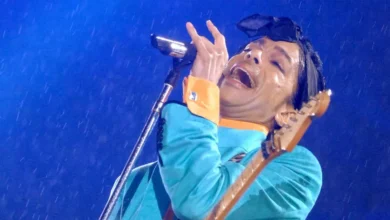
He enters with total authority, striking a high D on the neck of the guitar before following it with a mournful series of descending bends. The song is in A minor, so coming in on a D immediately suggests movement away from the expected center, as though the music is heading somewhere unfamiliar. Prince quickly drags the song into a new harmonic world, leaning into G major and blending sorrow with defiance. Just after the four-minute mark, he unleashes an astonishing baroque-like run, then follows it with a five-note phrase that sounds so perfectly shaped it feels composed rather than improvised. He even includes a deliberate nod to Eric Clapton’s original solo, a subtle signal that he knew the song’s history intimately. That detail comes from guitarist Michael Palmisano.
By then, the performance belongs entirely to Prince. The audience is no longer just listening to the notes; they are watching the physical spell he casts while playing them. Then comes one of the most incredible visual moments of the whole thing: he falls backward off the stage and returns in one fluid motion, as if gravity itself had briefly agreed to cooperate. It must have taken planning, immense nerve, and exceptional control. He clearly had to prepare the bodyguard for it. You can see Prince make eye contact just before he turns, then he disappears for a couple of seconds before rising again, still playing.
What makes the move so astonishing is not just the danger but the precision. He falls while still carrying a musical line, one that peaks on a bending note and resolves back toward the home chord just as he is pushed back onto the stage. It is a theatrical gesture, yes, but it is also musically integrated. It is not decoration placed on top of the solo. It is part of the solo.
Think of how many ways that moment could have failed. He could have hurt himself, certainly, but the greater risk was artistic. It could have looked labored, awkward, or self-conscious. Instead, he pulls it off so cleanly that it feels almost supernatural. It becomes a moment of pure grace, closer to a kind of baptism than to any ordinary act of stagecraft.
After that, he pauses and flashes a grin at Petty, as if to say, “You like that? I’ve got more”. Those glances and smiles do not really read as friendly gestures of simple camaraderie. They feel more like expressions of command, the magician letting everyone know that he is fully in control of the illusion and the power behind it.
Then he launches into another passage, climbing toward a piercing, almost crying D before reaching what may be the emotional and technical summit of the entire solo: a sequence of rising octaves up the neck of the guitar, ending in syncopated, modernist triplets. Somehow, after stretching the song so far into his own imagination, he lands on a note that folds perfectly back into the band. He does all of this while grinning at Petty, as if to say: Am I gonna bring this home? Trust me.
Prince closes the whole thing with one final immaculate phrase, tosses the guitar behind him, and walks off. That last act, the decision to leave the stage without even looking back, is dazzling theatre. But it also unlocks something essential about the emotion underneath the performance. What comes through is not just showmanship, but cold fury—channeled, stylized, and turned into something unforgettable.