Heart Brings “These Dreams” to Life With a Haunting Las Vegas Performance (Nov 14, 2025)
On November 14, 2025, as the house lights softened inside the BleauLive Theater at Fontainebleau Las Vegas, the night had already begun to feel like more than just another stop on a classic rock tour. Heart were back on the road, the Royal Flush Tour banner glowing across screens, and fans had traveled from all over the country to see Ann and Nancy Wilson reclaim a stage many thought they might never share again. The show had already moved through the opening blast of Bebe Le Strange, the steady burn of Never, and the warm, rolling groove of Love Alive, but there was a low hum of expectation in the room for one particular moment still to come.
By the time Little Queen wrapped, the crowd had fully settled into that sweet spot between nostalgia and wonder. People in their fifties and sixties, who had worn out cassette copies decades earlier, stood shoulder to shoulder with younger listeners who had discovered the band through playlists and live clips. When the stage lights shifted to a cooler, twilight palette and the first hints of a familiar keyboard pad and gentle guitar shimmer floated out, there was an almost instinctive recognition. The murmurs died down, phones rose a little higher, and an invisible wave of anticipation swept across the balcony and the main floor.
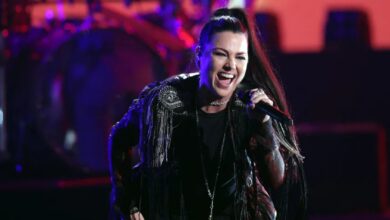
These Dreams has always carried a special place in Heart’s catalog—a song that walks the line between radio hit and private confession—and on this night in Las Vegas, it felt even more like a doorway into another world. Nancy moved toward the front with her guitar, Ann found her place at the mic, and the band eased into the intro with the kind of unhurried confidence that only comes from decades of playing together. The BleauLive’s three-level design, with its clean sightlines and polished acoustics, turned that opening into something almost cinematic, a slow zoom into the heart of the evening.
From the first verse, there was a different tone to the performance than the glossy studio version so many fans knew. Nancy’s vocal lead had a slightly roughened edge, the kind that speaks of years and miles rather than studio polish, and that texture suited the song perfectly. Each line about drifting away in dreams landed with a kind of weary tenderness, as though she were revisiting an old diary entry and finding new meaning in it. Behind her, Ann’s harmonies brushed in like a second narrator, framing the story from just over her shoulder.
The arrangement itself felt deliberately stripped back compared with the original recording. The synth textures were there, but softened, more like a mist than a wall. Nancy’s guitar, bright but never sharp, threaded through the melody with small, lyrical phrases instead of flashy fills. The drums held a relaxed pulse that seemed to float rather than drive, giving the song room to breathe. It was These Dreams reshaped for a room that could hear every breath, rather than for a radio mix fighting for attention in the 1980s.
What made the performance so striking, though, wasn’t just the sound—it was the sense of life lived between the lines. When Nancy reached the chorus, there was a moment where her voice caught just enough to be noticeable, not as a mistake but as a flash of human vulnerability. You could feel hundreds of people quietly registering it, connecting the song’s images of escape and longing to everything the Wilson sisters had been through: the long road, the breaks, the reinventions, and most recently, Ann’s very public battle with cancer and return to the stage. The lyrics about wandering through dreams no longer felt like youthful fantasy; they felt like survival language.
Ann, standing a step behind and to the side, added shading in a way that only a sibling can. Her harmonies did more than echo the main melody; they slipped beneath certain words, rising on others, almost like an emotional undercurrent. At times she closed her eyes and let the phrases hang in the air a fraction longer than expected, and that tiny stretch of time created an ache that the audience clearly felt. Even when she wasn’t singing, the knowledge of her recent recovery added weight to every note that passed through the PA.
The BleauLive Theater itself seemed designed for a moment like this. With a capacity big enough to feel like an event but small enough to keep everyone close, the venue turned These Dreams into a communal experience rather than a distant spectacle. Up in the higher levels, people leaned over the railings; on the floor, some swayed gently, some stood frozen, just watching. For a song that lives in the space between reality and imagination, the room became something like a shared dream—3,000-plus people quietly drifting through the same memory at once.
As the middle section arrived, Nancy’s guitar tone became almost lullaby-like, singing between the vocal phrases with patient, unhurried lines. The band kept everything restrained—no extra drums, no big dynamic stunt—trusting the song to carry itself. This restraint was its own kind of power. In a city that thrives on overstimulation, Heart were making a different statement: that a simple melody, sung with honesty and age in its voice, can cut deeper than all the lasers and pyrotechnics on the Strip.
Somewhere around the final chorus, you could feel the audience crossing an invisible threshold. It was no longer just admiration for a beloved song or respect for legendary performers. It had become something more fragile and intimate, an acknowledgment of time passing—for the band and for everyone listening. People weren’t simply remembering where they were when they first heard These Dreams; they were thinking about everything that had happened since, and about the unlikely gift of standing there on a cool November night, hearing it sung again by the women who first brought it into the world.
When the last line faded and the band let the final chords ring out, the silence that followed carried its own kind of volume. For a few seconds, nobody seemed willing to break it. The crowd didn’t leap immediately into applause. Instead, there was this soft collective exhale, as if everyone needed one breath to come all the way back from wherever the song had taken them. Only then did the cheers crash in, not as a quick burst but as a long, rising wave of appreciation.
Ann and Nancy exchanged a look that felt like a conversation in itself—part gratitude, part relief, part quiet triumph. They had taken a song long associated with chart success and nostalgic radio plays and turned it into something rawer, more present. The applause went on long enough that Ann finally stepped to the mic, offered a brief thank-you, and gestured toward her sister, making it clear that this was Nancy’s moment to carry. The crowd responded with another swell of noise, honoring the partnership at the center of everything they had just witnessed.
From there, the show would ramp back up, shifting into the driving force of Crazy on You, the tenderness of Dog & Butterfly, and eventually the Zeppelin tributes, the guitar showcase of 4 Edward, and the climactic hits later in the set. But for many people in the room, These Dreams remained the evening’s emotional pivot point. It was the place where the concert stopped feeling like a greatest-hits victory lap and instead became a story about endurance, memory, and what it means to keep bringing these songs to life year after year.
In the wider arc of the Royal Flush Tour, the Las Vegas performance at Fontainebleau marked more than just another date on a long list. It was part of Ann Wilson’s first full run of shows after putting cancer treatment behind her and stepping back into the spotlight with new vulnerability and strength. That knowledge hovered gently around These Dreams, coloring every phrase and changing the way people heard lines they might have taken for granted before. The song became, in its own quiet way, a testament to continuing—through fear, through uncertainty, through age.
As fans spilled out onto the casino floor afterward, that performance kept resurfacing in conversations. People compared this version to the one they saw in the eighties or nineties, talked about how Nancy’s voice had deepened, how Ann’s harmonies carried a different kind of gravity now. Some mentioned the way the room had gone still during the chorus, others admitted they had to wipe away tears in the dark. For a four-minute ballad in the middle of a rock set, These Dreams had done something rare: it had stopped the night in its tracks.
Looking back on that November evening, it’s easy to point to the big crescendos—the roaring encore of Barracuda, the Zeppelin covers that shook the walls, the thunder of applause as the band left the stage. But the true heart of the show, the place where past and present met most clearly, lived in that gently glowing pocket of time when These Dreams floated through BleauLive Theater. It was there, in the hush between notes, that fans could feel not just who Heart had been, but who they still are.
And for Ann and Nancy Wilson, standing side by side under the Las Vegas lights, the song seemed to serve as a mirror. It reflected the years behind them, the challenges they had navigated, and the bond that survived all of it. On November 14, 2025, These Dreams wasn’t just a hit revisited. It was a living, breathing chapter in an ongoing story—a moment that proved their music still has the power to slip past time, sink into people’s hearts, and stay there long after the last chord fades.
Sources (for date, venue, and setlist verification, not the creative narrative): setlist records for Heart at BleauLive Theater on November 14, 2025, and Royal Flush Tour coverage.