Megadeth “Tipping Point” Live in Saskatoon, February 24, 2026
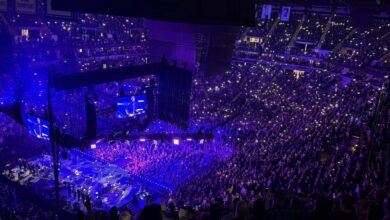
The SaskTel Centre in Saskatoon had the kind of pre-show electricity that only a full-on thrash-metal triple bill can generate: everyone knows they’re about to be tested, and everyone came ready to pass. On February 24, 2026, the building’s timeline was stacked and tight—doors, then Exodus, then Anthrax, and finally Megadeth taking over the night slot—so the vibe in the concourse wasn’t casual at all. It felt like people were timing their last beers and merch runs the way you’d time a pit entry: you don’t want to miss the first riff that matters. By the time the house lights dipped for Megadeth, the room was primed for something immediate, not a slow build—one of those nights where the opener has to hit like a warning shot, or the crowd will riot in spirit if not in action.
That’s why “Tipping Point” as the lead-off choice in Saskatoon is such a statement. It’s a newer song, but it arrives with the posture of a classic: sharp angles, a forward-leaning tempo, and that familiar Megadeth habit of sounding like it’s accelerating even when it’s already moving fast. The title itself reads like an announcement—this is the moment where things shift from anticipation into impact—and the band treats it that way. What makes the Saskatoon performance feel different isn’t just that it’s “tight.” It’s that it’s purposeful. The guitars aren’t simply loud; they’re arranged like blades, each part cutting its own lane. Even if you’ve heard the track before, the live version changes the stakes because the crowd becomes a second percussion section, reacting to every turn as if the song is a set of cues they’ve been waiting to shout back at for months.
Context matters here, too. This wasn’t a random one-off where a band experiments with a new song and shrugs if it lands. Saskatoon sat inside a clearly mapped Canadian run, with the date and venue baked into the official touring schedule, meaning the set had to function as both spectacle and system: repeatable, powerful, and built to survive night after night. That’s part of what makes the performance interesting—Megadeth are at a point where they can treat a new track like an established weapon, not a fragile debut. The band’s whole approach on this tour has felt like a “no wasted motion” philosophy: hit hard, leave a mark, move on to the next city. Saskatoon is a perfect snapshot of that machine working at full pressure.
And yet, “Tipping Point” isn’t just speed for speed’s sake. The song’s personality is built around tension—tight rhythmic locking, then releases where the riffs open up and the drums push air through the room like a blast door swinging wide. That tension-release effect is exactly what live audio amplifies. In a venue, you don’t just hear the chugs; you feel the space between them. You can sense the crowd’s collective timing, the way people learn the accents in real time—heads snapping on the same beat, arms rising for the same break. A studio recording can sound pristine, but it can’t replicate the way a live audience “frames” the music, turning small rhythmic details into big moments because thousands of bodies decide they matter at the same second.
The Saskatoon setlist placement also tells you how seriously the band sees the track. “Tipping Point” wasn’t tucked into the middle as a curiosity; it opened the show, right before older staples that carry instant recognition. That sequencing makes the new song the gateway into everything else—as if the band is saying, “This is the modern front door to the catalog.” According to the documented setlist for that night, Megadeth hit the stage around 9:10 PM and launched straight into “Tipping Point,” then followed with “Angry Again,” “Hangar 18,” and more—an ordering that effectively dares the new material to stand shoulder-to-shoulder with the classics. In Saskatoon, it does, because the performance treats it like it belongs there.
There’s another layer that gives this song extra weight in 2026: it arrived as part of the band’s late-era push that many outlets framed as a fierce, no-soft-edges chapter, not a victory lap. Reviews of Megadeth’s most recent era have highlighted how “Tipping Point” carries that classic bite—riff-first aggression, a snarl that doesn’t apologize, and a structure that keeps pivoting just when you think you’ve caught it. That’s the DNA that plays especially well live, because it invites reaction. You can hear it in the way crowds respond to Mustaine-led material: not just cheering the chorus, but roaring at the turns, the stops, the sudden changes where the band flips the room’s momentum like a switch. That push-pull energy is what makes the Saskatoon take feel alive rather than merely accurate.
The fan-shot footage from Saskatoon matters because it captures a truth that polished broadcast audio often sands down: the rough edges are part of the charm. You hear how loud the room is, how the mix shifts depending on where the camera holder stands, how the guitars feel like they’re coming from multiple directions at once. Those “imperfect” elements create a documentary vibe—proof that this wasn’t manufactured for an upload; it was a real moment in a real building. In that kind of clip, you can also sense the crowd’s mood in micro-details: the split-second surge when the opening riff lands, the way people lean in when a lead line climbs, the roar that swells not only at familiar parts but at sections that simply sound vicious.
If you zoom out, Saskatoon also sits inside a tour narrative that’s almost tailor-made for thrash fans: a veteran headliner running a tight ship, backed by openers who are legends in their own right. That lineup changes how the headliner performs, because the baseline intensity is already high before Megadeth even hits the stage. When Exodus and Anthrax are on the bill, there’s no room for “warming up.” By the time the main set starts, the crowd has already been sprinting emotionally. So Megadeth choosing “Tipping Point” to kick things off is like throwing gasoline on a fire that’s already blazing—risky if the song can’t command attention, brilliant if it can. The Saskatoon performance lands on the brilliant side because it sounds like a band that understands exactly what kind of night they’re in.
In the Saskatoon clip, the standout quality is momentum. The band doesn’t play the opening like they’re introducing a new track; they play it like they’re reclaiming the room. The riffs feel clenched, almost percussive, and the drums keep the whole thing riding on a forward push that never relaxes. What makes this version feel different from a lot of live debuts or early-tour run-throughs is how confident the transitions sound—those moments where a lesser band would “travel” from part to part, but Megadeth instead snaps into the next section as if the song is already welded into the set. It also helps that the crowd noise isn’t polite; it’s present, loud, and constantly bleeding into the audio, which gives the performance a sense of scale. You’re not watching a band in a vacuum. You’re watching a band driving a room.
The official music video/studio presentation reveals why the live performance hits so hard: the song was built for motion. The recorded version is precise—every guitar layer placed where it needs to be, every rhythmic accent sharpened like a chisel—and that precision becomes the blueprint the band can exaggerate onstage. You can hear how the live version in Saskatoon leans into the track’s harder edges: the hits feel heavier, the pauses feel more dramatic, and the “attack” of the guitars feels less compressed and more physical. It’s also worth noting that the track and its visual rollout were positioned as a major moment in the band’s late-era story, with heavy rock media highlighting the release and framing it as a significant chapter in the band’s ongoing legacy. That framing adds weight when the song opens a live set—because the audience arrives already treating it as important.
When you jump back to the live debut era (like the Amsterdam clip), you can hear the difference between “new song energy” and “tour-hardened confidence.” Early performances often carry a slight edge of caution—tiny hesitations, the sense that everyone is focused on nailing the roadmap. That’s not a flaw; it’s part of watching a track grow up in public. Comparing that to Saskatoon is where the fun is: by February 2026, the song sounds less like a fresh addition and more like a trigger the band can pull whenever they want to instantly raise the room’s temperature. The riffing feels more settled into the band’s collective muscle memory, and that frees them up to emphasize attitude—making the stabs sharper, the grooves meaner, the whole thing more theatrical without ever turning sloppy.
Berlin (October 2025) is a great “middle snapshot” between debut and the Canada run. You can often hear the band starting to personalize the arrangement here—tightening certain moments, leaning into certain accents, subtly shaping the live identity of the track. By the time you reach Saskatoon, those choices feel finalized, like a song that’s earned its stage version. That evolution is exactly what makes the Saskatoon take feel special: it isn’t only good; it’s seasoned. It carries the confidence of repetition while still sounding hungry, which is a tricky balance for any veteran band. The best thrash performances always feel like they could fly off the rails at any second, even when you know the musicians are in complete control. Saskatoon has that illusion of danger—the sense that the band is pushing the tempo and the crowd is chasing it.
The Victoria performance (February 15, 2026) is another useful comparison because it shows how the song was already functioning as a tour engine early in the Canadian stretch. You can hear how the crowd response changes city to city—some audiences react like they already know the track, others react like they’re discovering it in real time—but the band’s intent stays consistent: play it like it’s essential. That consistency is part of what makes Saskatoon feel like a peak. By February 24, the show had a week-plus of tour momentum behind it, and you can sense that the band is fully warmed up, fully locked, and fully willing to come out swinging. It’s the difference between a strong performance and a performance that feels like it’s arriving at exactly the right point in the run.
Calgary (February 20, 2026) helps underline what Saskatoon adds: atmosphere. Technically, both performances can be excellent, but the Saskatoon clip has a particular kind of room noise—an audible “presence” that makes the performance feel bigger than the sum of the instruments. And because Saskatoon’s show night was structured with well-known support acts and a defined schedule, the crowd energy makes sense: they’d been building toward Megadeth’s set time all evening, and when “Tipping Point” opens the gates, it feels like the release of hours of anticipation.
What ultimately makes “Tipping Point” in Saskatoon feel important is what it says about Megadeth in 2026: they can still make a newer song feel like an era-defining opener. That’s not just about playing fast or being loud. It’s about clarity—knowing what kind of band you are, what kind of crowd you have, and what kind of moment you’re trying to create in the first sixty seconds of a headlining set. The Saskatoon performance has that clarity. It sounds like a band that trusts its present as much as its past, and that’s a rare flex for any legacy act, especially in a genre where fans are famously protective of the classics. If the “tipping point” idea is about the instant where momentum becomes irreversible, then this Saskatoon version captures it: the second the riff lands, the night is no longer waiting to happen. It’s happening.