Whole Lotta Love On The Voice Australia: Natalie Colavito’s Blind Audition And Adam Lambert’s Onstage Surprise
There’s a particular kind of risk that reality TV can’t manufacture, no matter how dramatic the lighting gets or how hard the music swells before a chair turns. It happens when a singer walks onto a stage designed for safe choices and sings something that is, by nature, unsafe. That’s the feeling that hit the room on The Voice Australia when Natalie Colavito chose Led Zeppelin’s “Whole Lotta Love” for her Blind Audition. In a format built around first impressions, she didn’t go looking for “pretty” or “polished.” She went for big, loud, classic-rock swagger, the kind of song that dares you to either own it completely or crash in public.
By the time Season 13 rolled around, the show’s identity was already clear: it loves moments, but it loves them most when they feel earned. The 2024 season was stacked with personalities who could spot that kind of courage instantly, with a coaching panel that mixed global star power and very different musical instincts: Adam Lambert, LeAnn Rimes, Guy Sebastian, and Kate Miller-Heidke, with Sonia Kruger hosting. The season began airing on August 19, 2024, and ran through October 27, 2024, which matters because the vibe of a new panel is always part chemistry experiment, part culture shock, and part talent hunt. This panel didn’t just “judge”; they reacted like fans. That detail becomes crucial once Natalie starts singing.
Blind Auditions can be oddly quiet places for something that’s supposed to feel like a concert. Contestants walk out, the band locks in, and for a few seconds you can practically hear the coaches deciding whether the voice in front of them matches the voice in their head. It’s not only about range or tone; it’s about intent. When Natalie picked Zeppelin, she wasn’t only choosing a song. She was choosing a posture. “Whole Lotta Love” doesn’t beg for approval. It commands attention. And because the show’s structure is built on turning around for what you hear—not what you see—Natalie’s job in those first bars was to make the room believe she could carry something that iconic without hiding behind it.
What makes rock auditions tricky on a mainstream singing show is that rock doesn’t want to behave. Pop rewards precision. Country rewards storytelling. Musical theater rewards clarity. But rock—especially classic rock—rewards nerve, timing, attitude, and that slightly dangerous feeling that you might set the whole place on fire if the band pushes you hard enough. Natalie’s approach, as reflected in widely circulated clips of the audition, leaned into that principle: she wasn’t treating the song like a museum piece. She was treating it like a live wire. And that shift in energy is usually the moment coaches stop leaning back in their chairs and start sitting forward, like they’re watching a surprise party unfold in real time.
Then came the kind of reaction TV producers dream about but can’t script cleanly: the panel looking genuinely jolted by what they’re hearing. In the clips shared online, Adam Lambert and LeAnn Rimes are shown reacting with visible excitement as Natalie drives the performance forward. This isn’t the polite “that was nice” energy that sometimes floats around early auditions. It reads like adrenaline. Lambert, in particular, has a public musical persona built on big theatrical rock vocals, so when a contestant commits to Zeppelin with confidence, you can almost see the gears turning. It becomes less “Should I turn?” and more “Do I need to be part of this?” The show’s best reactions always have that feeling: an artist recognizing another artist’s instinct.
A key detail that made this audition pop is how it fit the season’s wider mood. Season 13 had a formal structure—teams, blocks, battles, and all the strategy that comes with it—but it also had the vibe of a panel still discovering itself. New coaches often overcompensate by playing it cool. Here, the opposite energy showed through. The season introduced twists like the block and an “Ultimate Block,” which is basically the show admitting, out loud, that competition between coaches is part of the entertainment. That’s important because a high-voltage performance doesn’t just attract turns; it triggers tactics. A Zeppelin choice is like throwing a chair into the middle of a negotiation: everyone suddenly wants to win, and everyone wants to win loudly.
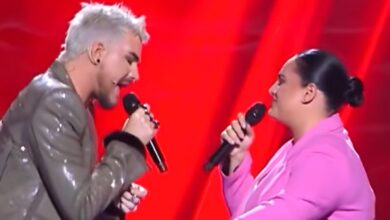
But even among competitive moments, this audition stands out because it reportedly tipped over from “coach reaction” into “coach participation.” In widely shared versions of the clip, Adam Lambert doesn’t just praise Natalie from the chair—he gets up and moves toward the stage, joining her for a spontaneous onstage moment that ramps the energy even higher. That’s the kind of thing fans replay because it’s a crossover between two worlds: the contestant’s once-in-a-lifetime shot and the coach’s performer instinct. The premise of The Voice is separation—the judges are turned away, the artist is alone in the spotlight—but a surprise onstage duet collapses that distance instantly. It turns the audition from a test into a shared event.
If you’ve watched enough singing competitions, you know that not every “spontaneous” moment is truly spontaneous. Sometimes the camera angles are a little too perfect, and the timing lands a little too neatly. What made this one feel different, at least as it’s circulated in official and fan-facing uploads, is that it plays like a genuine reflex: Lambert responding the way a frontman responds when the band hits a groove and the singer in front of him is matching the intensity instead of shrinking from it. The moment becomes bigger than “a coach helping a contestant.” It becomes a snapshot of how rock music works in the wild—call-and-response energy, shared rhythm, mutual escalation, and a crowd feeding the whole exchange.
That escalation is the real secret sauce of “Whole Lotta Love” as a TV audition. The song is built to grow teeth as it goes, and when a performer understands that, you can feel the room tighten in anticipation. The drums stop being background. The guitar becomes a dare. The vocal stops being melody and starts being a stance. Natalie’s performance, as the show’s circulating material presents it, taps into that architecture. And because The Voice stage is designed for big, clean vocals over a controlled band, a contestant who brings a looser, more concert-like energy can make the entire set feel like it just got re-wired.
It also helps that the Season 13 panel wasn’t shy about showing personality. Adam Lambert’s presence—big, theatrical, rock-fluent—naturally primes the audience for moments that feel closer to a live show than a polite TV audition. LeAnn Rimes brings a different kind of authority: a singer’s singer, the kind of artist who can hear control, pitch, and emotional commitment even under a heavy arrangement. Put those instincts in the same room, and when someone takes a risk that bridges genres—classic rock delivered with vocal strength—the reactions can look like disbelief turning into delight. That’s exactly the emotional arc that makes an audition replayable: the room being won over in real time.
After the Blind Auditions, the show’s machinery moves fast—teams fill up, strategy kicks in, and standout contestants either grow into the pressure or get squeezed by it. What’s telling about Natalie’s presence in the season is that she’s listed among Team LeAnn’s artists for Season 13, anchoring the idea that her audition didn’t just create a viral moment; it also placed her inside a real competitive path. Once you’re on a team, the story shifts from “Can you shock the room once?” to “Can you keep people listening when the novelty wears off?” That’s the real grind of the format, and it’s where a bold first impression either becomes the beginning of a narrative or a single bright flare.
The best part of these big audition moments is that they often reveal something about the coaches, too. The show sells coaching as mentorship, but viewers also love it as a window into how famous artists think. When a coach jumps into the action, it signals a particular philosophy: that music isn’t only critique and correction; it’s participation. It’s “Let’s do it together.” Whether the moment was fully improvised or simply felt improvised in how it unfolded, the effect is the same for the audience. It reframes the coach not as a distant authority but as an active musician who can be pulled into the gravity of a great performance.
And for the studio audience, that kind of shift is everything. People come to tapings expecting a TV show; they’re hoping for at least one “I can’t believe that just happened” moment they can brag about later. A coach leaving the chair and joining the stage scratches that itch perfectly, because it breaks the rules of the room. It turns the set into a live venue. Suddenly, the applause isn’t only for a contestant being brave; it’s for a whole environment becoming electric. Those are the moments where you can practically hear the story writing itself: the song choice, the shock, the coach’s reaction, the onstage surprise, the crowd swelling, the clip escaping into the internet.
What made Natalie’s audition special, beyond the headline-friendly details, is that it hit multiple audiences at once. For casual viewers, it’s thrilling because it’s loud and fearless and recognizable—Led Zeppelin as an instant cultural shortcut. For rock fans, it’s intriguing because it’s a rare time a mainstream TV format lets a hard-edged song stay hard-edged. For Lambert fans, it’s catnip because it aligns with his public identity as a performer who thrives when things get big and dramatic. And for the show, it’s valuable because it signals that this season can generate moments that live beyond the episode—moments that travel on their own as short-form clips and reaction videos.
Even the wider season coverage leaned into the idea that this panel brought heat. Articles and episode pages describing the 2024 run emphasized a “new coaches” era and the heightened energy that comes with it. That’s the atmosphere in which a Zeppelin audition doesn’t feel like a random stunt; it feels like a signal that the show is willing to let the volume go up. And when a contestant matches that signal with a performance that feels confident and full-bodied, it becomes a meeting point between the show’s brand and the music’s rawest instincts: risk, payoff, and a room turning from cautious to completely engaged. (Now To Love)
If you zoom out, this is what reality music competitions are really trying to capture: the moment a performer steps into a version of themselves that’s bigger than the nerves, bigger than the format, bigger than the stakes. It doesn’t matter if it’s a ballad or a rock classic—the magic is always the same. The singer stops “auditioning” and starts performing like they already belong there. Natalie’s “Whole Lotta Love” audition reads like one of those moments. It’s a gamble that pays off because the performance isn’t timid. It’s committed. And commitment is contagious: it pulls reactions out of coaches, it pulls noise out of the crowd, and it pulls the clip out of the episode and into the wider conversation.
And that’s why this moment keeps getting framed as more than a solid audition. It’s a little story arc compressed into a few minutes: a bold song choice, a performance that lands, coaches reacting like fans, and a surprise onstage interaction that makes the entire studio feel like it’s watching lightning strike in a controlled environment. In a season built on strategy—blocks, teams, competitive pitches—this is the kind of scene that reminds viewers why they watch in the first place. Sometimes the best TV isn’t the twist. It’s the spark.