Hello Heaven, Hello: The Night YUNGBLUD Turned Melbourne’s Sidney Myer Music Bowl Into a Shared Heartbeat (Live, 13 January 2026)
Sidney Myer Music Bowl always feels like more than just a venue, especially on a balmy Melbourne night in mid-January. When you arrive, there’s a wide sweep of lawn stretching before a stage that feels both intimate and enormous at the same time. The city’s breeze drifts through the trees, and by the time dusk settles into evening, you almost forget you’re about to witness something electric. For thousands gathered that night, the Bowl became a shared cosmic space where strangers turned into a single crowd breathing in time to the rhythm of expectation.
By the time YUNGBLUD took the stage, a hush spread across that sea of people, the kind of hush that feels like everyone collectively holding their breath. The opening chords of “Hello Heaven, Hello” didn’t just start a song — they cracked open the evening like a doorway into something raw, unfiltered, and monumental. You could feel the energy shift immediately, like the air itself was vibrating with possibility. The moment was less about anticipation and more about acceptance: this was going to be an unforgettable night.
The nine-plus minutes of “Hello Heaven, Hello” stretched and unfurled like a narrative, not just a track. In a musical world where most songs are edited for instant hooks and rapid consumption, this piece refused to be rushed. It asked the audience to lean in, to listen with intent, to be present without distraction. At times the band pulled back into quieter spaces, allowing the crowd to fill the silence with their own collective voice, and at other times they surged forward, instruments and vocals colliding in glorious, cathartic waves.
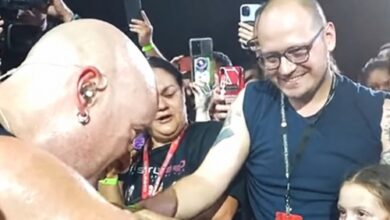
Down in the bowl, under the open sky, that opening number became something almost primordial — thousands of people standing shoulder to shoulder, synchronized not by choreography but by emotion. Some faces were lit with wonder, others with tears, and many simply glowed with pure exhilaration. The song didn’t just resonate; it rooted itself in the very soil of the venue, as though the Bowl and the crowd had become partners in a grand, improvised ritual. Every beat felt like a heartbeat shared among thousands.
Once the intro track finished, the momentum didn’t lose speed; it only grew sharper and more urgent. Songs that followed seemed to thrive on the energy that had been built in those first sweeping minutes, creating a chain reaction where the audience fed into the performance and the performance fed back into the crowd. There was a rhythm to it, an emotional cadence, where every lyric landed like a personal message, as though YUNGBLUD was speaking directly to each person individually, even in a sea of thousands.
In that kind of charged atmosphere, even familiar melodies felt brand new, refreshed by the intensity of live presence. The Bowl’s acoustics, wide and open, carried the sound outwards, and there was a point where it felt like the music wasn’t just audible — it was tangible, brushing across your skin like a current. Every chorus became a shared incantation, with voices rising and falling together like waves that refused to break.
As the set unfolded, there were moments where the crowd collectively let go — arms raised, bodies moving, hearts thumping. It wasn’t just concert behavior; it was a mass exhale of emotions sometimes too heavy to carry alone. People danced with abandon, jumped in unison, and belted out lines they knew by heart, forming an unspoken pact of belonging. That’s what made Sydney Myer Music Bowl feel less like a venue and more like a cathedral of shared experience.
Of course, not every moment was all sheer force and electricity — there were stretches where the performance got quieter, more introspective. These were pauses that felt intentional, reflective, even sacred. These were the points in the night when the crowd wasn’t just reacting, but truly listening, leaning into lyrics with widened eyes and softened hearts. There’s something almost surreal about a vast outdoor venue falling into silence, as if the earth itself is holding its breath to hear every word.
At one point, a song shifted into an unexpected cover that turned the energy inside out — slowing the pace and drawing everyone’s attention inward. A quiet hush replaced the chants and shouts, and people seemed to wrap themselves in the layered meanings of the moment. In that quiet, you could hear more than melody — you heard personal stories in the lips that mouthed lines, and glances exchanged between friends as if to say, “I get this.”
Even as the set barreled back into punchier, more aggressive tracks, that moment of tenderness lingered in the night air like a memory. The contrast only made the heavier songs feel even more electric, more urgent, more alive. By the time the band pushed back into harder-edged pieces, the crowd was a synchronized organism of motion and sound, breathing in shared relief and release.
Then came a moment that felt like a declaration — a song that was less about performance and more about identity. It wasn’t loud or wild; it was earnest and true, the kind of piece that feels like a compass needle settling into its rightful place. People sang it not as fans, but as participants in a collective moment of acknowledgment. The lyrics didn’t just fill the space — they resonated in the chest like truth.
When the night began to crest toward its final chapters, there was a palpable shift in the crowd’s energy. You could almost sense the collective heartbeat hurrying, almost as though the lawn itself was thrumming like a living thing. Everyone knew the end was approaching, but instead of disappointment, there was a rising crescendo of joy, relief, and fierce attachment to the now.
And then came the finale — an encore built not on spectacle but on emotional release. Instead of fireworks or dramatic costume changes, what filled the Bowl was pure voice, pure unity. The first few chords were met with an eruption of cheering that felt like the crowd exhaling all they had been holding in since the first note of the night. Lights up, arms waving, voices joining together as one: a communal exclamation point on everything that had happened.
In those final minutes, under the expansive Australian sky, it no longer mattered who was on stage and who wasn’t. Instead, there was a single, unified field of shared emotion — a luminous, vibrating mass of people who had come as individuals but were leaving as something collective. When the final notes faded, the applause wasn’t just a response — it was reverberation, echoing into the night, refusing to dissipate easily.
Walking out of the Bowl into the warm Melbourne night, you could still feel the afterglow of the experience in your bones. People lingered on the grass, in conversations, in quiet reflection. Some were laughing, some were quietly introspective, but all carried the same sense: they had been part of something larger than a concert. They had been part of a moment — a chapter in both the artist’s journey and their own.
That night wasn’t simply a performance; it was an emotional odyssey — a nine-minute opening statement that became a story, a mood, a shared heartbeat stitched into the fabric of Brandon’s music and the audience’s memory. When the music finally faded, it didn’t feel like an ending — it felt like a resonance that would continue to vibrate long after Melbourne’s lights dimmed and the crowd went home.