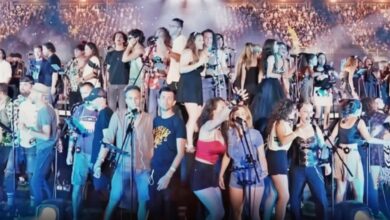
Megadeth’s “Hangar 18” Ignites Canada Life Place In London, Ontario On February 28, 2026
The night Megadeth rolled into London, Ontario on February 28, 2026, Canada Life Place didn’t feel like an arena so much as a sealed chamber waiting to be pressurized. The kind of crowd that shows up for a band like this isn’t there to “check off” a legacy act—they’re there to be reminded, physically, why thrash metal became a language in the first place. The building’s own event listing put the date and start time in black and white, but the energy in the room was all nervous color and motion, people shifting their weight like they could already hear the opening chord change in their bones.
What made this particular London stop feel immediately important is that it sat right inside the momentum of Megadeth’s 2026 Canadian run, the stretch where nights start blurring together for a touring band but fans treat each show like a once-in-a-lifetime appointment. On Megadeth’s official tour page, the London date is part of that sequence—one of those listings that looks simple until you remember it represents thousands of individual stories showing up in the same place. And once the house lights dropped, it became obvious: the crowd wasn’t just waiting for the hits. They were waiting for proof that the band still plays them like they mean something right now.
The set in London didn’t waste time trying to warm up gently. “Tipping Point” cracked the seal, and it did what openers are supposed to do: it turned chatter into attention and attention into unity. Then, with almost no patience for suspense, “Hangar 18” arrived early—second in the running order that night—like a statement rather than a treat. That placement matters, because “Hangar 18” isn’t the kind of song you tuck into the middle to keep the pacing safe. It’s a technical flex and a narrative sprint, the sort of track that announces the band’s standards for itself.
You can feel the difference when “Hangar 18” hits a crowd that actually knows what it is. This isn’t a chorus-driven singalong; it’s a shared obsession with movement, with timing, with the thrill of watching musicians step into a tight corridor at full speed and never touch the walls. The riff doesn’t just “start”—it snaps the room into alignment, and suddenly you’re hearing the audience react to tiny turns: a slight rhythmic push, a bend held a fraction longer, a drum accent that lands like a bootprint. In London, that reaction came fast, the kind of roar that doesn’t wait for permission because the crowd recognizes the first phrase like a password.
Part of what makes this version feel different is the way the performance breathes inside a modern Megadeth show. “Hangar 18” was born as a razor-clean studio beast, but in a live setting it becomes something more human: it’s still precise, yet it’s also full of micro-decisions that can only happen in the moment. Even when you’ve heard it a hundred times, the song keeps a dangerous edge because it’s structured like a climbing route—one slip, and everyone notices. In London, the band played it with that confident, slightly daring posture that says they’re not just reproducing history; they’re reentering it, night after night, and daring it to fight back.
The crowd’s mood in London also mattered because the rest of the setlist reinforced the idea that this wasn’t a one-song highlight—it was a tightly packed ride through eras. The reported set order around “Hangar 18” included cuts like “Angry Again,” “She-Wolf,” and “Wake Up Dead,” building a flow that keeps the room bouncing between grit, hooks, and pure speed. That context makes “Hangar 18” pop even harder: you don’t hear it as an isolated shred-festival; you hear it as a cornerstone in a set designed to keep tension high and attention locked.
And then there’s the mythology of “Hangar 18” itself—aliens, secrecy, cold corridors, the cinematic paranoia that made Rust In Peace feel like it belonged to a larger universe. Even if you don’t think about the lyrics much, the music carries that theme in its architecture: fast, contained, urgent, like something is trying to escape. In a room full of fans, that theme becomes communal. People don’t just watch; they lean forward. They track the turns. They anticipate the next section like a jump scare they actually want. London felt like that: a crowd tuned to the song’s internal map, reacting in real time to every landmark.
By the time “Hangar 18” ended, the room had that specific kind of afterglow—a mix of adrenaline and satisfaction that only comes from watching a difficult thing executed cleanly. It’s the feeling that turns a clip into a shareable moment and a show into a memory people insist was “one of the best nights” of their year. In London, it also set the tone for everything that followed, because once a band nails a song like that early, the rest of the set benefits from the trust it creates. The audience stops wondering if the night will deliver. They start enjoying the fact that it already has.
After you’ve heard that London performance, it’s worth mentally rewinding to what “Hangar 18” is at its core: a studio recording engineered to feel like a perfectly sharpened machine. The original version isn’t just “fast” or “technical”—it’s arranged so every section hands off energy to the next without any wasted motion, like a relay race where nobody slows down to celebrate. That’s why comparing live versions is so satisfying: you can measure how the band chooses to honor the blueprint while still letting the moment shape the details. The studio track is the reference point, the baseline temperature, and it makes the London clip feel even more alive because you can hear what’s fixed in the DNA and what’s happening only because it’s February 2026 in that room.
One of the easiest ways to understand why the London version stands out is to place it next to a big-festival performance, where the scale is larger and the band is feeding off an ocean of people. Wacken sets have a different physics: the sound carries differently, the crowd response arrives in massive waves, and the band often plays with a slightly broader body language because they’re commanding a field, not a single enclosed arena. Yet “Hangar 18” still demands tightness, even in that environment, which is why it’s such a useful comparison. You hear how the song keeps its bite no matter how huge the stage is, and you can also hear the subtle differences in pace and attack that come from playing it under different pressure.
A newer pro-shot style festival clip pushes the comparison even further, because modern high-definition live footage captures tiny details the older recordings miss: the exact pick attack, the way the drums sit against the guitars, the quick glances that signal a transition is coming. Performances like this can make “Hangar 18” feel less like a myth and more like a living discipline—something the band continuously maintains rather than something they achieved once in 1990 and then simply repeated. When you watch a sharp modern festival take, you also notice how fans react across generations: older listeners recognize the classic instantly, younger listeners react to the speed and intensity like they’ve just discovered what “real” thrash precision feels like.
Budokan footage brings a different flavor again: the legendary venue aura, the intense focus of the crowd, and the sense that the band is stepping into a hall where every note feels like it’s being judged by history. “Hangar 18” thrives in that atmosphere because it’s a song that rewards concentration. The tension isn’t only in the speed; it’s in the constant forward pull, the way it refuses to settle into comfort. Comparing Budokan to London highlights something fun: London’s arena energy can be rowdier, more openly explosive, while Budokan often feels like the audience is absorbing every detail with surgical attention. Both moods suit the song, but they shine different light on why it endures.
When you stitch these versions together in your head—the London fan-shot immediacy, the studio track’s cold perfection, the festival scale, the modern pro-shot clarity, the Budokan intensity—you start to see why “Hangar 18” stays a fan favorite across decades. It’s not just nostalgia. It’s a song built to survive different eras of sound, different lineups, different rooms, different audiences, because its core identity is movement and control. London on February 28, 2026 felt like a reminder of that truth: this track isn’t famous because it’s old. It’s famous because it’s hard, it’s thrilling, and when it lands clean in a live setting, it makes everyone in the room feel like they just witnessed something that still shouldn’t be possible.