The Night Metallica Set the Stage on Fire — On Purpose: Fort Worth, May 9–10, 1997
On May 9 and 10, 1997, in the unglamorous concrete shell of the Tarrant County Convention Center in Fort Worth, Texas, Metallica did something no major rock band had ever attempted to film. During the encore of “Enter Sandman,” in front of thousands of fans who had no idea what was coming, the entire stage appeared to collapse. Steel scaffolding crashed down. Pyrotechnics exploded across every angle of the platform. A lighting rig fell from the ceiling. A technician dropped from above, hanging by a cable. And then a man — a stuntman the band’s crew would later affectionately nickname the “Burning Dude” — ran across the stage completely engulfed in flames.
It looked like a disaster. It was choreographed to the second. And it was being captured by enough cameras to film a Hollywood movie.
The two-hour concert film that resulted from those two nights would be released the following year as Cunning Stunts, a deliberate spoonerism of a much cruder phrase that perfectly captured the band’s irreverent mood at the time. It would go on to become one of the most-watched concert DVDs in heavy metal history and, alongside Live at Donington and Live in Rio, one of the defining live documents of late-twentieth-century rock and roll.
But to understand why Cunning Stunts matters — and why Metallica chose Fort Worth, Texas of all places to film it — you have to understand what kind of band Metallica had become by the spring of 1997.
Six years earlier, in 1991, the Black Album had launched them from underground thrash legends to global superstars. By 1996, with the release of Load, they had pivoted hard. Out went the long hair. In came short cuts and Anton Corbijn photoshoots. Out went the pure thrash riffing. In came blues, country, and alt-rock textures. A significant portion of their original fanbase felt betrayed. The internet of the mid-nineties was filling up with angry letters, burned T-shirts, and accusations that Metallica had sold out.
The Poor Touring Me tour, which began in 1996 in support of Load, was the band’s response. They were going to play arenas. They were going to play hard. And they were going to remind everyone that whatever they wore, whatever their hair looked like, and whatever direction the studio records had gone, they were still the most punishing live band on the planet.
By May 1997, the tour had been running for nearly a year. Reload was finished but unreleased. The band were in the middle of a creative peak — they had two albums’ worth of new material in their pocket, a setlist that mixed it with the deepest cuts of their classic catalogue, and a stage show that had been refined night after night across hundreds of dates. The decision was made: it was time to capture all of it on film.
For the director, the band hired Wayne Isham, the music video veteran who had directed Metallica’s “Wherever I May Roam” video years earlier. Cinematography was handled by David Hausen and Daniel Pearl. Production was overseen by Dana Marshall and Joe Plewa. Multiple camera angles were rigged across the stage. The plan was to shoot the band over two nights so that, if any song needed a second take for camera coverage, the crew could repeat it on the second night with fresh angles. Five songs in the final cut would be performed twice across the two-night run for exactly that reason — once for the wide shots, once for the close-ups of each band member.
The setlist was a 24-song endurance run. It opened, in a deliberate break from Metallica tradition, without the usual Ennio Morricone “Ecstasy of Gold” intro that had launched their concerts for years. Instead, the houselights came up, the band walked on, and they tore into a cover of Anti-Nowhere League’s “So What” — a punk track they had recorded years earlier as a B-side. From there, the show worked its way through the entire span of their career. “Creeping Death.” “Sad But True.” “King Nothing.” “Wherever I May Roam.” “One.” “Master of Puppets.” “Fade to Black.” “Nothing Else Matters.” Slow-burning ballads sat next to thrash anthems. New material from Load sat next to songs that had been written when the band were still teenagers in California in the early eighties.
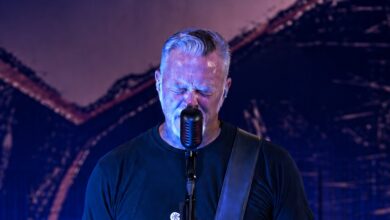
James Hetfield prowled the stage. Jason Newsted pounded the bass. Lars Ulrich played as if his life depended on it. Kirk Hammett’s solos cut through the arena. And the cameras — placed on cranes, dollies, handhelds, and rigs above the stage — caught all of it.
But the moment everyone who has ever seen Cunning Stunts remembers is the encore.
After “Master of Puppets” closed the main set, the band walked off stage. The arena went dark. And then, when they returned and launched into “Enter Sandman,” the most famous song in their catalogue, what happened next was the kind of moment that lives in heavy metal lore.
The pyrotechnics went off — bigger than usual. Then bigger again. Then something appeared to go wrong. A flare launcher seemed to malfunction. A stage technician ran out to fix it and was suddenly engulfed in flames. Another technician, hanging from rigging above the stage, fell. Steel scaffolding columns collapsed inward. Lighting rigs crashed down. Smoke flooded the platform. From the audience’s perspective, it looked like the entire stage was coming apart in real time, with crew members in mortal danger and the band itself caught in the middle of a catastrophe.
It was, of course, completely staged. Every single beat of it had been rehearsed for weeks. The “Burning Dude” was a professional stuntman in a fire suit, designed to give the band exactly the visual they wanted: a man running across the stage on fire, in front of one of the loudest songs in rock history, while the world appeared to collapse around him. The falling technician was rigged on a controlled cable. The collapsing scaffolding was engineered to fall in a precise, predetermined sequence. The “blackout” that followed was the cue for the crew to clear the wreckage and reset for the rest of the encore — “Battery,” “Last Caress,” and the final cuts of the night.
The audience didn’t know any of that. The cameras caught fans in the front rows visibly horrified, hands over mouths, certain they had just witnessed a fatal accident on a major rock stage. Then the lights came back up, the band kept playing, and the realization slowly spread that they had just been part of one of the most audacious pieces of theatrical stagecraft ever attempted at a heavy metal concert.
The legend of the Cunning Stunts “accident” was so vivid that, fifteen years later in 2012, when Metallica played a similar staged collapse during a show in Mexico City, fans in the audience genuinely thought it was real, and so did the international press. Photos and videos of “burned crew members” and “stretcher evacuations” went around the world before the band’s promoters confirmed it had been a recreation of the Cunning Stunts sequence. The original 1997 staging had been so effective that it became, decades later, its own self-perpetuating myth.
When the DVD was released in November 1998, it carried over 140 minutes of concert footage, behind-the-scenes interviews, a tour documentary, and a photo gallery of nearly a thousand images shot by Anton Corbijn — many of which had been used in the album sleeves of Load and Reload. Three songs in the final cut featured viewer-controlled multi-angle camera options, allowing fans to switch between perspectives during “Sad But True,” “King Nothing,” and “Wherever I May Roam.” The package was a technical and artistic statement: Metallica weren’t just a stadium band, they were a stadium band with the resources, the vision, and the audacity to film one of the most ambitious concert documents of the decade.
Cunning Stunts would later be reissued multiple times, remastered for HD, and added to streaming platforms. It remains, alongside Live Shit: Binge & Purge and S&M, one of the three essential live Metallica releases of the nineties.
The title was a joke. The stagecraft was deadly serious. And the two nights in Fort Worth in May 1997 captured Metallica at the exact peak of their commercial power — controversial, polarizing, surrounded by critics, and absolutely untouchable as a live band.
Sometimes the loudest argument a band can make isn’t a record. Sometimes it’s a stage that appears to collapse around them while they keep playing.