Watch What Layla Clark Has to Work Around in Her Marching-Band Uniform
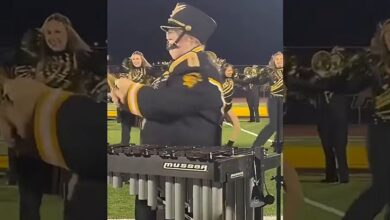
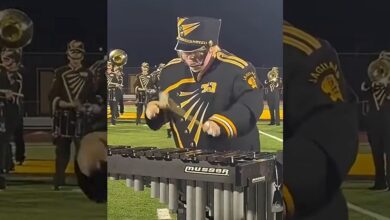
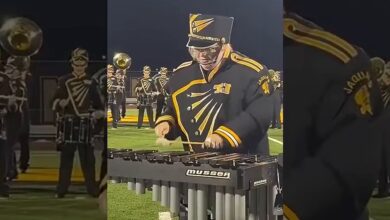
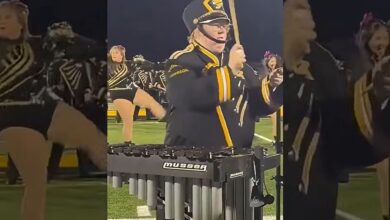
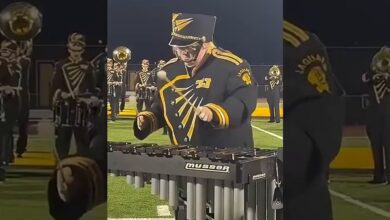
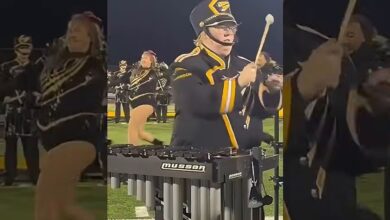
The uniform gives the clip much of its visual identity. There’s the tall hat with the black-and-gold insignia, the jacket and the cuffs moving just above the marimba. One viewer looked at all of that and thought about what it would feel like to play the riff dressed for a football field.
The keyboard is spread out in front of Clark, and the mallets have to cross part of it over and over. When the camera stays close enough to show her wrists, the amount of control is easier to appreciate. She keeps the movement compact even when a mallet has to travel farther for the next note.
How warm she felt on the night is something the video cannot show. The visible detail is the extra fabric around her arms and the precision she maintains anyway. Both hands stay close to the playing surface, which leaves more of the beat available for the strike itself.
The speed gets attention on a first watch. On a replay, watch the space between her jacket cuffs and the bars. That’s where the comment about the uniform becomes a specific observation about the performance.
The physical work hiding under a familiar riff
A fast passage can be surprisingly economical to look at. Clark’s arms rarely go all the way out and back. Most of the work is in the short travel from one bar to another and in the rebound after the mallet touches down. That is worth noticing before you look at the hands that seem to be moving the fastest. A small movement has to be accurate at this speed, and every unnecessary inch has to be travelled twice. The time saved between two strikes is what gives the next pair of notes room to breathe.
In the close-up, the cuffs make a convenient visual marker. You can follow them more easily than the tips of the mallets, which occasionally blur as the camera tries to keep up. The cuffs tell you roughly where the wrists are, while the bars show how far the hands actually have to go. The jacket is what the viewer joked about. It’s also a practical way to see the compact playing motion that makes the joke work.
The hat puts the face at a particular angle in the frame. For much of the opening, Clark’s attention is directed down toward the playing surface. The familiar notes can make the task sound automatic, but the downward glance gives a hint of what she is tracking: the distance to the next bar and the right place to return. That’s different from following a part on paper, and it’s different again from the way a guitarist feels for notes along a fretboard.
The clip gives no reliable measure of how warm the player felt. That part belongs to the viewer’s impression of playing outdoors in a full band uniform. The physical demands you can see are concrete enough. Clark has to keep her grip, make repeated contact with a small playing surface and control the rebound while the rest of the field is moving around her. Her posture and the way the mallets return to the bars give you more to look for than the speed alone.
What changes when an instrument leaves the rehearsal room
In a practice room, the loudest detail might be the sound of the strike, and the player can stop any time a passage needs work. At a game, the audience can be close enough to hear the individual attacks while the field is full of people waiting for a cue. Once the opening starts, the next section has to be able to trust the time. The uniform is part of the context that makes this a performance, with a set of musical decisions that have to hold under the conditions on the field.
The clothes also make the achievement recognizable to people who have never played mallets. Former band students know what it’s like to look after an instrument and a uniform at the same time. Everyone else can see the visual contrast between the dressed-up pageantry of halftime and the simple motion of a mallet falling onto wood. The clip lets a person who has never handled a marimba appreciate the practical parts of the task.
Clark has said the passage took her a long time to learn. It helps to hold that answer in mind when you watch the speed of the opening. Learning the note sequence is one part of a fast pattern. Getting the timing consistent, making the returning note sound like it belongs, and staying ready for the full band are separate things that have to work together. The performance compresses all of that into a few seconds that can look deceptively easy.
One other detail becomes more noticeable once you start thinking about the uniform. Clark spends much of the passage looking ready for the next note before the previous one has finished ringing. That posture matters when the bars are far enough apart to require a change in reach. A small shift through the shoulders can do some of the work before the arm has to travel. You don’t need to decide which hand plays every note to see the effect. Notice how little the center of her body moves as the notes go back and forth. The cloth moves much more than the player does, which is part of what makes the jacket a good reference point on a replay.
For one replay, keep your eyes on the sleeves and ignore the song you recognize. For another, listen to the strikes without looking. The image shows the constraints and the audio shows what Clark did with them. When you put the two back together, it’s easier to see why a comment about a hat and a hot uniform found something more specific to say than another compliment about fast hands.