The AC/DC Riff Nobody Expected to Hear on a School Football Field
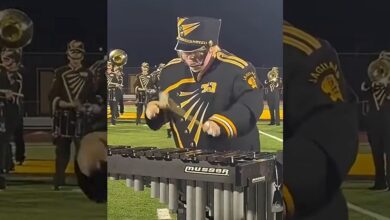
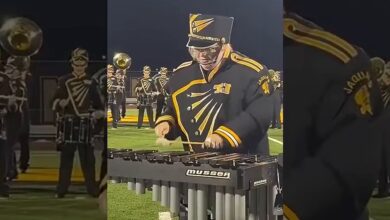
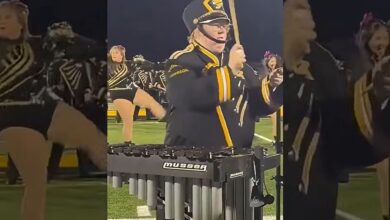
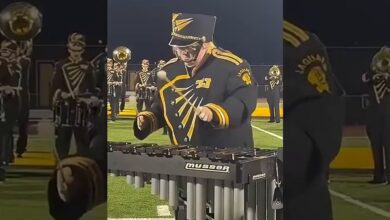
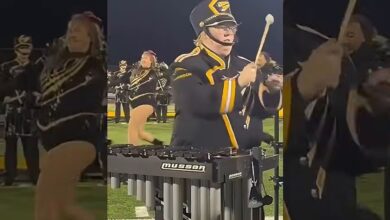
The first sound in the clip is enough to identify the song. The surprise comes when the picture catches up. There’s a student in a black-and-gold marching-band uniform behind a row of wooden bars, carrying the opening figure from AC/DC’s “Thunderstruck” with two mallets.
The instrument in front of Layla Clark is a marimba. The bars give each strike a different edge from a distorted guitar, but the quick return to the same pitch makes the outline of Angus Young’s riff immediately recognizable. Listen to the first few repetitions before the full band arrives and the change in timbre is especially clear.
The clip comes from Thomas Jefferson High School’s 2025 marching season in Pennsylvania. The close camera angle is part of its effect: it lets you see which object is actually making the sound. Even if you know the song by heart, that can take a second to register.
The arrangement has a payoff beyond the novelty. Once the mallet section has established the pattern, the Jaguars can come in around it. The recognizable part of the record has become a cue for a football field full of musicians.
How a guitar riff survives the change of instrument
The opening of “Thunderstruck” depends on the listener noticing two things at once. One pitch keeps turning up and the pitches around it change. If you follow only the moving notes, the line sounds busy. If you follow the note that keeps returning, the line starts to feel like a series of variations around a fixed point. That fixed point is part of why the school version gives itself away so quickly. The marimba can change the color of the notes as much as it likes, provided the repeated part of the figure still tells your ear where it is.
AC/DC put “Thunderstruck” first on its 1990 album The Razors Edge. That placement makes musical sense even if you ignore the title and the record’s history. The opening asks for attention before most of the band is audible. By the time the arrangement builds, the listener has already learned what to follow. The Jaguars use that same sequence on the field. The choice to start with mallets may sound surprising, but the choice to leave them room is close to what makes the original record so immediately legible.
A marimba has one bar for each pitch, laid out in a pattern that a piano player would recognize. Beneath the bars sit the resonators. A strike has an initial click and a fuller pitched sound that follows it. Those two parts of the note are easier to distinguish in this recording than they would be in a dense mix of amplified guitars. Clark’s instrument gives the riff a rounder tone without hiding the edges of the rhythm. It lets the listener hear that the little spaces between the notes are doing almost as much as the notes themselves.
The online reaction makes more sense if you separate the recording’s reveal into three parts. First comes recognition: this is AC/DC. Then comes the visual surprise: the player is standing behind wooden bars, in a band uniform, on a school field. Finally there’s the realization that the arrangement is going to keep working. A quick novelty can get someone to pause. Holding the pattern long enough to bring in the rest of the band is what turns those first seconds into a complete musical thought.
A school field changes what the arrangement has to do
A recording can use a mix to place every sound exactly where the producer wants it. A field show has to communicate across open air, with people moving behind the instrument and a crowd spread along the sideline. The opening therefore needs a clear point of focus. The recognizable AC/DC figure does part of the work, but the players still have to state it clearly enough to be heard as a melody. The simplicity of the setup is one reason it travels so well from the field to a phone speaker.
There’s an easy listening test for the switch. Play the school opening without the picture, then turn on the picture and watch Clark’s wrists. Next, go back to the guitar version and follow the returning note in the same way. The recordings sound different before you even hear the band come in. The pattern feels familiar through all of it. That exercise makes the clip a small lesson in arranging: if a listener recognizes what a phrase is doing, there is room to change who plays it and what it sounds like.
Clark has pointed out that five mallet percussionists played the opening. That detail makes it easier to hear the group inside the close-up. A phone frame favors one instrument and one person, whereas a marching-band arrangement has to work for people looking from all along the stands. There is a moment when those two points of view overlap: the camera catches the work of one set of hands while the rest of the field starts to answer. It’s a much more interesting payoff than the unusual instrument alone.
There’s another reason the opening is a generous choice for a school audience. Recognition can happen at several distances. A close listener hears the different texture of the strike. A spectator farther away can still recognize the repeated contour. Someone who misses the very first notes can catch the figure when it comes round again. The arrangement gives all three people an entry point, and it does that before asking the full band to take over the sound.
The comment’s surprise still holds up after you know what to expect. On a replay it shifts from “How is that sound coming from there?” to “How did those students make that opening sit so naturally?” The first question gets you into the video. The second sends you back to the tune and, if you have the wider angle open, into the performance the camera caught only a piece of.