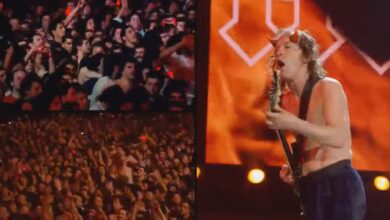
Def Leppard Ignite The Colosseum With “Photograph” — Las Vegas, February 5, 2026
The Colosseum at Caesars Palace is built for big voices and bigger memories, and on February 5, 2026, it felt like it was built specifically for Def Leppard. The band’s Vegas residency had already sparked the kind of chatter that turns a normal weeknight into a destination event, and by the time people streamed into the theater, you could feel that buzz in the air—equal parts anticipation, nostalgia, and that uniquely Las Vegas sense that tonight might turn into a story you’ll tell forever. Doors were listed for 7:00 PM, the start time was slated for 8:00, and when the lights finally shifted and the band came on around 8:15, the roar didn’t sound like polite applause. It sounded like a room of fans who’d been counting down days, not minutes.
Before a single member hit the stage, the night already had a cinematic opening: “Funeral for a Friend/Love Lies Bleeding” played from tape, an unexpected choice that instantly set a dramatic, almost theatrical tone. It worked like an overture in a classic Vegas show, telling the crowd this wasn’t going to be a rushed sprint through hits—it was going to be paced like a real production. That’s the residency advantage: the band knows the room, knows the rhythm of the crowd, and can shape a set like a story instead of a random playlist. In that moment, the arena-band scale of Def Leppard was compressed into something more intimate, where the details were clearer, the sound felt closer, and you could watch reactions spread across faces instead of disappearing into the distance.
Then came “Rejoice,” and it wasn’t just another opener—it was a statement. The track had been talked about going into the residency because it signaled Def Leppard still enjoying the thrill of forward motion, not just celebrating the rearview mirror. In a theater setting, the mix can be sharper and more immediate, and “Rejoice” landed with a punchy drive that jolted the audience into the present tense. The chorus hit like a chant, and even for fans who walked in mainly for the classics, the song served its purpose: it made the crowd lean in. It also set the emotional theme of the night—resurgence, momentum, and that feeling of a band proving they’re not just still here, but still hungry.
The early run through “Animal” and “Let’s Get Rocked” was where the room fully locked into the show’s groove. “Animal” has that glossy, adrenalized pulse that instantly turns strangers into a single moving body, and “Let’s Get Rocked” is basically built to light up a room like a neon sign. In Vegas, surrounded by the city’s constant glow, those songs felt especially fitting—bright, loud, shamelessly fun. Joe Elliott worked the stage like someone who understands theater sightlines, not just stadium distance, and that matters at The Colosseum. In this space, you’re not performing to the back row through a sea of screens; you’re performing to faces you can actually see, and Def Leppard’s confidence in that intimacy gave the show a warmer, more personal energy.
The surprise edge arrived with “Personal Jesus,” and the crowd reaction had that immediate “wait—no way” lift. Covers can sometimes feel like filler, but here it landed like a deliberate injection of darker swagger, giving the set a sharper contrast. The arrangement fit neatly into Def Leppard’s sound without sanding off the song’s grit, and it gave the band room to flex a different posture—less glossy anthem, more stomping menace. In the context of a residency, these moments matter because they keep the night from becoming too predictable. Vegas audiences include everyone from diehard super-fans to people who decided on a show last minute, and a curveball like this pulls everyone into the same moment of surprise at once.
The emotional temperature shifted with “Bringin’ On the Heartbreak,” a song that still hits like a slow-motion punch because it carries the DNA of early Def Leppard—melodic, dramatic, and raw around the edges. In a room built for vocal clarity, the chorus felt huge without losing its ache. Then “Switch 625” arrived like a flash of pure musicianship, reminding everyone that Def Leppard’s story has always been more than hooks—it’s also about the craft underneath the shine. In a smaller venue, you can feel the band’s dynamics more precisely: the way the rhythm section breathes, the way guitars layer without stepping on each other, the way the song’s tension is controlled rather than forced.
“Just Like ’73” and “Rocket” kept the momentum climbing, and “Rocket” especially has that propulsion that feels like it’s physically pushing the crowd forward. The residency pacing showed itself here: the band didn’t stack all the biggest singalongs early. They built waves—high energy, then drama, then swagger, then lift. That’s exactly how you keep an audience engaged for a full run time without making it feel like a checklist. By this point, the show had a sense of inevitability to it, like the band had taken the room’s pulse and was now controlling it. People weren’t just watching. They were anticipating, ready for the next cue that would send them back into another chorus together.
“Rock On” brought a different kind of vibe—looser, more playful—before “White Lightning” arrived and quietly deepened the whole night. This is one of those songs that carries history with it, and even if you don’t walk in knowing every piece of the band’s backstory, you can feel when a room collectively treats something with reverence. The energy didn’t drop; it transformed. You could sense people listening harder, taking in the weight of it, the way the melody and message sit differently than the party anthems. In a residency setting, those emotional pivots land even more strongly because the environment is designed for focus, not distraction.
Then “Foolin’” rolled in like a reminder of how well Def Leppard can balance grit and gloss, swagger and melody. It’s one of those tracks that feels like a bridge between eras, and the crowd responded like they were greeting an old friend. “Slang” followed, and its presence said a lot about the residency concept: this wasn’t only about the biggest radio moments, it was also about acknowledging the band’s full timeline. In a typical greatest-hits set, “Slang” might not appear at all. Here, it felt purposeful—an acknowledgment that the band’s journey includes reinvention, not just repetition. For longtime fans, those choices hit like respect; for newer fans, they add depth and texture to what could otherwise be a straightforward nostalgia night.
When “Promises” began, the vibe in the room tightened in the best way, like everyone collectively leaned forward at once. The song has a built-in emotional lift, and in a venue with crisp acoustics, it hits with a kind of clarity that makes you notice the structure—the way it rises, the way it lands. This stretch of the set was also where the audience started to sound less like individuals and more like a single voice, a unified response that kept getting louder as the night went on. That’s one of the telltale signs of a special show: the crowd stops waiting to be entertained and starts participating instinctively, as if singing along isn’t a choice but a reflex.
By the time “Armageddon It” landed, the night felt fully ignited. It’s the kind of song that doesn’t just get applause—it gets movement, shouting, people pointing at the stage like they’re trying to physically throw the chorus back at the band. “Love Bites” shifted the mood again, not into quiet, but into something more intimate and emotional. In that moment, the residency setting really showed its power: ballads can get swallowed in giant arenas, but in The Colosseum, you could feel the crowd’s attention tighten around the melody. You could see couples leaning into each other, friends singing to each other, strangers sharing that “this song still matters” look without needing to say a word.
“Rock of Ages” hit like the sound of the room lifting off its foundation, that classic moment where everything becomes a chant and the band doesn’t have to push—the crowd carries it. And then, finally, the song everyone wanted to hear explode in this room: “Photograph.” It didn’t feel like just another hit in a long list. It felt like the emotional exhale of the night, the moment where the show’s energy, the venue’s intimacy, and the crowd’s nostalgia all aligned perfectly. When the chorus arrived, it was less a singalong and more a takeover—thousands of voices turning one of rock’s most iconic hooks into a shared declaration, loud enough that you could imagine it spilling out into the Strip.
What made “Photograph” special on February 5 wasn’t only the performance—it was the way the crowd treated it like a personal memory. That’s the magic of this particular song: it’s about capturing a moment, freezing a feeling, holding on to something that time tries to erase. In a city built on sensory overload, “Photograph” somehow created focus. You could feel phones rise, not because people wanted content, but because they wanted proof for themselves that this moment happened exactly the way it felt. It’s the kind of performance that turns into a “you had to be there” story even when there’s video, because the video can’t replicate how the chorus sounded when it was coming from every direction at once.
From there, the set moved into “Hysteria,” which acted like a cinematic glow after the explosion of “Photograph.” It’s not a song that punches; it floats, and in a venue like The Colosseum, that floating sensation becomes almost physical. The band gave it room to breathe, letting the audience sink into it rather than rushing through it. That pacing is one of the reasons this residency run drew so much attention—Def Leppard weren’t playing like they had something to prove. They were playing like they had something to deliver. The audience responded accordingly, treating each big moment not as a predictable beat, but as a gift they were receiving in real time.
And when “Pour Some Sugar on Me” closed the night, it didn’t feel like a finale so much as a victory parade. It’s the kind of ending that leaves everyone laughing and shouting and walking out into the casino lights like they’re still inside the chorus. The show wrapped around 9:55 PM, and you could tell from the way people lingered afterward—taking photos of the stage, replaying clips, repeating the same phrases to each other—that this wasn’t just a “good concert.” It was the kind of night people mentally file under best-ever territory, the kind you compare other shows to for years. Vegas offers countless ways to spend a night. On February 5, 2026, Def Leppard made theirs the one that felt impossible to top.