Dhani Harrison, Jeff Lynne and Joe Walsh Honour George With a Moving ‘Something’
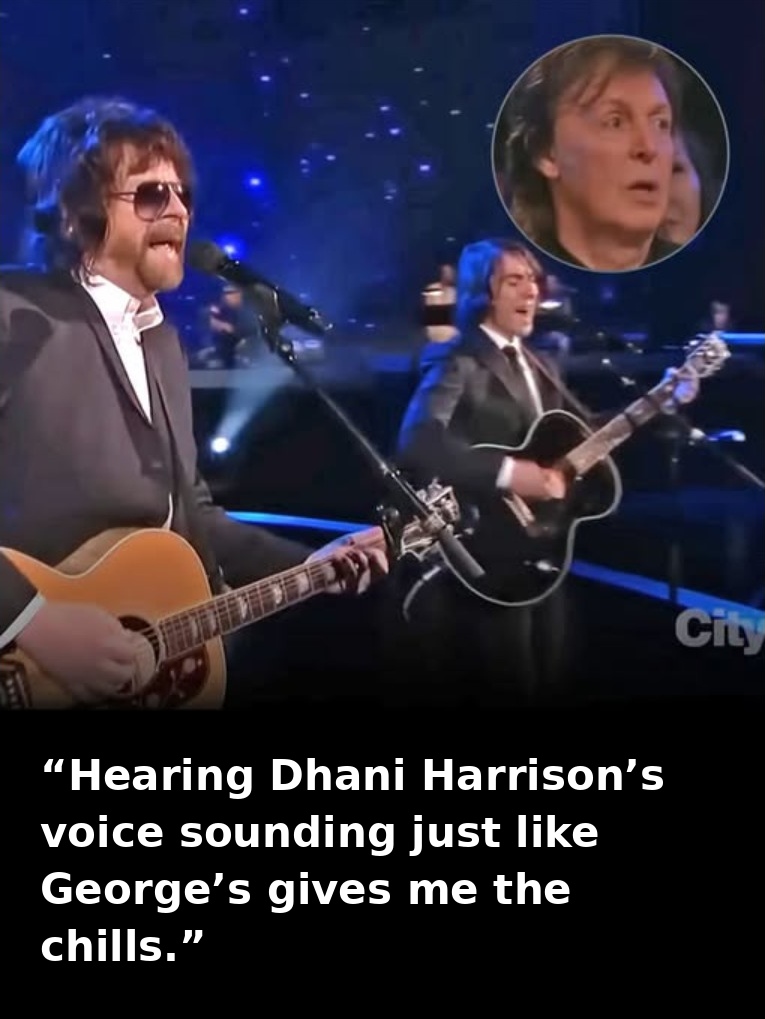
Some songs carry a whole history into the room before the first line is sung. “Something” is one of them. When Dhani Harrison joined Jeff Lynne and Joe Walsh to perform his father’s Beatles classic, the familiar melody became the centre of a tribute whose emotional force came from the people sharing it.
The performance belonged to The Night That Changed America: A GRAMMY Salute to the Beatles. Recorded in January 2014 and broadcast that February, the television special celebrated the band’s landmark arrival on American television half a century earlier.
Paul McCartney and Ringo Starr were there to hear the song. Their presence gives the footage a particular intimacy: two musicians from the original recording’s story watching another generation help carry it forward.
Dhani’s appearance inevitably recalls his father, but his contribution deserves to be heard beyond that resemblance. Performing a song so closely associated with a parent involves a delicate balance between personal expression and the audience’s powerful memories.
Lynne’s singing gives the arrangement a warm centre, while Dhani’s supporting voice adds another colour around it. Their blend draws attention to the melody rather than treating every phrase as an opportunity for vocal fireworks.
Walsh brings the same sense of care to the guitar. The instrumental passages matter because they continue the feeling of the vocal line. A singing guitar tone can say something that an extra flourish would only interrupt.
That is the attraction of this interpretation: the musicians make room for a song that already knows how to move people. Its appeal comes through the connection between the parts rather than through a radically different arrangement.
George Harrison wrote “Something” for the Beatles’ Abbey Road era. Long after its original release, its combination of melodic directness and emotional uncertainty continues to invite performers back to it.
The song’s tenderness also gives tribute musicians a useful kind of freedom. It can express romantic affection in one setting and become a gesture of gratitude in another, without requiring its words to be rewritten.
Here, those meanings overlap. Listeners can hear the love song they already know while also recognising an affectionate acknowledgement of its writer. That second layer comes from the occasion and the people onstage.
McCartney and Starr’s presence strengthens the connection between performance and memory. The audience is part of the story, but the music remains its centre; the song does not need a spoken explanation to establish why it matters.
It is tempting to judge a tribute by how closely it recreates a famous recording. A more rewarding question is whether the performance keeps the composition alive as an encounter between real musicians.
Lynne, Dhani and Walsh offer that kind of encounter. Their different musical identities meet within a melody that remains recognisable, allowing familiarity and individual character to coexist.
The recording is also a reminder that Harrison’s legacy extends beyond Beatles nostalgia. His songs keep creating occasions for musicians and listeners to gather around a shared feeling.
That is what makes this “Something” worth returning to. A son, two accomplished collaborators and an unforgettable composition come together in a tribute that lets affection speak through the music.
More performances to enjoy
The Beatles’ original “Something” provides the starting point for hearing how the melody and arrangement have travelled into later tributes.
Paul McCartney and Eric Clapton’s “Something” from Concert for George offers another perspective on the same song as a musical remembrance.
Social Media Image