Freddie Mercury’s ‘Ay-Oh’ at Live Aid: How One Voice Turned Wembley Into a Choir
Freddie Mercury needed no chorus, no piano introduction, and no guitar solo to create one of Live Aid’s most recognisable moments. Between songs at Wembley Stadium on July 13, 1985, Queen’s frontman sent a short vocal phrase across the crowd and waited for it to come back. The response was enormous. In a concert built around major stars and familiar hits, a brief exchange of sounds became a vivid demonstration of what Mercury could do with an audience.
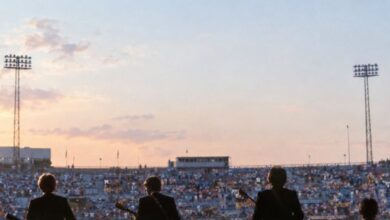
The London stadium held around 72,000 people, according to Wembley’s own account of the event. During the exchange, that crowd became part of the performance itself. Mercury offered a phrase; the audience supplied its echo. The idea was simple enough for anyone to understand immediately, even without knowing Queen’s songs. For a few seconds, the distinction between the stage and the stands seemed unusually small.
What makes the footage compelling is the way Mercury develops the game. He varies the length and shape of the phrases, giving the audience something slightly different to answer each time. His gestures provide the cue, while the pauses leave space for the stadium’s collective voice. The attraction lies in that back-and-forth rhythm: a challenge, an answer, and the anticipation of what he might try next.
The exchange lasts less than a minute, yet its structure is remarkably clear. It has an invitation, a playful escalation, and a release. There is no story to explain and no lyric for the crowd to remember. Listening and responding are enough. That accessibility is part of its power: thousands of individual voices can join the same musical conversation without rehearsal.
Mercury’s timing is as important as the notes. He makes room for the crowd rather than treating it as background noise. Each answer becomes material for the next gesture, giving the exchange the feeling of something being created together. A large stadium can make a singer seem distant. Here, the simple pattern of call and response gives that distance a purpose, allowing the audience’s sound to travel back towards him.
The moment also reveals the theatrical intelligence behind his apparently effortless confidence. Mercury understands that attention can be held through a pause as effectively as through a big musical entrance. By briefly stripping the performance down to a voice and its answering crowd, he gives Wembley a different kind of spectacle. The audience gets to hear its own participation becoming part of the show.
This approach had a history before Live Aid. Queen’s retrospective account of “Ay-oh” traces Mercury’s developing call-and-response routines through earlier concerts, including footage from Milton Keynes in 1982. Those exchanges became a recognisable part of his stagecraft. At Live Aid, the technique worked within a particularly concentrated setting, where the band had only a short appearance in a much larger event.
That context helps explain why the vocal interlude belongs so strongly to memories of Queen’s set. Live Aid brought together different artists and their listeners for a shared charitable cause. Mercury’s invitation required no particular allegiance. A person could take part simply by answering the sound in front of them. The result was a brief, direct form of connection amid an exceptionally large production.
The surviving clip continues to stand on its own because its appeal is so immediate. Even a viewer arriving without the rest of the concert can understand the exchange in seconds. Mercury sings, Wembley answers, and the scale of that reply supplies the drama. It is a reminder that commanding a stage can mean knowing when to let the audience become the loudest voice in the performance.
Queen’s 1986 Budapest performance of the Hungarian folk song “Tavaszi Szél Vizet Áraszt” offers another example of Mercury reaching across the distance between stage and audience. The band’s official retrospective revisits the moment he addressed the crowd through a song rooted in their own language.
Queen’s “Somebody to Love” from the 1981 Montreal concert film provides a contrasting view of Mercury’s stage presence within a full band performance. The shifts between quieter passages and expansive vocal phrases show another side of the musical personality behind the famous crowd exchange.