Johnny Depp and Jeff Beck’s “Isolation”: Voice Meets Guitar
Ever wondered what happens when a familiar screen presence steps up to the microphone beside one of rock’s most distinctive guitarists? Johnny Depp and Jeff Beck’s “Isolation” gives that question a compelling musical setting. Their cover of the John Lennon song puts Depp on lead vocals and Beck on guitar, bringing two very different public identities into the same frame. The attraction is immediate: a singer whose musical work still surprises some viewers, a guitarist with an unmistakable reputation, and a song whose vulnerability gives them something substantial to share.
There is an important detail behind the video. It features footage from Eric Clapton’s Crossroads Guitar Festival in Texas. The accompanying single was recorded in the studio. The images show a real concert collaboration, while the released recording supplies the soundtrack. Understanding that combination makes it easier to appreciate the video on its own terms: a presentation of the song and the partnership, rather than an unedited document of the concert audio.
Lennon’s “Isolation” comes from John Lennon/Plastic Ono Band, an album that brought intensely personal songwriting to the foreground. Its subject is fear and disconnection, including the uneasy distance between outward success and inward security. That makes it an interesting choice for performers surrounded by powerful public images. The song asks for a human presence beneath the reputation. A convincing interpretation has to make that vulnerability meaningful, even when the audience already knows the faces in front of it.
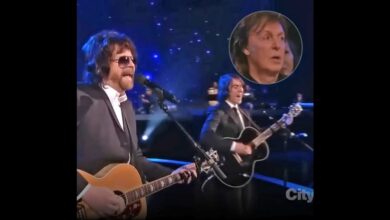
The frame accompanying this article captures the relationship clearly. Beck stands with his white guitar on the left, while Depp is closer to the camera, singing into the microphone in a hat, sunglasses and a scarf. One musician directs his attention towards the instrument; the other gives the words a visible physical presence. The image is striking because both roles remain distinct. It offers a useful introduction to the collaboration’s appeal: voice and guitar sharing a song without needing to become the same kind of performance.
Beck and Depp are joined on the recording by Vinnie Colaiuta on drums and Rhonda Smith on bass. That supporting cast matters when considering the partnership: the song has a complete band behind its two prominent names. The official video below is the best starting point for hearing how those parts fit together. Give the vocal and guitar equal attention, then notice how the rhythm section supports their exchange. The central question is not simply whether Depp can sing, but what his presence contributes to this particular interpretation.
Why Depp and Beck’s collaboration draws listeners in
Depp’s appearance invites a reaction shaped by expectations. Viewers who primarily know his films may approach the microphone as a surprise; listeners familiar with his music have a different starting point. Neither perspective needs to settle the experience in advance. A rock vocal does not have to demonstrate every possible technique to serve a song. Character, phrasing and emotional commitment can be as important as range. “Isolation” gives the audience an opportunity to consider Depp as a participant in a musical conversation, with the song as the reference point.
Beck’s role brings attention to another kind of voice. An electric guitar can express tension through the length of a note, the shape of a phrase and the space around it. Those are useful things to listen for here. A vocal carries language; an instrumental part can deepen or challenge the feeling that language suggests. The fascination of a singer working with Beck lies partly in that division of labour. The guitar has room to contribute emotional meaning rather than function only as decoration between lines.
That is also why the partnership need not become a contest. A famous guitarist and a recognisable singer can tempt viewers to ask who dominates the scene. A more revealing question is whether their contributions belong together. Lennon’s song supplies a shared emotional centre, giving the musicians something beyond individual display to work towards. Listen for how your attention moves between the vocal and the instrumental passages. The quality of that movement can matter more than any attempt to assign a winner.
The rhythm section deserves some of that attention. A cover can retain a familiar melody while changing the physical feeling beneath it, and drums and bass are central to that change. Colaiuta and Smith’s credited presence reminds us that this is a band recording with several interacting parts. Returning to the track with those roles in mind broadens the experience. Instead of following only the most recognisable faces, the listener can consider how the whole arrangement gives the song its weight and continuity.
The choice of “Isolation” also gives the collaboration a lasting point of connection. Beck and Depp explained that they wanted their version to offer comfort during a period when separation was part of everyday life. Yet the song’s concern with loneliness reaches beyond the circumstances of its release. That is one reason an older composition can find a new audience through a cover. Different performers and a different context bring listeners back to an emotion they recognise, without exhausting the meaning of the original.
From “Isolation” to more Johnny Depp performances
Their working relationship extended beyond this single. Their album 18 grew out of a friendship built around shared interests that developed into recording together. The album combined covers with Depp originals, and “Isolation” appeared on its CD and digital editions. Seen in that context, the video is one entry into an ongoing creative exchange. It points towards a broader body of work for anyone whose curiosity lasts beyond the initial surprise of seeing the pair together.
“This Is a Song for Miss Hedy Lamarr” is a natural next step because it brings Depp’s songwriting into that exchange. The song is an homage to the actress and inventor, and Beck’s enthusiasm for it was an important reason for making the album. That gives it a different relationship to “Isolation.” One performance interprets a familiar composition; the other introduces a song associated with Depp’s own writing. Together they provide a fuller picture of what the partnership was exploring.
Depp’s vocal work with Hollywood Vampires offers another useful comparison. The band’s version of David Bowie’s “Heroes” places him at the microphone in a different musical setting, with a different song carrying the emotional stakes. Readers can also explore our feature on Johnny Depp singing “Heroes” at Montreux. Hearing an artist across several performances is more informative than treating a single clip as a final verdict. It allows the listener to notice continuity, variation and the effect of the musicians around him.
The enthusiastic reaction to “Isolation” is easy to understand as an invitation to look again. When a performer exceeds an audience’s expectations, the discovery itself becomes part of the pleasure. But the collaboration has more to offer than that moment of surprise. Its subject, the choice of Lennon’s song and the meeting of vocal and instrumental personalities provide reasons to return. A second listen can shift the focus from recognition towards the music, letting the arrangement establish its value beyond the names on the title.
Johnny Depp and Jeff Beck’s “Isolation” remains an engaging doorway into their work together. It brings a vulnerable song into a rock setting and pairs a visible stage partnership with a carefully presented recording. Depp’s role at the microphone and Beck’s role on guitar give the viewer two distinct centres of attention, supported by an accomplished rhythm section. The most rewarding response is to follow that exchange, then explore where it leads. The two official videos below continue the journey through Depp’s collaboration with Beck and his music with Hollywood Vampires.
Watch two more performances
Jeff Beck and Johnny Depp — “This Is a Song for Miss Hedy Lamarr”: Continue with the duo’s official music video for a song that brings Depp’s writing and vocals together with Beck’s guitar. It offers a closer look at the collaboration beyond their Lennon cover.
Hollywood Vampires — “Heroes”: This official music video features Depp singing the David Bowie classic with Hollywood Vampires. It is the Rise version, a separate video from the Montreux performance covered in our earlier article.