Metallica’s “Battery” Turns Sphere Into an Immersive Concert Experience
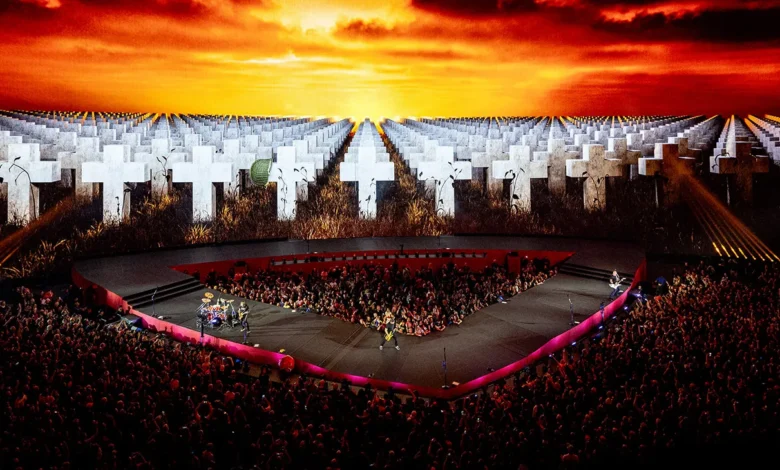
Some concert openings announce that a band has arrived. Metallica’s “Battery” at Sphere made the entire room feel as though it had been switched on. The opening night of the Life Burns Faster residency placed one of the group’s most explosive songs inside a venue capable of surrounding the audience with images. Yet the attraction of the footage is more immediate than the technology: four musicians launch into a familiar piece of music, and thousands of people respond to its momentum.
“Battery” makes particular sense as the first invitation into this world. Its acoustic introduction leaves space for anticipation before the electric guitars overturn that calm. Once the main riff lands, the song moves with a force that needs little explanation. Inside Sphere, that transition also establishes the relationship between the performance and its setting. The room can offer an enormous canvas, but the music supplies the movement that gives the canvas a purpose.
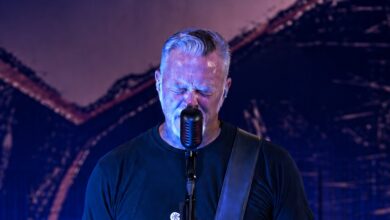
James Hetfield’s rhythm playing is central to that effect. The riff has a hard, tightly controlled attack, creating a foundation for Lars Ulrich’s drums and Robert Trujillo’s bass. Kirk Hammett brings a different kind of motion through the lead guitar, stretching across the precision underneath him. Watch the players as well as the screen and the concert becomes easier to understand: the production expands the scale of something the band is already doing onstage.
The opening also carries the weight of a song that has accompanied listeners for decades. “Battery” comes from Master of Puppets, an album whose influence extends far beyond Metallica’s own audience. Some people in the room will have lived with this music since its release; others will have discovered it through live clips, playlists, or a family member’s record collection. A riff shared across those different histories gives a huge venue an unexpectedly personal point of connection.
That is why the first performance video is worth watching before moving through the other clips. It offers a sense of the concert as an unfolding event rather than a collection of striking images. Listen for the change from anticipation to full-band impact, then notice how the audience reacts when the song settles into its charge. The screen contributes to the occasion, but the opening’s strongest argument is the sound of “Battery” taking possession of the room.
After that entrance, the evening had room to change shape. “Creeping Death” followed, while later songs gave the visual production different moods to explore. Metallica’s catalogue contains enough contrasts to support that approach: relentless passages, ominous build-ups, spacious melodies, and sections made for an audience to sing together. Sphere gives those changes an architectural dimension. Instead of watching scenery behind a stage, spectators can find themselves looking into an environment that seems to extend beyond the musicians.
The shorter videos below capture that surrounding world from several positions. Their value lies partly in the differences between them: one frame may emphasize the screen’s height, another the stage, another the people watching beneath it. Viewed consecutively, they help explain why a single photograph cannot convey the full experience. These are audience views of the stage visuals, so each clip preserves a particular angle on the production rather than presenting one continuous account of the entire show.
One of the evening’s most memorable transformations accompanied “Now That We’re Dead.” Cathedral imagery and stained-glass representations of the band turned the space into a monumental setting for the song’s heavy pulse. The effect suits music that builds through repetition and weight. As the images rise around the performance, the musicians remain the point of reference, giving the audience something human to follow within a scene whose proportions would otherwise be difficult to take in.
“Wherever I May Roam” offered a different kind of journey. A simulated train carried the visuals through landmarks before arriving at Sphere, giving the song’s restless character a literal route across the screen. It is an accessible idea because the relationship between the song and the imagery is easy to grasp. The audience can follow the movement while staying connected to the riff, and the changing scenery adds another layer to a track already associated with travel and independence.
The set also included “…And Justice for All,” returning to live performance after an absence stretching back to 2014. For listeners who pay close attention to Metallica’s changing set lists, that choice gave opening night another reason to matter. The residency’s appeal therefore reaches beyond what the venue can display. There is also the question of what the band will play, which corners of its catalogue it will revisit, and how those choices will feel in this particular room.
“The Call of Ktulu,” dedicated to Cliff Burton, brought the concert into darker territory with monstrous imagery. An instrumental piece allows a production like this to work differently: the audience can follow the music’s tension without a vocal line directing attention toward a lyric. It also leaves room for the significance of the dedication. The spectacle may be enormous, but Metallica’s history, including the musicians who helped shape its identity, remains part of the experience.
The closing “Master of Puppets” brought the evening back to a song with an unmistakable hold on a crowd. Early reactions reflected enthusiasm for both the performance and its visual surroundings; Eddie Trunk described the opener with the words, “Epic would be an understatement.” The audience footage helps put that response in context. There is the scale of the room, certainly, but also the pleasure of recognizing a passage and hearing a large audience meet it together.
For another perspective on that connection, Metallica’s official “Master of Puppets” performance from Lollapalooza in Chicago offers a useful companion. The outdoor festival setting changes the surroundings completely, while the song’s central attractions remain easy to recognize: the opening attack, the shifts in pace, and the crowd’s familiarity with its landmarks. Watching it alongside the Sphere footage highlights how much of Metallica’s concert identity travels with the musicians from one stage to the next.
The performance of “Nothing Else Matters” with the San Francisco Symphony at S&M2 provides a second, more reflective comparison. Here, the arrangement opens space around the melody and lets orchestral texture become part of the song’s emotional movement. It demonstrates another way Metallica can expand a familiar piece without losing its character. After the speed of “Battery” and the scale of Sphere’s visuals, this performance draws attention to the band’s quieter sense of drama.
Taken together, these videos show why the Sphere opening gives viewers more to discuss than a spectacular new backdrop. The residency places Metallica’s music in an environment that can change dramatically from song to song, while the band’s playing keeps the evening connected. “Battery” establishes that relationship at once. Everything around it can grow larger, stranger, or more immersive, but the opening riff still gives the audience a clear place to begin.