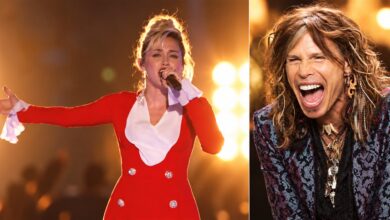
Miley Cyrus’s ‘Dream On’ Performance Puts Her Rock Voice in the Spotlight
Miley Cyrus makes her entrance into “Dream On” with the kind of rough-edged force that changes the feel of a shared performance. Standing alongside Alicia Keys, Adam Levine and Blake Shelton, she gives Aerosmith’s ballad a darker vocal colour and a burst of physical energy. It is a brief television collaboration, but her contribution gives rock listeners a clear reason to keep returning to it.
The four singers performed the song for a special preview of The Voice’s eleventh season. Broadcast on August 21, 2016, the appearance introduced a coaching lineup that brought Cyrus and Keys together with returning coaches Levine and Shelton. Their choice of material gave each singer a different role within one familiar arrangement.
Keys opens at the piano, establishing a measured beginning before the other voices enter. Shelton brings a lower vocal register, while Levine supplies guitar as well as vocals. The early restraint gives the performance somewhere to go: the song’s growing intensity depends on the contrast between its quieter passages and its later release.
Cyrus enters with a rasp that immediately stands apart within the ensemble. Wearing red, she reaches outward with one arm as she sings, turning the refrain into a physical performance as well as a vocal one. Her voice has enough weight to cut through the fuller arrangement without losing its recognisable character.
The cameras also catch the collaboration unfolding around her. Shelton smiles behind Cyrus during her section, while the other singers continue to support the arrangement. Those details matter because this version relies on the exchange between its performers. Each voice introduces a different texture, and the accompaniment gives those changes room to register.
Levine takes the demanding high passage toward the end, providing another focal point after Cyrus’s forceful entrance. The full video shows how the quartet moves from the piano-led opening into the closing escalation. Cyrus’s section stands out most clearly when heard as part of that entire progression.
The comments beneath the YouTube upload show how strongly that entrance connects with viewers. A remark by @kristeldilaora8130, displayed with about 9,400 likes when checked, reads: “they all slayed but Miley carried this whole performance, we can just be objective about that”. It is one listener’s enthusiastic verdict, and it captures a recurring attraction of the clip: the sudden impact of her voice within a group of established singers.
The performance also invites a broader question about the stages that suit Cyrus. Her command of a familiar rock chorus, visible energy and willingness to push into its rougher edges make a Super Bowl halftime appearance an appealing prospect. That is a response to the music, rather than news of a booking or an announced NFL plan.
Contemporary coverage noted that the original broadcast dedicated the performance to Christina Grimmie, the former Voice contestant who had died earlier that summer. That context adds meaning to the collaboration beyond the arrival of a new coaching panel. The song offered the four performers a way to share the stage around a piece of music with an unusually strong emotional rise.
What makes Cyrus memorable here is the specificity of her sound. Her phrasing and vocal grain remain distinct within the arrangement, while Keys, Shelton and Levine give the performance contrasting colours. The result leaves room for viewers to favour different moments: the opening piano, the harmonies, Cyrus’s entrance or Levine’s closing ascent.
For another example of Cyrus bringing that vocal weight to classic rock, her Glastonbury performance of Led Zeppelin’s “Black Dog” makes a useful companion. Its exposed vocal phrases and answering guitar riff place her voice in a different kind of conversation with the band.
Aerosmith’s own “Dream On” performance from The Midnight Special’s archive offers a second perspective. Steven Tyler’s delivery shows the original dramatic shape that later interpreters inherit, from its controlled opening to the exposed vocal climax.