Miley Cyrus Gives ‘Dream On’ a Rock Edge Alongside The Voice Coaches
Miley Cyrus’s entrance changes the temperature of The Voice coaches’ “Dream On” performance. Dressed in red, she steps into Aerosmith’s ballad with a rough-edged vocal that gives its familiar refrain fresh urgency. Four very different singers find their place inside the same arrangement, giving the familiar song contrasting textures.
The collaboration brought Cyrus together with Alicia Keys, Adam Levine and Blake Shelton for the show’s season 11 preview, broadcast on August 21, 2016. Keys and Cyrus were joining the coaching panel, and the performance gave viewers an introduction to the new lineup before the regular season began. The song offered a shared musical test for the new coaching team.
Keys establishes the atmosphere at the piano, giving the opening room to breathe. Levine contributes guitar, while Shelton brings a lower, more grounded vocal colour. Those contrasting sounds matter because “Dream On” needs somewhere to climb: its later intensity carries more weight when the beginning leaves space around the melody.
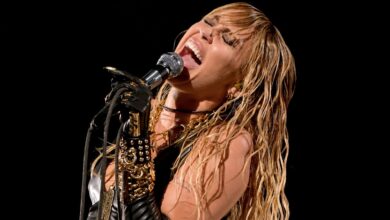
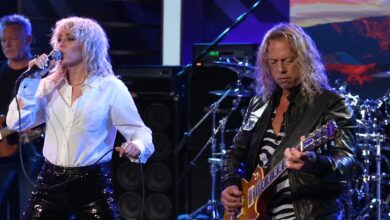
Cyrus supplies a striking change of texture. Her voice has a grain that sits comfortably against the song’s expanding rock arrangement, and she attacks the refrain with a physical confidence that is visible as well as audible. The raised arm, firm microphone grip and concentrated expression make the passage feel committed rather than merely decorative.
The camera also catches the performance as an exchange between musicians. Around the middle of the clip, Shelton smiles behind Cyrus as she sings with one arm lifted. It is a small, unforced moment inside a carefully staged television production, and one that captures the pleasure of the collaboration.
The arrangement keeps building toward the high register closely associated with Steven Tyler’s original delivery. Levine takes that demanding closing passage, giving the performance another focal point after Cyrus’s entrance. The full recording below shows how the four voices move from the restrained opening into the final escalation.
The response beneath the upload reflects those different attractions. Some listeners single out Cyrus’s energy and suitability for rock; others focus on Levine’s high notes or Keys’s supporting harmonies. One self-described metal fan ranks the performance among their favourite “Dream On” covers, while another listener praises Cyrus’s rock interpretations more broadly.
What makes Cyrus’s contribution stand out is the contrast between her familiar pop profile and the sound she brings to this song. She does not need to reproduce Tyler’s phrasing to make the material convincing. Her darker vocal grain gives the refrain a different centre, while the other singers preserve the sense of a song growing beyond its initial restraint.
The performance also carried a dedication to Christina Grimmie, the former Voice contestant who had died earlier that summer. Contemporary reporting noted that a memorial message appeared after the song. That context belongs to the original broadcast and gives its closing moments a significance beyond the introduction of a new coaching panel.
Aerosmith introduced “Dream On” on their debut album in 1973. Its movement from a measured beginning toward an exposed vocal climax gives later performers both a clear structure and a difficult challenge. This version works through the contrast among its singers: Keys’s piano-led opening, Shelton’s lower register, Cyrus’s rasp and Levine’s final ascent each serve a different part of that progression.
For another example of Cyrus working inside a classic-rock arrangement, the first companion video features her Glastonbury performance of Led Zeppelin’s “Black Dog.” It is a different song and setting, but the exposed vocal phrases and the band’s answering riff offer a useful comparison with the way her voice cuts through “Dream On.”
The second related performance returns to Aerosmith themselves. The Midnight Special’s official archive presents the band playing “Dream On” in a broadcast dated August 16, 1974. Hearing that early rendition alongside The Voice collaboration makes the connection clear: the singers change, but the song’s gradual rise and the demands of its closing section remain central.