Post Malone, Slash, Duff McKagan, Andrew Watt, and Chad Smith Turn “War Pigs” Into a Stadium-Sized Farewell at the Grammys
The night was already moving at that familiar Grammys pace—big smiles, quick cuts, categories flying by—when the mood shifted into something heavier, slower, and unmistakably real. During the In Memoriam portion of the Grammy Awards, the room at Los Angeles’ Crypto.com Arena stopped feeling like a television set and started feeling like a gathering. People don’t just watch that segment; they brace for it. And when it became clear the show was building toward a tribute to Ozzy Osbourne, the air changed in a way you could practically measure—less applause-on-cue, more collective attention, like everyone understood they were about to witness a goodbye that couldn’t be faked.
The clever move was where the tribute lived: not as a detached “special performance,” but inside the memorial sequence itself, where emotion is already close to the surface. Grammys tributes sometimes try to summarize an artist’s life in a neat montage, but this one went for impact instead of recap. It didn’t aim to be soft or delicate, because the person being honored was neither. The segment’s power came from its directness: let the music do the talking, let the room react honestly, and let the loss sit in the open without rushing to tidy it up. For fans who’ve spent years treating Ozzy’s work like sacred noise, it felt like the show finally chose the right language.
Then the lineup appeared, and suddenly the tribute wasn’t just respectful—it was inevitable. Post Malone stepping into the lead role signaled this wouldn’t be a museum-piece reenactment, while Slash and Duff McKagan arriving together brought instant authority, the kind that tells you the guitars won’t be “TV nice.” Add Andrew Watt, who’s been closely tied to Ozzy’s later-era studio world, and Chad Smith, a drummer who never plays like he’s trying to stay out of trouble, and the tribute suddenly felt less like a segment and more like a real band forming in real time.
Choosing War Pigs was the key that made everything lock into place. That song doesn’t function as background music. It’s not polite, not sentimental, not designed to float over sad images. It’s a riff that stomps, a warning shot with moral teeth, a piece of protest theatre disguised as heavy rock. Using it as the tribute centerpiece effectively told the audience: we’re not sanding down the edges tonight. We’re honoring Ozzy the way he changed music—by making heaviness feel like a force of nature, by turning darkness into a spotlight, by delivering something that sounded dangerous enough to matter.
The performance itself hit with a kind of immediacy that’s rare on awards-show stages. It wasn’t over-complicated, and it didn’t waste time trying to “modernize” the track into something safer. Instead, it leaned into the song’s spine: that signature churn, the ominous bounce, the sense of a march moving toward confrontation. The players approached it with a seriousness that read instantly on camera—no winking at the audience, no “look how fun this is,” just a collective commitment to doing it right. When a tribute works, you stop thinking about the concept and start experiencing the music as if it’s happening in your own room. This one did that.
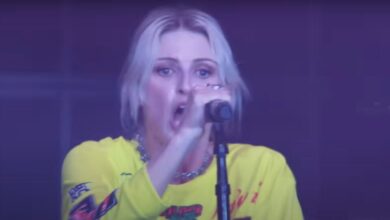
Post Malone’s role was fascinating because it didn’t rely on imitation. He didn’t try to wear Ozzy’s voice like a costume; he delivered the song like someone who understands what it represents. That distinction matters. The best tributes aren’t impersonations—they’re acknowledgments, like bowing your head while still singing at full volume. His vocal approach leaned gritty and human, with enough strain to feel honest and enough control to keep the performance from turning into chaos. It came off less like “I’m replacing him” and more like “I’m carrying this for him,” which is exactly the emotional lane a memorial performance needs.
On guitar, Slash brought the kind of presence that instantly changes how the room listens. Even before you isolate any individual phrase, his tone announces weight and intent, like the sound itself is built to fill arenas. In a tribute context, that matters because it transforms nostalgia into something living. He played with that signature mix of precision and danger—the feeling that every note is deliberate, but the heat underneath could flare at any second. It didn’t sound like a polite tribute arrangement. It sounded like a rock performance that just happened to be taking place on a massive stage with grief in the front row.
Post Malone tribute to Ozzy Osbourne at the Grammys. pic.twitter.com/UvlIeZh5YN
— Junior (@RIDDICK325) February 2, 2026
Duff McKagan’s bass did what great bass always does in big moments: it made everything feel inevitable. “War Pigs” needs low-end muscle not just for heaviness, but for clarity—so the riff stays focused and the momentum stays physical. Duff played like a musician who knows the assignment isn’t to steal the spotlight; it’s to lock the foundation so hard the whole structure becomes unstoppable. In the best tributes, the band sounds like a band, not a collection of celebrity cameos taking turns. That cohesion was one of the most impressive parts of the performance, and the bass was a major reason it held together.
Chad Smith, meanwhile, gave the performance its heartbeat—and not the polite kind. He plays with a natural force that makes even controlled environments feel like live venues, and that’s exactly what this moment needed. Awards-show sound can sometimes flatten rock music into something overly tidy, but his drumming pushed against that, keeping the performance urgent and forward-moving. He managed that balancing act where the song still feels big and wild, yet tight enough to fit the broadcast. It’s a subtle skill, and it’s why the tribute didn’t feel “placed” into the show; it felt like it erupted inside it.
Andrew Watt’s presence carried an extra layer of meaning beyond the notes. For many viewers, he’s the connective tissue between Ozzy’s legacy and the modern rock ecosystem—someone who helped keep Ozzy creatively active and sonically current in the later chapters. That gave the tribute a personal grounding, like this wasn’t just the Recording Academy assembling famous names, but Ozzy’s wider musical circle showing up in public to say, we’re here because he mattered to us in real life. When tribute lineups include someone with direct creative history, the moment stops being abstract and starts feeling like family, even if the family is made of guitars and studio credits.
And then the camera cuts made the emotion unavoidable. Watching Sharon Osbourne, Kelly Osbourne, and Jack Osbourne in the audience—visibly overwhelmed—anchored the whole performance in reality. It’s one thing to honor an icon in theory; it’s another to see the people who loved him watching strangers and peers carry his song for a few minutes on the biggest stage. Those reaction shots didn’t feel like the show hunting for drama. They felt like the show witnessing something private spilling into public, and the audience collectively respecting it by simply letting the moment happen.
The staging choices pushed the tribute from “great cover” into “memorial statement.” Reports described fiery effects behind the performers, a visual decision that fit Ozzy’s mythology without turning the moment into cartoonish spectacle. It was theatrical, yes, but it was also thematically honest: Ozzy’s career has always lived at the intersection of darkness, drama, and showmanship. So giving the performance that visual heat didn’t dilute the seriousness—it reinforced it, like the show understood that honoring him meant honoring the scale and the shock he brought into mainstream culture.
What made the performance especially memorable was that it didn’t try to do too much. No medley, no rushed summary of a discography, no over-explaining through narration. It trusted one song to carry the weight, and “War Pigs” is the kind of track that can handle that burden. In a strange way, that restraint made the tribute feel bigger. The Grammys didn’t attempt to close grief with a bow. They presented a moment of loud remembrance, let the family be moved, let the audience feel the loss, and then moved on—because the show must move on, even when the room doesn’t want it to.
Online, the reaction had the familiar shape of a true pop-culture moment: clips spreading immediately, fans rewatching specific seconds, arguments about how well the category “belongs” to any one scene, and plenty of people simply saying they didn’t expect to cry at a heavy song. But the most telling response was simpler: people described it as a real performance, not a cute TV tribute. That’s the highest compliment for something like this. For a few minutes, the awards-show frame fell away, and the tribute felt like what it was supposed to feel like—a room of musicians and listeners acknowledging a giant absence with the loudest respect they could offer.
In the end, the tribute worked because it understood Ozzy’s legacy as something living, not archived. It didn’t ask the audience to “remember” him like a museum exhibit; it let his music take the stage and behave the way it always has—bold, confrontational, unforgettable. If a memorial performance is supposed to capture what the artist gave the world, this one did it the Ozzy way: with volume, with fire, and with a song that refuses to be background music. It was grief expressed through amplification, and for that reason, it will likely be remembered as one of those rare Grammys moments that feels bigger than the broadcast itself.