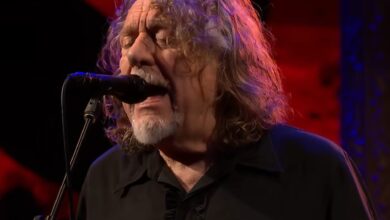
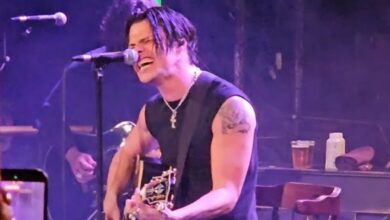
Def Leppard “Foolin’” At The Colosseum At Caesars Palace, Las Vegas, February 14, 2026
Valentine’s Day in Las Vegas is already built for drama, but Def Leppard have a way of making a room feel like it’s living inside a chorus. On February 14, 2026, at The Colosseum at Caesars Palace, they dropped “Foolin’” into the middle of their residency set like a secret handshake for the lifers—those fans who don’t just want the radio staples, but the songs that smell like cassette tape, backstage sweat, and late-night jukebox faith. The beauty of “Foolin’” is that it’s both swagger and vulnerability at the same time, a track that struts while quietly admitting it’s not as invincible as it pretends. In a city that sells fantasy by the mile, that mix of confidence and confession hits differently.
This residency run has been marketed as something more “spectacular” than a standard tour stop, and the Colosseum is the perfect room for that promise because it forces detail. In an arena, the band has to throw their sound like a spear; in a theater like this, they can shape it like a sculpture. You hear the edges of the guitars, the spaces between the snare hits, the way Joe Elliott phrases a line when he knows the room is listening closely. That matters for “Foolin’,” a song that lives and dies on tension—verses that prowl, a chorus that explodes, and a bridge that feels like a spotlight suddenly snapping onto your chest. The venue’s controlled acoustics and tight sightlines make the performance feel less like a distant spectacle and more like a shared moment.
There’s also something poetic about “Foolin’” showing up in this era of Def Leppard’s story. The band have always been framed as pure celebration—big hooks, bigger harmonies, the kind of choruses that turn strangers into friends for three minutes at a time. But “Foolin’” sits in a darker corner of that universe, born out of the Pyromania period when their sound was sharpening into something meaner and more dangerous. It’s a song with teeth, and on this night it serves as a reminder that Def Leppard’s identity isn’t only neon and sugar. It’s also grit, timing, and that hard-earned confidence that comes from surviving every era that tried to replace you.
What makes the February 14 performance feel distinct is the way it’s positioned in the set’s emotional arc. By the time “Foolin’” arrives, the show has already established its modern heartbeat and its classic sheen, so when that riff kicks in, it feels like the residency briefly pivots from celebration to storytelling. The crowd reaction tells you a lot: this isn’t just a “sing the chorus and move on” moment. You can practically sense recognition spreading through the room, that “oh wow, they’re really doing it” feeling that only happens when a band reaches into the deeper catalog and lands on a song fans didn’t realize they were craving. In Vegas, where audiences can be a mix of devoted fans and spontaneous ticket-buyers, “Foolin’” acts like a filter—suddenly you can tell who came for the hits, and who came for the history.
Musically, “Foolin’” is a masterclass in controlled release, and that’s where this version shines. The opening has that stalking momentum, guitars locking in with a sense of purpose rather than flash, then the chorus hits like a curtain snapping open. Phil Collen and Viv Campbell’s interplay is the kind of dual-guitar chemistry Def Leppard have always used as a signature, but here it feels extra focused—less about showing off, more about driving the song forward like a classic car that still runs too fast for its age. The rhythm section gives it a tight backbone, making the whole performance feel muscular without getting messy. It’s a song that can turn to chaos if it’s played too loose, and this rendition keeps it sharp, clean, and dangerous.
Joe Elliott’s approach is where the tenderness creeps in. “Foolin’” demands attitude, but it also demands control, and in 2026 he sings it like someone who understands the weight of every decade behind the words. The voice isn’t about trying to sound twenty again; it’s about using experience as texture. That’s what gives the performance its emotional edge: it’s not nostalgia for nostalgia’s sake, it’s a veteran band inhabiting an older song with the confidence of people who’ve lived long enough to know what the lyrics actually cost. You can hear the crowd lean in during the familiar lines, not because they’re surprised by the melody, but because the delivery carries an extra layer of meaning.
Visually, the residency staging makes a song like this pop in a different way than it would outdoors or in a stadium. In a theater, lighting becomes more like cinematography than pyrotechnics, and “Foolin’” benefits from that. The darker vibe of the track pairs naturally with shadowy washes, sharp accents, and those moments where the band is framed like characters in a story rather than icons on a giant screen. The Colosseum’s scale also means the audience’s energy is more concentrated, so when the chorus arrives, it doesn’t feel like sound dispersing into open air—it feels like a pressure wave that stays in the room. That intensity is exactly what turns a “good performance” into a clip people keep replaying.
And then there’s the specific charm of a fan-shot document of the night: the way a phone camera captures reality, not perfection. You hear the room as it actually was, you feel the crowd’s timing, you catch the little variations—an extra shout, a slightly different guitar emphasis, a beat where the audience gets ahead of itself. Those imperfections are the point, because they prove the performance is alive. For “Foolin’” on February 14, 2026, that liveliness is the headline: Def Leppard aren’t preserving a museum piece. They’re showing you a song that still moves, still hits, still makes people throw their hands up like it’s 1983 and tomorrow doesn’t exist.
Comparing those performances is where the Vegas version quietly wins its argument. The studio cut is sleek and hungry, built for the early-’80s moment when hard rock was learning to be both razor-sharp and massively accessible at the same time. Later live versions often lean into pure horsepower, sometimes pushing the song as a victory lap. But the February 14, 2026 rendition threads a rarer needle: it keeps the bite, keeps the swagger, and still leaves room for nuance. It feels like a band that understands their own catalog so well they can shift the emotional lighting without changing the architecture. That’s why this take stands out—because it doesn’t treat “Foolin’” as just a crowd-pleaser. It treats it like a scene.
It also says something about Def Leppard’s current identity that “Foolin’” can land this hard in 2026 without sounding like a tribute act saluting their younger selves. The residency format encourages curation, and curation encourages storytelling, and this song benefits from being framed as a statement rather than a random deep cut. On a night like Valentine’s Day, when the city is loud with romance and spectacle, “Foolin’” becomes a sly counterpoint: a reminder that desire is messy, confidence can be a mask, and the most satisfying rock songs aren’t only about winning—they’re about feeling everything at full volume and surviving it. That’s the magic of this moment in Las Vegas: not that Def Leppard looked back, but that the past still sounded like it had unfinished business.