The Night Led Zeppelin Returned To The O2 Arena And Made The Rule Feel Real Again
For decades, Led Zeppelin lived inside a rule that felt unbreakable. The band ended when John Bonham died, and no amount of fan pressure, money, or nostalgia ever seemed strong enough to bend that line. It wasn’t marketing language or legal positioning; it was a belief repeated often enough that it hardened into fact. Zeppelin wasn’t something you revived. It wasn’t a legacy act waiting for the right offer. It was a body of work tied to a specific chemistry that stopped in 1980. That understanding shaped how the band was spoken about for a generation, and it’s why the idea of a full-length performance in 2007 felt less like a reunion and more like a contradiction waiting to happen.
What ultimately made December 10, 2007 possible was context. The concert at London’s O2 Arena was staged as a tribute to Ahmet Ertegun, a central figure in the band’s early career and someone whose influence reached far beyond Led Zeppelin alone. Framing the night as a memorial gave it moral weight. This wasn’t a comeback tour or a rebranding exercise. It was a single event tied to gratitude and history rather than momentum. That distinction mattered deeply to a band that had spent years resisting the idea of returning for its own sake. The night existed because it meant something beyond the band itself.
Even getting to the stage felt fragile. The show had already been postponed once due to injury, which only added to the sense that the entire thing might collapse before it ever happened. When the doors finally opened at the O2, the atmosphere carried a kind of suspended disbelief. This wasn’t excitement alone. It was tension. Fans weren’t just wondering if the band would sound good. They were wondering whether the idea of Led Zeppelin playing again could even exist without undermining everything the band had protected for decades. The stakes weren’t musical alone. They were philosophical.
The scale of demand made those stakes even heavier. Ticket requests reached historic levels, turning the show into a cultural event before a single chord was struck. That level of attention creates a strange pressure: the performance can’t simply be competent. It has to justify its own existence. A mediocre reunion fades quietly. This one would have collapsed under its own symbolism. Everyone in the building knew that if the music didn’t feel real, the rule would snap back into place instantly, stronger than before.
The most important decision was also the most obvious one. The drummer’s seat could never be filled by a substitute pretending nothing had changed. Choosing Jason Bonham was the only option that preserved honesty. He wasn’t there to replace his father, and the band never framed it that way. He was there because the music lived in him differently than it could in anyone else. He had grown up with it, absorbed it, and understood its weight without turning it into imitation. That choice didn’t erase loss, but it allowed the band to stand on stage without pretending the loss hadn’t defined them.
The setlist reflected that seriousness. This wasn’t a cautious run-through of radio staples designed to trigger applause on cue. The band leaned into demanding material, including songs that required patience, internal communication, and trust. The decision to debut “For Your Life” live that night was particularly telling. Bands looking for safety don’t take risks like that. Zeppelin did, because the night wasn’t about comfort. It was about testing whether the band could still function as a living organism rather than a historical exhibit.
“Kashmir” became one of the night’s emotional anchors. The song’s power doesn’t come from speed or flash, but from inevitability. It needs a drummer who can hold tension without rushing it, who can make restraint feel massive. On that stage, the groove locked in. The music didn’t sound resurrected. It sounded grounded. That moment did more than any speech could have done, because it addressed the real question head-on: was the feel still there? For a few minutes, the answer was unmistakable.
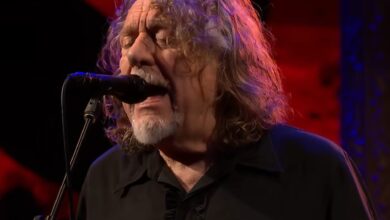
Robert Plant approached the night without pretending time had stood still. His voice carried age, history, and wear, and that honesty gave the performance its credibility. He didn’t chase the past. He stood in the present and let the songs adapt. That choice made the music human instead of ceremonial. John Paul Jones provided the quiet center that kept everything upright, anchoring the structure so emotion never tipped into chaos. Jimmy Page, prepared and focused, played with commitment rather than nostalgia, treating the night like something earned rather than something owed.
After the final notes faded, the most important thing about the night became clear in what didn’t happen next. There was no reunion tour. No attempt to stretch the moment into a new chapter. The band stepped away again, preserving the meaning of what had just occurred. Years later, the release of the concert film and album gave the night a permanent form, not as a starting point, but as a closing statement. It allowed people to revisit the performance without turning it into an ongoing demand.
The official concert film captures the night in full, documenting not just the sound but the pacing, the restraint, and the way the band navigated two hours without leaning on spectacle. Watching it reinforces how carefully the performance was shaped and why it still stands apart from typical reunion shows. It feels intentional from start to finish, with no sense of coasting or obligation.
Studio recordings of songs like “Kashmir” remind listeners what the original blueprint sounded like: controlled, immense, and meticulously layered. Placed alongside the O2 performance, the studio version highlights how much of Zeppelin’s identity lived in feel rather than precision alone. The live version doesn’t replicate the studio. It interprets it through time.
Other historic live performances from earlier eras show Zeppelin at their wildest and most untamed, stretching songs beyond structure and into chaos. Comparing those nights to the O2 reveals what changed and what didn’t. The recklessness faded, but the authority remained. The music aged, but it didn’t weaken.
Later-era live recordings by other legendary bands often show what happens when reunion becomes routine. Set against those, the O2 concert feels restrained in the best way. It happened once, with purpose, and then it ended. That decision preserved its power.
In the end, the O2 Arena night wasn’t about breaking a rule. It was about honoring it carefully enough to let the music speak one last time. Led Zeppelin didn’t prove the past could be rebuilt. They proved something rarer: that knowing when to stop can be just as meaningful as knowing how to return.