Three Days Grace Ignite Nationwide Arena With A Powerful Anthem In Columbus, Ohio On March 8, 2026
On March 8, 2026, Three Days Grace turned Nationwide Arena in Columbus into the kind of hard-rock pressure cooker where an old anthem can suddenly feel brand new again. “Just Like You” has always carried a sharp, restless pulse, but this performance hit with extra meaning because of where the band stands in 2026. The Alienation Tour has been defined by a renewed sense of identity, with Adam Gontier back in the fold alongside Matt Walst, giving the group a bigger, more layered live presence than fans had seen in years. In Columbus, that chemistry gave the song a fresh edge. It was not simply a nostalgic play for longtime listeners. It felt like a statement, a reminder that Three Days Grace can still make a familiar chorus sound like it belongs to the present tense, not just the memory of an earlier era.
That matters because “Just Like You” is one of those songs that helped define the band’s early emotional vocabulary. It arrived in the 2000s with that instantly recognizable Three Days Grace formula: tight, driving guitars, a hook simple enough for an arena to scream back, and lyrics that captured alienation without sounding theatrical. Two decades later, the challenge for any band is avoiding the museum effect, where classic songs survive only as fan service. In Columbus, that did not happen. The performance carried enough bite to escape nostalgia and enough warmth to acknowledge what the song means to people who have been following this band for years. There is a real difference between a song being played because it is expected and a song being played because it still works. This version felt very much like the second kind.
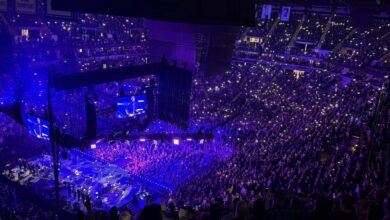
Nationwide Arena was the right setting for that kind of moment. It is a big room, capable of swallowing lesser performances, but when a band knows how to pace a set, the place can turn into a giant amplifier for crowd emotion. Three Days Grace were deep enough into the evening to understand exactly how to use that energy by the time “Just Like You” arrived. The March 8 show ran as a full-scale arena production on the Alienation Tour, with the band taking the stage after 9 p.m. and delivering a set that mixed newer material with older staples. “Just Like You” landed in the later stretch of the night, after the audience had already been pulled through bruising newer songs, old radio giants, acoustic detours, and a few emotional turns. That placement made the song feel earned, almost like a second wind breaking open inside the building.
The broader setlist helps explain why the Columbus version stood out. This was not a short nostalgia sprint built around obvious singles. It was a substantial 25-song show that moved through “Dominate,” “Animal I Have Become,” “So Called Life,” “Pain,” “I Hate Everything About You,” “Lost in You,” “Lifetime,” “Mayday,” “Never Too Late,” and “Riot,” among others. That range matters because it showed the band refusing to reduce themselves to one chapter of their history. By the time “Just Like You” arrived as song number twenty, it had context. It was no longer just an old hit from the self-titled years. It became part of a bigger argument about continuity, survival, and reinvention. In a set built to prove that different eras of Three Days Grace can coexist, “Just Like You” suddenly sounded like a hinge point between the band’s past and present, instead of just one more box checked for the crowd.
One of the most interesting things about the current version of Three Days Grace is how the two-vocalist structure changes the emotional texture of older songs. Even when one singer is clearly carrying the lead, the band now feels wider, more conversational, and more dynamic in performance. That is especially effective on a song like “Just Like You,” which thrives on contrast between restraint and release. The verses need tension. The chorus needs lift. In Columbus, that push and pull came through in a way that made the track feel larger than its studio DNA. Instead of simply recreating the old recording, the band treated it like living material, something that could absorb a different stage energy and a different era of musicianship. That is what longtime bands need if they want their catalog to stay alive. They do not need perfect replicas. They need songs to breathe differently in front of people.
The crowd’s role in that transformation should not be overlooked. Three Days Grace have always built songs that invite mass participation without becoming empty chant machines, and “Just Like You” may be one of the clearest examples. The chorus is built for collective release. In Columbus, with thousands packed into the room, that release felt enormous. Arena rock lives or dies on whether the audience becomes part of the arrangement, and here they absolutely did. The response sounded less like polite appreciation and more like recognition, as though the entire room knew exactly where the song sits in the band’s emotional history. That is one reason live versions of older singles can still matter. When a crowd locks into them at the right moment, the song stops being a performance and turns into a shared reflex. That is what gave this rendition its pulse. It was not just heard. It was activated.
There is also something compelling about the contrast between the band’s newer material and an older song like this on the same tour. The Alienation era has brought fresh songs and a revived spotlight, but the old catalog still carries enormous emotional weight. In Columbus, “Just Like You” benefited from being surrounded by songs that are heavier in places, moodier in others, and broader in production. Against that backdrop, its straightforward attack felt almost refreshing. The riffing is direct. The hook is immediate. The emotional angle is blunt in the best possible way. Sometimes a band’s older material can sound smaller beside modern arena production. Here, the opposite happened. The relative simplicity of the song made it hit harder. It cut through the set rather than disappearing into it, and that clarity is a big part of why this performance lingered as one of the show’s most satisfying turns.
Columbus also caught the band at an important moment in the tour’s narrative. By early March, the 2026 run had already established itself as more than a routine lap around old markets. There was genuine interest around the reunited lineup, the dual-vocal setup, and the way the band was rebalancing its catalog. Fans were watching to see whether the chemistry would feel real in full-size rooms, not just in clips and headlines. Performances like “Just Like You” helped answer that question. They showed that the band was not leaning on reunion novelty alone. They were actually finding new dramatic value in familiar material. That is a crucial distinction. Plenty of tours arrive with a good press angle and fade once the lights go up. This one has felt stronger because the songs themselves are carrying the story. In Columbus, “Just Like You” sounded like proof of concept delivered at arena volume.
Watching the fan-shot footage from Columbus makes the appeal of this version easy to understand. A good fan clip often captures what polished concert edits smooth out, and that rawness works in the band’s favor here. The camera may not be perfect, but the atmosphere comes through clearly: the size of the room, the force of the crowd reaction, and the way the song lands as a genuine event rather than a routine selection. There is a specific thrill in seeing an arena sing back a chorus that has outlived trends, lineup changes, and the normal erosion of time. The clip also underlines how late in the set the song appears, which adds to the sense of catharsis. By then, the room is fully warmed up, the band is locked in, and “Just Like You” arrives with the feeling of a release valve opening. That timing is a huge part of what makes the Columbus performance feel bigger than a casual archive upload.
Returning to the official video after hearing the Columbus performance is revealing because it shows how much of the band’s identity was already present in the song from the start. The studio version has the compact efficiency that made early-2000s hard rock so effective on radio and on television. Nothing is wasted. The hook arrives fast, the guitar tone is cleanly aggressive, and the vocal phrasing sells frustration without oversinging it. But the live 2026 reading brings something the original could not possibly contain: time. It carries the weight of years, the knowledge of what the band went through, and the reaction of listeners who have lived with the track long enough for it to become part of their own personal soundtrack. That is why comparing the two is so satisfying. The studio version explains why the song broke through. The Columbus version explains why it stayed.
A great live performance does not always reinvent a song structurally. Sometimes its value lies in emotional recontextualization, and that is exactly what happened here. “Just Like You” was once the voice of youthful frustration, the sound of a band introducing its emotional blueprint to a mass audience. In 2026, the same song carries that original edge, but it also feels seasoned by endurance. That is especially striking in a band like Three Days Grace, whose music has always lived in the space between vulnerability and force. In Columbus, the song still punched, but it also resonated differently because the band’s current era is built on reconciliation, coexistence, and continuity. The performance did not soften the song. It deepened it. That is a much harder trick to pull off than simply playing the hit cleanly, and it is one of the main reasons this version deserves more than a passing mention in tour recaps.
Another useful comparison comes from a more recent live-era performance of the same song outside the Columbus context. Hearing “Just Like You” in a different room, from a different year, helps isolate what March 8, 2026 did so well. The Denver-era footage shows that the song has remained a durable part of the band’s arsenal, but Columbus feels more charged because of the current lineup story and the larger tour stakes. Arena shows generate a different kind of emotional scale, especially when a band is riding renewed attention and visibly enjoying the moment. The older live clip demonstrates the song’s consistency. The Columbus clip demonstrates its escalation. That difference matters. A song can survive on muscle memory for years and still suddenly bloom under new circumstances. That is what happened in Ohio. The song was not merely stable. It was newly vivid, which is why comparing live eras only makes the Columbus rendition look stronger.
Including a newer live performance of “Never Too Late” in the conversation also helps clarify what kind of emotional lane Three Days Grace currently occupy onstage. “Never Too Late” leans toward uplift and ache, while “Just Like You” punches more directly at irritation, defiance, and raw self-definition. Hearing both in proximity highlights how important balance has become to the band’s current shows. They are not just hammering through heavy songs. They are shaping an emotional arc. That matters in Columbus because “Just Like You” hits harder when it is part of a wider spectrum rather than presented in isolation. The audience is not merely reacting to one riff or one chorus. They are riding a full-band narrative that moves from pressure to release, from confrontation to reflection and back again. In that context, “Just Like You” becomes one of the set’s sharpest turning points, precisely because it delivers direct impact after more layered emotional terrain.
The official “Never Too Late” video is useful for another reason: it reminds anyone revisiting this catalog just how central emotional accessibility has always been to Three Days Grace’s appeal. They were never a band built purely on heaviness or image. Their major songs connected because listeners could project themselves into them almost immediately. “Just Like You” has that same gift, but in a more confrontational mode. In Columbus, that quality was amplified by the size of the room and the maturity of the band. The song no longer sounded like a complaint thrown into the void. It sounded like a bond between stage and audience, an old declaration still sturdy enough to hold thousands of people at once. That is why it still lands. The lyrics are not obscure. The construction is not complicated. But the emotional architecture is strong enough that, when played right, it still fills a modern arena with something much bigger than simple recognition.
Looking back at an older live performance of “Just Like You” from Toronto offers a final angle on why the Columbus version mattered. The Toronto clip has that rough, straightforward electricity that longtime fans will recognize immediately, and it shows how naturally the song has always worked in a live setting. But the March 8, 2026 performance carries an extra dimension because it sits inside a more layered chapter of the band’s history. There is more biography in the room, more narrative around the lineup, more curiosity from fans, and more pressure on the band to prove that this era is not just sentimental but musically convincing. Columbus answers that challenge beautifully. The song retains its old snarl while gaining broader emotional reach, and that is not something every band can pull off with legacy material.
In the end, what made “Just Like You” in Columbus so memorable was not novelty, spectacle, or some drastic arrangement overhaul. It was conviction. Three Days Grace took a song that has lived with their audience for years and played it as though it still had unfinished business. That is the difference between a competent live catalog run and a genuinely meaningful concert moment. The March 8 performance carried the force of a band that understands its history but does not want to be trapped by it. In an arena show loaded with big titles, emotional pivots, and renewed chemistry, “Just Like You” stood out because it distilled everything that currently makes the band compelling: durability, directness, crowd connection, and the sense that old wounds and old songs can still produce fresh sparks when the timing is right.