Meet Lincoln — The Rescued Eagle Whose Real-Life Journey Turned a Super Bowl Ad Into an Emotional Event
If you saw that eagle lift off at the end and thought, “No way that’s real,” you’re not alone. But the bird is real, and his story is the kind that feels like it was written for a Super Bowl screen. His name is Lincoln, and long before millions watched him soar in a Budweiser spot, he was a struggling bald eagle whose life depended on people stepping in at the right time.
Lincoln’s story begins in Tennessee with the kind of fragile start most wild animals never survive. The details that matter aren’t cinematic at first—they’re practical: survival, feeding, safety, basic instincts. And that’s exactly why his life later became so powerful on camera. Because when an animal can’t be raised normally, the consequences are lifelong. In Lincoln’s case, the missing piece was the most important one: learning how to hunt and fend for himself.
That one gap changes everything for a bald eagle. Eagles don’t just “figure it out” later like a house cat getting braver. Hunting is learned, practiced, refined, and passed down. When that chain breaks—when a young eagle is raised without the right conditions—nature doesn’t give extra chances out of kindness. Nature simply moves on. That’s why Lincoln’s early life didn’t lead to a clean, triumphant release into the wild.
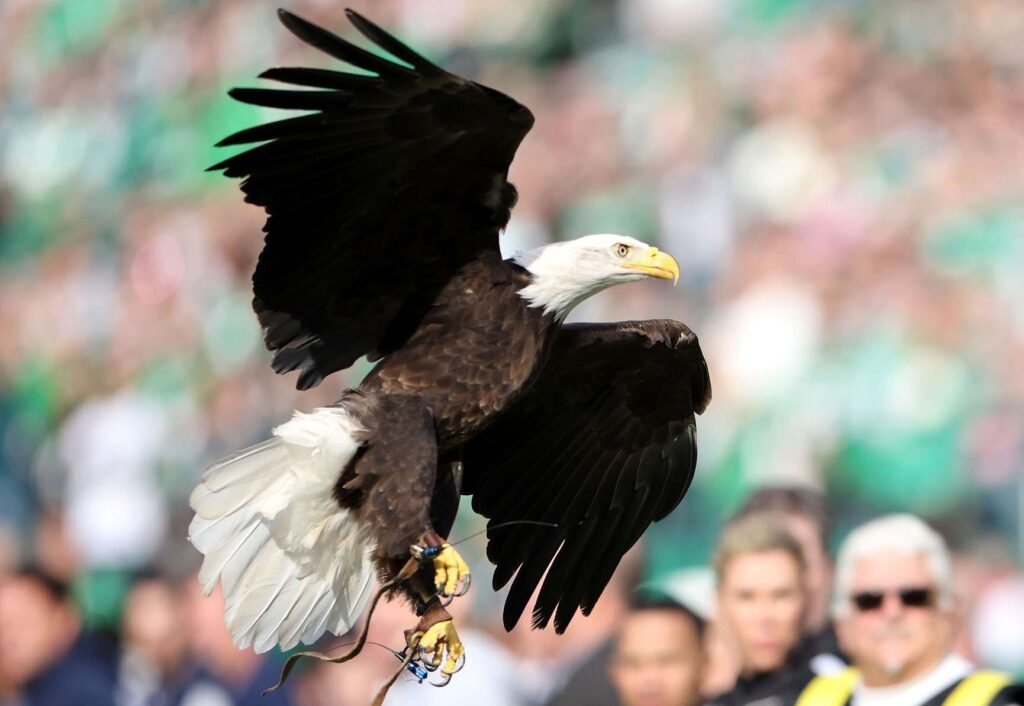
Eventually he came under the care of American Eagle Foundation, a group known for rescuing and caring for birds of prey and educating the public. Their job isn’t to “collect animals” for show; it’s to do the hard reality-based work: determine what’s possible, what’s not, and what kind of life an eagle can still have if the wild is no longer an option.
The most heartbreaking chapter is also the most telling: Lincoln was released into the wild twice, and both times it failed. Not because he refused freedom, but because freedom without survival skills is just a slow emergency. Each time, he was found again in terrible condition—thin, weak, unable to sustain himself the way a wild eagle must. Those are the moments that force experts to make the call nobody romanticizes: this bird cannot safely live on his own.
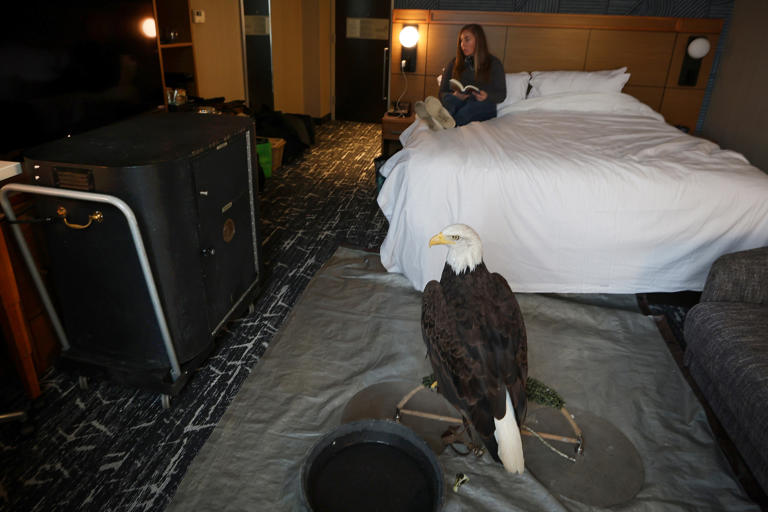
At that point, the story shifts from “rehabilitation” to “purpose.” A non-releasable eagle still needs enrichment, structure, activity, and a meaningful life. That’s where training enters—but not training in the circus sense. Think of it as building confidence, fitness, and reliable behavior patterns so the bird can move safely in controlled environments, handle noise and distance, and remain calm under conditions that would normally send a wild eagle into panic.
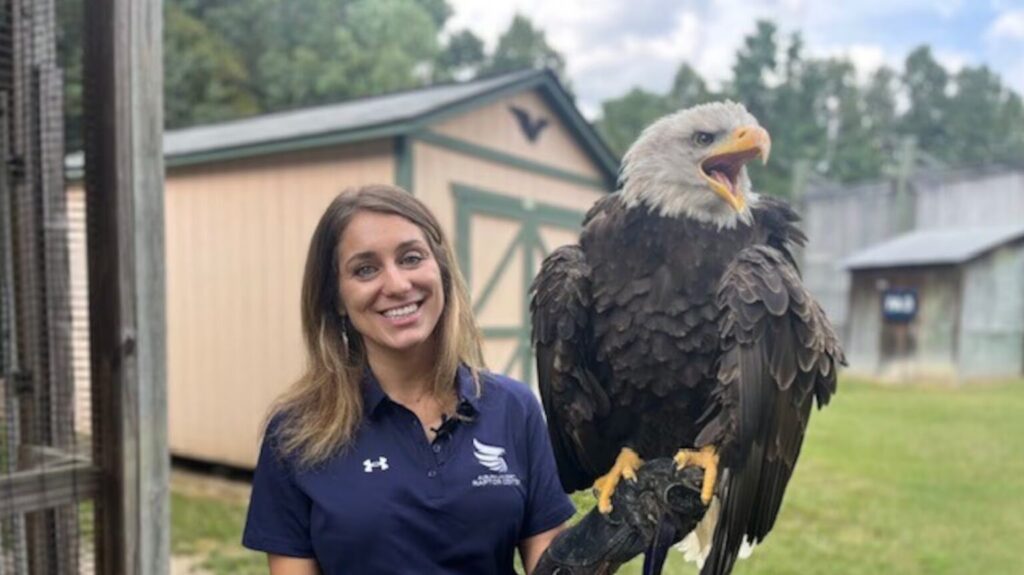
And this is where the timeline matters. Lincoln wasn’t prepared for stadium flights overnight. He wasn’t turned into a “symbol” in a month. According to the accounts around him, it took years of careful preparation—gradual exposure, controlled practice, repeated routines—until he could do something that looks effortless to the crowd but is actually the result of deep trust and consistent handling.
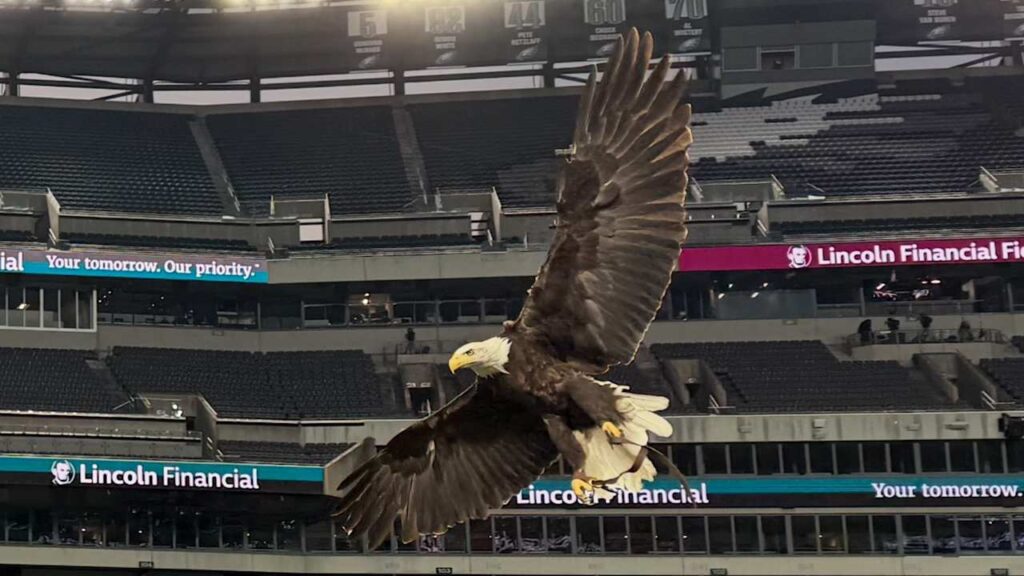
The idea of flying an eagle in a stadium sounds simple until you imagine what a stadium actually is for an animal: echoing sound, shifting light, sudden movement, unpredictable energy, massive open air, and thousands of people who instinctively react at once. A single unexpected moment can become dangerous—for the bird and for everyone around. So when Lincoln takes off and returns calmly, it isn’t just a “cool pregame moment.” It’s the visible tip of years of invisible work.
That’s why it’s so fitting that Lincoln became associated with Philadelphia Eagles home games. Not as a cartoonish mascot in the traditional sense, but as a living symbol that appears during a moment of collective attention—often around the national anthem—when the entire stadium goes still and looks up. In a weird way, it’s the opposite of modern hype. It’s a pause. A shared breath. A reminder of something larger than the scoreboard.
And the setting reinforces the symbolism, because even the place carries his name: Lincoln Financial Field. When Lincoln flies there, it doesn’t feel like a random stunt. It feels like a ritual. Fans describe it as one of those moments that makes the hairs rise—part sports tradition, part patriotic imagery, part pure animal awe. The crowd’s reaction isn’t just “that’s neat.” It’s the quiet shock of seeing something real.
That “realness” is exactly why Budweiser’s camera found him. In an era where so many commercials look synthetic—over-polished lighting, perfect CGI, fake “imperfect” moments—Lincoln brought authenticity that can’t be manufactured. When a real animal moves, there’s a truth in the motion. The wingbeats aren’t timed like animation. The lift isn’t edited into existence. You feel the physics. And that feeling lands emotionally even if the viewer can’t explain why.
So when Budweiser chose to end its Super Bowl story with Lincoln, it wasn’t just picking an eagle because eagles look cool. It was choosing an animal whose real-life arc already carries the themes the ad wants to evoke: rescue, resilience, second chances, and a different kind of freedom—freedom that exists inside care and protection when the wild isn’t possible.
The music choice turns that emotional math into a punch. Free Bird isn’t just background sound; it’s cultural memory. Its rise feels like liftoff. Its swell makes the final image feel bigger than a commercial. Put that song under a real eagle’s wings and your brain doesn’t file it under “ad soundtrack.” It files it under “moment.” That’s why people got emotional without even wanting to.
And then there’s the detail viewers keep repeating: the eagle at the end was not AI. That line matters because it’s a subtle protest against modern media fatigue. People are tired of being tricked. Tired of asking, “Is this fake?” Lincoln’s presence answers that question with a simple truth: this bird exists, and he has lived through things that make his flight meaningful. That knowledge hits harder than any special effect.
If you want to summarize Lincoln’s story in one sentence, it’s this: he couldn’t survive in the wild, but he didn’t become a tragedy. He became a bridge between people and what they’ve forgotten how to feel—quiet awe, steady tradition, and emotion that isn’t forced. That’s why his final flight in that commercial didn’t feel like a gimmick. It felt like a payoff.
And that’s the real behind-the-scenes twist: the most powerful “creative decision” wasn’t a camera angle or an edit. It was choosing a living animal with a real history, letting that truth do the heavy lifting, and trusting the audience to feel it. Lincoln’s flight isn’t just an ending shot. It’s the visible proof of a life redirected—away from survival in the wild, and toward purpose in a world that still needs symbols that are actually real.