Def Leppard Bring “White Lightning” Back To Life At Las Vegas Residency Opener — February 3, 2026
Las Vegas has seen every kind of spectacle, but on February 3, 2026, The Colosseum at Caesars Palace felt like it had been rewired for one thing: a band deciding to treat a residency opener like a statement. Def Leppard didn’t walk out like a nostalgia act doing the safest hits in the safest order. They walked out like they had something to prove, and the room could feel it before the first chorus landed. This was night one of a February run, and the vibe had that rare “first page of a new chapter” energy, where even longtime fans lean forward because they don’t know what’s coming next.
What made the opener instantly different was the sense that the show had been rebuilt from the ground up. The band had talked about scrapping previous touring production and coming in with a fresh stage approach, and you could hear that intention in the pacing. The transitions weren’t lazy. The set moved like a story instead of a checklist. The Colosseum’s theater-style intimacy did the rest: you’re not watching a distant light show in an open field, you’re watching a band inside a room that was designed for big voices, big moments, and details you normally miss in an arena.
They kicked off by leaning into drama, dropping a classic-rock curveball right away. Instead of easing into familiar comfort, the night began with “Funeral for a Friend / Love Lies Bleeding,” a move that signaled they were willing to make bold choices in a venue where every choice is magnified. It set a cinematic tone, like the curtains had opened on something larger than a “Vegas greatest-hits night.” The riffing and dynamics were the kind that make a crowd instantly lock in, because you realize the band is steering, not coasting.
Then came the real headline of the early stretch: “Rejoice,” performed as a live debut. That’s the kind of move bands talk about but don’t always execute on a high-profile first night, because a new song is always a risk. Here it played like a mission statement, not an obligation. The chorus hit with that “oomph” they’d been teasing in interviews, and the crowd reaction mattered: it wasn’t polite. It was engaged. You could feel people deciding, in real time, whether this new chapter deserved a place next to the classics.
Once the room was fully in their hands, they started stacking recognizable pillars: “Animal” and “Let’s Get Rocked” came in like a one-two punch that reminded everyone why Def Leppard’s greatest skill is turning melody into mass participation. In a theater, that effect is even more intense. Instead of sound disappearing into open air, it bounces back at you. When a chorus hits, you don’t just hear it—you feel it because the audience becomes part of the band’s volume. It’s the kind of setting where singalongs don’t drift; they snap into place.
And then, just when the set could’ve stayed predictable, they dropped the kind of surprise that launches a thousand posts the moment people walk out: “Personal Jesus,” played live for the first time. A cover can feel like filler, but this one was placed like a dare. It was gritty, punchy, and felt designed to wake the room up again after the early run of hits. The reaction was that perfect mix of shock and delight—people looking at each other like, “Wait… they’re doing this? Tonight?” That’s what a residency should be: a place to take chances with confidence.
From there, the show didn’t just chase novelty. It balanced the deep-cut thrill with the emotional core of what Def Leppard does best. “Bringin’ On the Heartbreak” arrived with that familiar ache, and “Switch 625” added the instrumental sting that reminds you how much of their identity lives in the guitars as much as in the choruses. This is where the “new stage, new flow” idea really paid off: the set moved like a rollercoaster. Up-tempo celebration, then a darker turn, then a surge back into fireworks. No dead zones.
“Just Like ’73” added a modern pulse without breaking the mood, and “Rocket” brought the room back into that big, communal groove that feels engineered for a Vegas theater. This is the part of the night where you can tell whether a band still has command, because you stop thinking about time. You stop thinking about what song you want next. You just follow. The audience isn’t bargaining with the setlist anymore; they’ve surrendered to it. That’s when a show becomes more than a collection of tracks.
There was also a playful curve in the middle with “Rock On,” and it worked because it didn’t feel like the band was trying to be cute. It felt like the band was comfortable. Comfort, when it’s earned, reads as swagger. And swagger is contagious. You could see people who came in cautious—maybe expecting a standard legacy-night—starting to loosen up. The room started to behave like a single organism: cheering at the first note, singing before the lyric even arrived, laughing at the little surprises, and trusting that the band was going to land the plane.
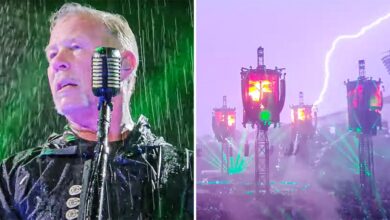
Then the moment your caption is built for arrived: “White Lightning.” Not just played, but played as the kind of centerpiece that makes a deep cut feel like a headline. Reports noted it hadn’t been performed live since 1993, and hearing it in 2026, in that room, gave it weight beyond “rarity.” It’s a song tied to memory and meaning—dedicated to Steve Clark—and in a residency opener, it felt like the band choosing to honor their own history without turning it into a museum. The performance didn’t beg for sentiment. It carried it.
What was striking about “White Lightning” in particular was how it changed the air in the room. You could feel fans reacting not just to the song, but to what it represented: the band acknowledging the past openly, then playing forward anyway. This is the kind of track that separates casual listeners from the people who’ve lived with the catalog for decades. And that’s exactly why it hit so hard in a theater setting. It wasn’t distant. It wasn’t swallowed by arena reverb. It was right there, close enough to feel personal.
After that, the set didn’t let the emotion linger too long without release. “Foolin’” arrived like a burst of adrenaline, and then “Slang” appeared as another sign that this night was not trapped in one era. A lot of bands talk about mixing eras; fewer bands actually put the riskier picks into the early weeks of a residency when the spotlight is sharpest. That choice matters. It tells fans you’re not going to get the same night copy-pasted twelve times. It tells them they should come back—or at least keep watching—because anything could rotate in.
“Promises” pushed the night into that big, polished anthemic zone, the place where Def Leppard’s songwriting shines: simple on paper, huge in the room. By this point the crowd was fully activated, and the later stretch started to feel inevitable—like the band had built a staircase and now everyone was ready to run up it together. That’s the difference between a good setlist and a well-told show. A setlist lists songs. A show builds momentum so the final run feels like the only possible ending.
“Armageddon It” and “Love Bites” were the kind of late-set pairing that makes people start thinking, “How is this still getting better?” One is pure fire and bounce; the other is pure emotional gravity. In Vegas, with a crowd that came specifically for this night, “Love Bites” doesn’t feel like a slow moment—it feels like a communal confession. People sang it with that half-smile, half-heartbreak look that only happens when a song has lived inside someone’s life for a long time.
Then the closing stretch hit the classics with purpose: “Rock of Ages,” “Photograph,” “Hysteria,” and “Pour Some Sugar on Me.” In a lesser show, these can feel like the predictable finish line. Here they felt like the victory lap the band earned by taking risks earlier. The audience wasn’t just waiting for the hits; they were grateful for them, because the night had already surprised them. When “Hysteria” washed over the room, it felt like a warm flood. When “Sugar” arrived, it wasn’t just celebration—it was release.
By the time the lights came up, the takeaway wasn’t only that Def Leppard played a strong Vegas opener. It was that they reminded everyone what a legacy band looks like when it refuses to behave like one. New song, rare returns, first-time live surprises, and then the biggest choruses delivered with total command. And “White Lightning,” sitting in the middle like a lightning bolt of meaning, became the symbol of the night: a band honoring where it came from while still moving like it has somewhere to go. That’s how a residency becomes an event instead of a rerun.