How Angus Young’s Guitar Part Found Its Way to a School Mallet Section
The beginning of “Thunderstruck” is recognizable even when the instrument changes. A viewer under the halftime video credited whoever decided to move Angus Young’s guitar line to the mallet section. It sounds like a simple idea, but the musicians still have to make the new instrument do the work.
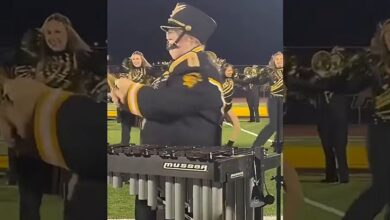
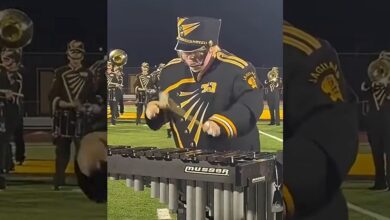
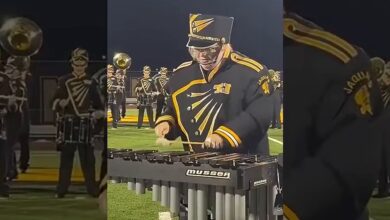
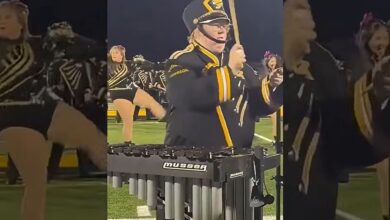
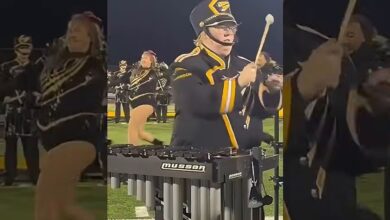
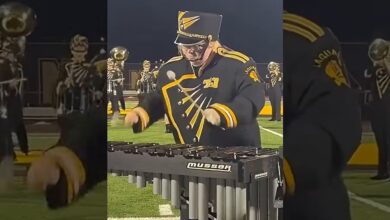
On guitar, the notes share a string and a recurring pitch ties the changes together. On marimba, the player moves physically between separate bars. Clark’s mallets give each note its own attack, yet the pulse keeps the line recognizable before the band adds the rest of the arrangement.
The choice fit the Thomas Jefferson show. The tune was one of several classic-rock selections the Jaguars played during the 2025 season. By leaving the opening to mallet percussion, the arrangement preserves the way the song starts with one strong idea and then expands.
Listen for the same pattern on the original record and the school video. You can hear where the arrangement stays close to Angus Young’s part and where the timbre of the marimba gives the passage a character of its own.
What the arranger had to keep from Angus Young’s part
Some guitar riffs are recognizable because of the exact distortion or the weight behind the attack. This one has an unusually strong shape even when you take away both. The repeated pitch gives the listener a point of reference, and the notes around it create enough movement to keep the pattern from sitting still. Listen for the returning pitch in both versions. As soon as you recognize its role, the school arrangement stops sounding like a gimmick and starts to sound like a decision about what makes the song identifiable.
On a guitar, a player can move between a fretted note and another pitch with relatively little movement of the hand. The marimba asks for a different kind of precision. The pitches are physically separate, and each strike has to land where a wooden bar can speak clearly. The line keeps its identity because Clark and the other players keep the timing and contour recognizable. The sound has changed, but the listener still gets the quick alternation between the familiar note and the one that moves the phrase forward.
The resonators under the marimba also do something a guitar amplifier doesn’t. They reinforce the sound of the bar after it’s struck. From the phone microphone you can hear the attack first and a short rounded sound after it. That leaves a bit of air between consecutive notes even when they arrive quickly. The texture is one reason the video is good for hearing the outline of the figure. The guitar version has a different bite, but the space between notes can be easier to pick out here.
A school arrangement doesn’t have to reproduce every part of the record in the same order or with the same weight. It does need to give people a reason to hear the connection. Leaving the mallet players alone at the start helps with that. The audience has time to place the song and notice what is different about the instrument. After that, the Jaguars can use the rest of their lineup to build an entrance that suits a football field. Recognition makes the new part easier to follow.
How to listen for the handoff
AC/DC chose the song as the opener on The Razors Edge in 1990. Listening to the two openings back to back makes a useful comparison. In the rock recording, the guitar gives the rest of the track something to gather around. In the school clip, several mallet players have that job. It is the same responsibility at a different scale. One of the most interesting sounds is the point where the identity of the riff is no longer up for debate and the arrangement can move on to adding weight.
You can test how much of the riff survives the arrangement by listening without the picture. See how long it takes to place the song. Then do the same thing with the image on and look at Clark’s hands instead of trying to follow every note. The ear recognizes the pattern faster than the eye can trace all the strikes. That is a sign of how well the musicians have preserved the musical logic of the part while asking a different instrument to carry it.
The camera gives one player much of the attention, but Clark said five mallet percussionists were involved in the opening. The arrangement asks them to act like one section when listeners recognize the tune. The attacks need to stay close enough together that the repeating note feels like a single line. If the passage works, you can hear a strong point of focus even though several people are contributing to it. That is as much a part of the idea as handing the guitar notes to a different instrument in the first place.
There is room in the comparison for both kinds of playing. Young’s part gives the song a clear identity. The school band’s part lets you hear that identity in another setting. The familiar pattern can be passed around because it has enough musical character to stand on its own, and the band can make it sound natural because the mallet players treat its timing as seriously as its notes.
The compliment in the comment goes to the idea, and the video gives you a chance to hear the execution. Once you know what to listen for, the musicians show how much of a famous passage can survive a change of instrument, a change of venue and a completely different group waiting to come in behind it.