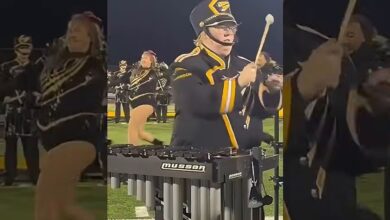
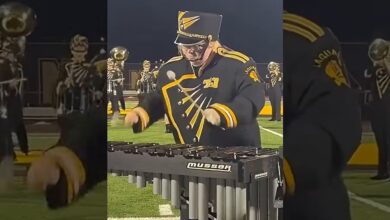
The Practice You Can Hear in Layla Clark’s First Few Notes
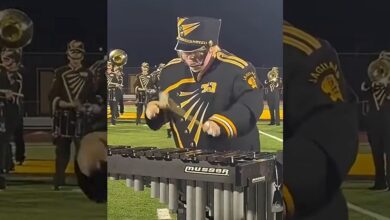
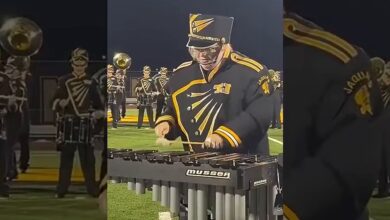
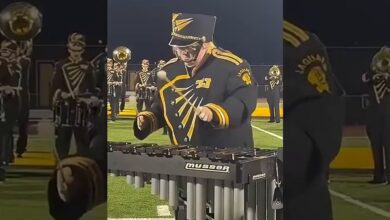
Layla Clark makes quick work of a pattern that took her a long time to learn. A viewer put the relationship between those two things plainly: this is what practice sounds like when it pays off. The performance gives you a few specific places to hear it.
Clark told CBS Pittsburgh the part took time to get down. Her mother told the Pittsburgh Post-Gazette that much of the work happened on a small glockenspiel at home. The small bars made each move demanding, even before the sound had to carry across a football field.
The marimba at the game has a different scale and sound. The part still calls for a recurring note and a series of quick trips away from it. Watch the return rather than the biggest movement. Each time her hands come back in time, the next phrase has somewhere to start.
Clark has said she can still hear things she wants to improve. That detail makes the apparently effortless playing feel more like a moment in an ongoing process. The riff holds together because she and the other players had put in the time before anyone pressed record.
What a small practice instrument can teach
The contrast between Clark’s practice setup and the football field is one of the more revealing details in her story. She told CBS News Pittsburgh that she worked on the part at home on a small glockenspiel. The footage that made people pay attention, by contrast, shows a full marching-band performance with more players, space and noise. Those settings ask different things of a musician. At home, a mistake in the repeating pattern has nowhere to hide. On the field, the part has to keep its shape as other sounds enter and the audience takes in the whole show.
A little set of bars can still make a demanding practice surface. There is less room for a strike to land, and a hand reaching for the next pitch may travel a different distance than it would on a larger instrument. What carries over is knowledge of where the pattern turns and how the rhythm is supposed to feel. A musician can work out the sequence in one setting and still need time to adapt it in another. That is part of what makes the home detail interesting. It shows how preparation can begin before the exact performance conditions are available.
A repeating line is often easiest to understand by looking at what happens at its edges. An isolated pass ends when the player wants it to. In the actual music, the last note of one pass has to lead straight into the first note of the next. Any hesitation at that junction makes the pulse waver. A practice session might therefore spend longer on a small transition than on the complete tune. That is a common way to tackle such material. Clark’s published account describes her instrument at home, while the clip lets us hear how smoothly the finished pattern repeats.
Speed gets the first reaction because you can see it. The second listen tells you more about the musician’s control. Do the notes keep landing at the same intervals? Does one passage get quieter when the reach changes? Is the pattern still clear as the band begins to add weight? These questions help explain why people can watch a short performance several times without tiring of it. They also explain why a piece that sounds immediately familiar can take time to prepare. Every small variation is audible against the memory of the phrase you just heard.
What rehearsal adds to the work at home
There is a point when knowing your own part becomes the beginning of the job. Playing with other people means agreeing on tempo and attack while listening for sounds you cannot produce by yourself. In Clark’s interview about the arrangement, she described five mallet players on the opening. A figure rehearsed alone has to sit inside that group sound. Everyone has to be able to repeat it cleanly enough that the rhythm stays readable. Then the same group has to fit into the larger band, whose entrance gives the opening a payoff the players cannot produce in isolation.
A recording can help show what the player in the room has stopped hearing. Under the hands, a pattern feels smooth when the movement is easy. On playback, the ear can find a late note or an accent the player hadn’t intended. For a section, playback can make it easier to hear whether several strikes are coming across as one. These are useful ways to understand the difference between playing through a part and preparing it for performance. They also offer a way for an audience to listen past the simple question of how fast the music goes.
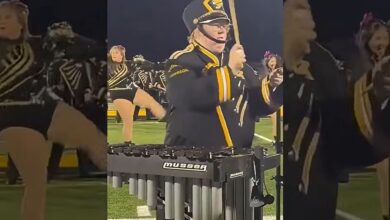
There is another change when the band goes out in front of people. A performance continues while the field, the stands and the rest of the players make their own demands on your attention. The video gives a small sense of that competing activity even as the camera stays with Clark. The timing needs to survive it all. Familiarity with the physical movement frees a musician to pay attention to the ensemble around them. In a successful entrance, that work disappears into the simple impression that everybody knew exactly where to come in.
It is easy to hear the AC/DC riff as a piece of spectacle because the original is so familiar and the change of instrument is so striking. The little glockenspiel story brings the scale back down. A piece of music that reaches a crowd can begin with someone repeating a short phrase at home, trying to make the next pass sound as even as the last. The video gives that private work a public sound. Its payoff is audible both in the opening itself and in the moment when the Jaguars build a whole field performance around it.
That makes the clip worth sharing with someone learning any instrument, even if they have never handled a pair of mallets. A viewer can recognize the result in seconds. The work behind it is made of smaller achievements that are harder to film: finding the notes, carrying the pulse through another repeat and learning how your sound fits the section. Clark and the Jaguars make those steps audible in the same short passage. You can hear the consistency before you know anything about how the arrangement came together.