How Aerosmith and Run-DMC Made Room for Each Other on the Rock Hall Stage
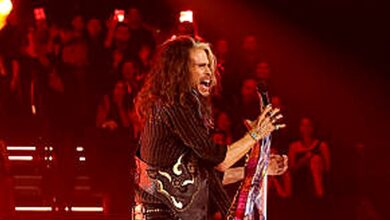
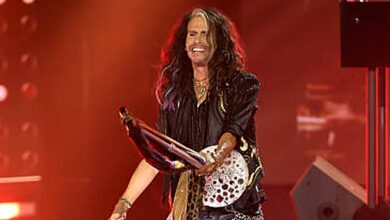
From the wide shot of the Rock Hall stage, you can see “Walk This Way” become a collaboration before you hear anyone rap. Joe Perry has started a guitar part the audience knows. Steven Tyler stops it. Rev Run and DMC come into view. The first few sounds are enough to tell the crowd what song is coming, and then the space around the microphone tells them who is about to make it their own.
That opening move matters at the end of an awards show. A stage full of names can get hard to read when everybody is singing together already. Aerosmith and Run-DMC give the audience a simple sequence to follow. Start with a recognizable guitar. Let the room hear the break. Give the two guests time to arrive before asking the band to get loud again.
The date was November 14, 2026, and the room was the Peacock Theater in Los Angeles. Chuck D introduced the finale, and Chad Smith played drums. The occasion honored producer Rick Rubin, who worked on Run-DMC’s 1986 recording of the Aerosmith song. Four decades later, the live version offered a practical demonstration of how two acts could share space inside the same riff.
Look at the distance the performers cover. With the guitar up front, the perspective belongs to Aerosmith. The arrival of two rappers redirects your eye and tells your ear where to look next. You can follow the gesture from a distant seat without knowing every prior version, because someone has given each performer an entrance with a clear musical purpose.
The handoff has a visual precedent. The 1986 music video gave the groups separate rooms and a wall between them. It made the moment they came together easy to understand in an instant. At the ceremony there is a much simpler set of signals. The musicians begin apart, one well-known figure stops and the next arrival tells you what was missing.
Watch the short space between the interruption and the restart in the audience footage. That is the part where people turn and look for the guests. Once those faces come together at the front, it gets easier to understand why a song that can sound crowded on paper feels so direct in a room.
Watch the performance
The first cue belongs to the guitar
Perry does a lot of work with a short figure. He can play a small part of the intro and expect people to recognize the tune from the exact shape of the guitar sound. Recognition is an unusually valuable tool on a stage this busy. An audience that has found its place in the song can sense immediately what it means when the guitarist stops, and then the anticipation belongs to the performers arriving next.
In the Aerosmith arrangement, Tyler’s rapid words are part of the rush around the riff. In the version with Run-DMC, its pulse is something the rappers can enter with a different feel. Keeping enough space around the riff at the start of the live performance preserves that possibility. Both groups get to respond to a sound the audience has already found a way to follow.
As the band comes back in, Chad Smith gives the timing a clear floor. With multiple microphones in use, the job really is to make it possible for different types of delivery to occupy the same measure. It is worth listening to the drums underneath a phrase that seems busy and then turning your ear to the next singer. The sense of a continuous song depends on the pulse carrying right through the change.
Listen to Perry again once the singers are in place. His timing remains legible even as the words begin to move faster. An audience member who catches only part of a verse can stay with the beat, because the guitar and drums still trace the figure in a form the ear already knows. That kind of clarity helps everyone on a crowded stage contribute something distinct.
What the group picture leaves out
The shared stage makes a good photograph, with a line of people drawn toward the center. The video adds the earlier information that makes the pose matter. In the first seconds there is a problem for a listener to resolve, however small it might be. The guitar has started and the singer has stopped it. When two figures appear, the audience gets to resolve that question for itself.
Different views of the recording are worth comparing. From far back you can see that an arrival changes the balance of the stage. Closer in, you can watch little physical decisions about whose microphone comes up and when Tyler pulls away. Both distances show a similar courtesy. A performer can take the foreground and still have an immediate plan for how to hand it over.
The next time you hear the song on a recording, think about how much it asks its performers to share. There is a melodic hook, a guitar figure that will be remembered immediately and room for more than one way of delivering a line. The reunion makes that division of work unusually visible. It takes a high-profile room and gives it the simple pleasure of watching people find their places in the same song.
That courtesy is part of what the applause registers. The audience gets the familiar riff, the pleasure of discovering the guests and the chance to hear how effectively the two acts keep an opening clear for whoever is about to speak.
Two more versions
A view from the Hollywood Bowl earlier that month shows the same two groups sharing a different amount of stage space. Look at how the entrances read from a seat much farther away, then compare the way the smaller Peacock Theater makes the final group easier to take in at once.
In Run-DMC’s official 1986 video, the wall does much of the work the live stage has to do with movement. The story is easy to recognize as soon as the camera sets the rooms next to each other. Seeing that visual idea makes Tyler’s choice to leave a gap at Rock Hall easier to appreciate.