The Queen Ballad That Lets Two Generations Hear Two Remarkable Voices
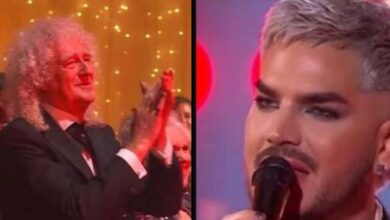
Some people heard “Who Wants to Live Forever” first as a Queen recording. Others already knew Adam Lambert’s voice when they found the song. Those two routes meet in the Stockholm performance, where Brian May and Roger Taylor are in the audience while Lambert sings it. In the same room you can see the people who helped give the ballad its life and hear a singer whose interpretation is now how other listeners know it.
The opening is an invitation to both groups. Lambert eases into the melody with a sound that has room for the words. If you know Freddie Mercury’s phrasing, memory can supply it almost immediately. If you are new to the piece, you simply hear how gently a singer can begin something which is going to occupy a much bigger space by its end.
May wrote the song for Highlander in 1986. The question behind it fits a film about immortality and the possibility that an unusually long life could be its own kind of loneliness. The lyric is direct enough to reach a listener who has never seen the movie. A voice that takes its time over the words gives people an entry point even without Queen’s history to guide them.
On the studio recording, May and Mercury have distinct roles within the same piece. May’s opening sound and the way Mercury opens out the melody help explain why a new vocalist can work here. The song grew up with two expressive characters inside it. Their difference has always been a part of its emotional movement.
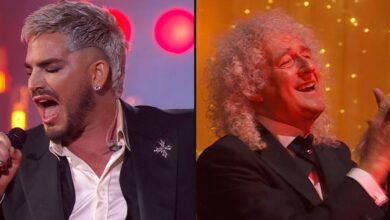
In May 2025, Lambert sang it at the Grand Hôtel in Stockholm for Queen’s Polar Music Prize ceremony. May and Taylor received the honor, and Lambert also gave the same audience “Another One Bites the Dust.” The ballad gave two of Queen’s musicians a particular listening position. They could sit where a fan might sit and hear a singer they had spent years performing with choose what to emphasize.
The audience reaction at the end is moving because there is a history behind those faces. Pay attention to the way the main vocal gets there. On a song whose title seems to look beyond the life of any single person, Lambert makes the words sound as if they belong to someone in the room today.
Watch the performance
How the song reaches a listener twice
One of the pleasures of a familiar Queen record is that someone can play it to you years after you first heard it and you will still remember where you were when it mattered. In a live performance with a new singer, the timing of a note or the grain of a vocal can bring the story back in a new way. Lambert’s Stockholm performance gives a listener time to notice that happening.
Mercury carries much of the drama on the original. Hear his strength where the lines widen and the high part of the voice steps forward, then pay attention to how Lambert makes his own changes in size. The singer a listener remembers has a place in the experience. The singer in front of them can still make decisions which the ear discovers for itself.
On first hearing the Stockholm recording, you might also make up your mind before the big note comes. The early phrases let individual words reach the listener with a clarity that can be easy to miss if a vocal arrives at maximum intensity. The smallness makes it easier to hear the human question in a song associated with the sound of Queen at full scale.
The distance between 1986 and 2025 gives the song another layer for people who have been listening all that time. It has served as a piece of film music, a Queen recording, a live ballad and a piece chosen to honor its band. The musical structure can bear those associations because it moves as simply as a question moving from one person to another.
Two faces in the audience
May and Taylor standing to applaud gives the cameras a way to mark the scale of the response in a few seconds. More than that, their presence ties the song you have just heard to the story of actually making it. A song that belongs to the public in a broad sense can have a very personal return to the people who recorded it. Stockholm lets you see something of that return.
If you grew up with Freddie Mercury, it is natural to remember what he could do with the melody when it began to rise. A new listener might carry away Lambert’s rather different way of letting the note grow. Someone who knows both can put on the Queen recording again and hear the clarity of its shape as if it had just been handed back to them.
The loveliest thing about these versions is the fact that they can stay in your listening life together. There is room for the thrill of hearing Mercury’s voice at the point where his recording opens out. It is possible to return the next day for Lambert’s patient phrases and the look of a room standing up. The different memories a song starts making are part of how it stays alive.
Two more versions
In Queen’s original video, you can hear the voice so many listeners associate with the ballad arrive after Brian May’s opening. Put the two singers’ entries side by side and notice how much the change in color helps the song expand. It is a good record to revisit after seeing what one singer does with the whole arc in Stockholm.
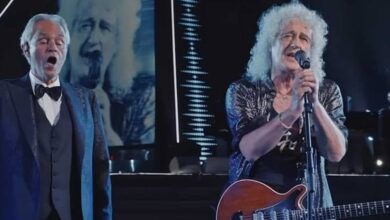
At the Teatro del Silenzio in Tuscany, May returned to his own song and sang it with Andrea Bocelli. May starts close to the words and Bocelli lets the melody open on a sustained tenor line. The contrast between their voices offers another way to hear a song whose identity has traveled through several generations.