Three Generations Could Hear Their Own ‘Walk This Way’ at Rock Hall
A crowd can hear the first few notes of “Walk This Way” together and still be thinking of entirely different records. Someone heard Aerosmith play it in the seventies. Someone else met the guitar through Run-DMC on MTV in the eighties. Younger listeners may know the same part from a playlist or a clip. At the Rock & Roll Hall of Fame, Steven Tyler could leave a single opening hanging long enough for all of those people to imagine what came next.
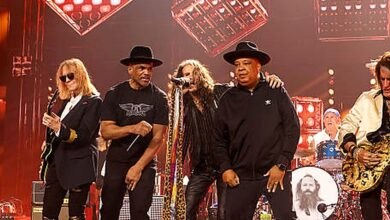
Joe Perry played the familiar riff at the Peacock Theater on November 14, 2026. Tyler stopped the opening, even though the audience was ready for the rest of the song. Then Rev Run and DMC appeared. The detail that makes the moment so revealing is how little needs to change about the music. Let different people take the words, and a listener who already knows the guitar gets a different way to hear it.
The first Aerosmith recording followed the sound of a singer putting a lot of words into a small space over a guitar figure he can lean on. In 1986, Run-DMC put much more emphasis on the rhythmic possibilities in that space. Both recordings make the ear pay attention to the pace of the words. The Rock Hall arrangement lets a room hear that relationship as the performers change places in real time.
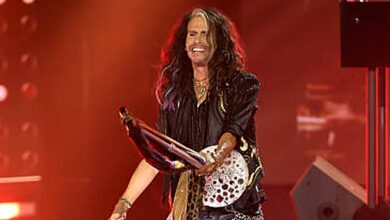
Tyler was 78 at the ceremony. The age has an obvious resonance in a story spanning four decades, but you can hear another sort of continuity in his timing. He can enter a line with the familiar urgency and still be part of a group of voices that need time to get through their own part. He brings that same timing to the pause immediately before the guests arrive.
Chuck D introduced the closing performance. It was a celebration of Rick Rubin, who produced Run-DMC’s version in 1986, and Chad Smith played drums in the live lineup. The crowd had time to hear Perry’s guitar clearly enough to place the tune before the room found out which voices would share it. That little interval gives a live audience the option of hearing the history in the order it actually happened.
The easiest way to follow those eras is to start with the guitar in the recording. The riff belongs to the same song from the first bars to the finish. Who gets to speak over it, and when the crowd realizes who is about to enter, are the details that give this performance a character of its own.
Watch the performance
A single riff can carry different histories
The guitar part is short enough to work in somebody’s memory as a whole. It has a recognizable attack and a repeated shape the other instruments can support. There is room to move words across it without losing the place the riff has already marked. That flexibility is an important part of why musicians can keep returning to it.
Run-DMC’s version supplied a new entrance into that history. Many listeners heard the riff through rap before going back to the Aerosmith records. Others did it in the opposite order. People who discovered the two tracks in the era of search may have heard them minutes apart. A live performance like this brings those ways of finding the song to one place without having to name them onstage.
The musical connection sounds clearer if you follow what the drums are doing as a line changes hands. Chad Smith makes the pulse easy to recognize, and Perry makes the other part of the pattern easy to follow. It gives the person singing and the people rapping a shared point of reference. The audience can listen to both sorts of phrasing without the number losing its direction.
Tyler himself takes up a different amount of space from one part of the performance to the next. For a few seconds the interruption gives him the floor as a speaker. Then the other performers arriving make it possible for him to share the center of the stage. When he sings again, a line has more impact because the ear has just been listening to people who use the same rhythm differently.
Why the first cheer belongs to more than one version
The first audience reaction comes from recognition. Some people may recognize Aerosmith’s guitar sound. Others can immediately supply a visual memory of the 1986 clip. The second reaction comes when the missing performers walk out. Even someone watching years later can understand why the same riff could produce those two kinds of cheers in a matter of seconds.
That crowd response gets overlooked when this particular reunion is presented chiefly as a piece of nostalgia. There is a point of interest for someone who heard the song for the first time in that room. The opening lays out the musical question, the guests let people see where the answer comes from, and the first shared lines give them a chance to hear it.
You can hear that connection in the little gap the musicians leave before the more crowded sections. It gives the ear time to move between old habits and new details.
A finale built with that much musical clarity can make time feel very short. A guitar starts and a man stops it. Two guests step into view, and now there is room in the tune to remember three different ways of knowing it. The applause lets you hear how many of those memories happened to be in the theater.
Two more versions
Run-DMC’s 1986 music video keeps the initial contact between the groups visible as well as audible. It is worth watching how the camera introduces each side of the wall. The picture shows how listeners who knew the tune from different directions wound up sharing the same hit.
The Hollywood Bowl performance earlier in November offers another chance to hear the two groups on the same stage. From that distant audience view, the guitar can do almost all the work of identifying the moment. It is a different place to hear how quickly this riff makes people feel they already belong to the song.