The Quiet Cue James Mirabella Gave the Jaguars in His Final Rock Show
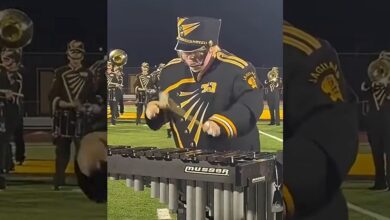
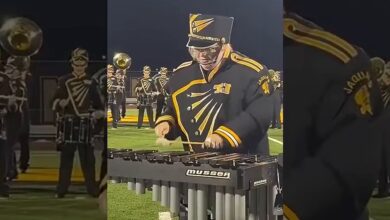
The silence sounded like a mistake to the students who were playing. Five mallet percussionists had started “Thunderstruck” at rehearsal, and nobody else joined them. Layla Clark recalled that the players stopped. Thomas Jefferson High School marching band director James Mirabella told them to keep playing. The quiet was exactly the space their opening was supposed to occupy.
The story comes from Clark’s account to the Pittsburgh Post-Gazette. By the time people encountered the performance online, it was easy to hear why the opening had been left exposed. The AC/DC figure is recognizable, and the sound of the mallets gives it a different edge from the record. There is time to notice both things before a larger group takes over the field. At rehearsal, the people responsible for those notes had to learn to trust that the quiet was intentional.
The arrangement belonged to a rock halftime program in Mirabella’s final season. Clark recalled “Back in Black” and Metallica’s “Enter Sandman” among the other pieces the Jaguars worked on. Those titles give an idea of the challenge the director and students faced. The songs have sounds many listeners can identify in seconds. A school band has a different set of instruments and has to decide which parts will carry that recognition in the open air.
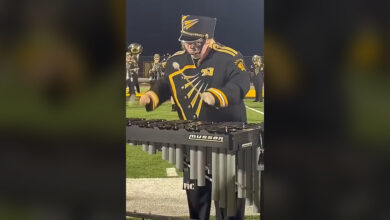
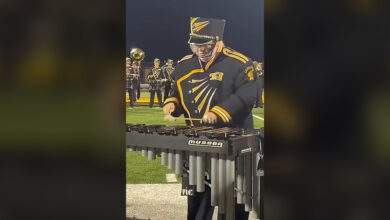
For “Thunderstruck,” the choice was the mallet section. An audience waiting for a guitar attack instead hears tuned bars, with the first figure set out clearly enough to make the transfer obvious. A person following the song can recognize Angus Young’s pattern by how often the notes come back to the same point. A person watching Clark’s hands can see where she has to go each time to make that happen.
An arrangement built around that opening asks the players elsewhere to do something important during their quiet. They need to keep their place and be ready to enter together. The students who are already playing have the opposite job. They have to make the figure hold its pace and give the rest of the field a clear place to come in. The rehearsal story catches both responsibilities meeting before everyone understood how the opening would feel.
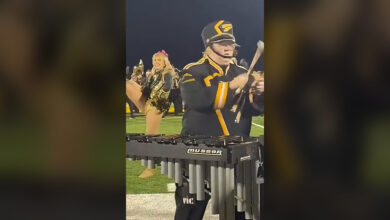
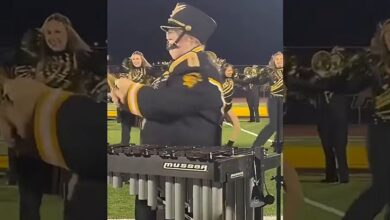
The phone clip provides a point of view the whole audience did not have. It stays near Clark, leaving some of the other percussionists and much of the formation outside the frame. For a few seconds the recording can feel like a solo. The five-player opening and the wider sound that follows put the scene back in the context of the band Mirabella was directing.
Why leave the field quiet?
On a football field, a full ensemble can get people’s attention by getting bigger. This opening finds a different way to do it. A single line of music holds the center, and listeners have just enough information to anticipate the next repeat. When more instruments appear, the arrangement can become expansive without having to interrupt that sense of direction.
There is a parallel in the original recording. The recurring guitar notes create a feeling of movement before all the other sounds have taken their places. A marching-band version cannot reproduce every element of a record, and it does not need to. The Jaguars can create their own version of that effect by deciding which sound people should hear first and how much room it gets.
The final-season program also reminds viewers how much of a school show usually stays outside a viral excerpt. Students spend an evening playing through a sequence of pieces, adjusting to a new part of the field or a different set of entrances. The internet can select one exceptional passage and let it stand for the whole night. The broader recording gives the director’s choices and the students’ work a little more of their original scale.
The note worth taking into the replay
Start watching again and hear how many times the opening returns before the other sections are obvious. It is a better guide to the arrangement than trying to match a particular frame to the rehearsal story. That rehearsal is what Clark described. The public clip shows the group carrying out the idea they had to learn to trust.
The moment stands out because a small instruction solved a clear musical question. Once the mallet players understood that they were meant to continue, the space could do what the arrangement needed. It let people in the stands recognize the song and enjoy the surprise of hearing it from the front ensemble. Then the rest of the Jaguars took what the percussionists had started and made it sound like a whole halftime show.
The field version also shows why a distinctive entrance can do a lot of work for a whole program. It gives an audience something clear enough to understand from across the stands. The first few seconds establish a sound, a pulse and a reason to wait for the rest of the group. Students who play elsewhere in the show get to build on that moment. What first sounded like a mistake in rehearsal became a way to let one section of the band set the terms for everybody who followed.
The wider recording of the Jaguars’ 2025 show gives another way to appreciate that result. Pulling the view back makes it easier to notice how many students have to be ready even when they are not the center of attention. A director choosing to leave part of the field quiet is still asking it to participate. That is a large decision made audible through a few seconds of restraint.